Markets · Analysis
China Shenhua’s HK$6.7 Billion Share Placement Puts Debt and Dividends in Focus
China Shenhua priced a 177 million-share H-share placement at a 7.7% discount, directing most proceeds to debt repayment after its 2026 acquisition.

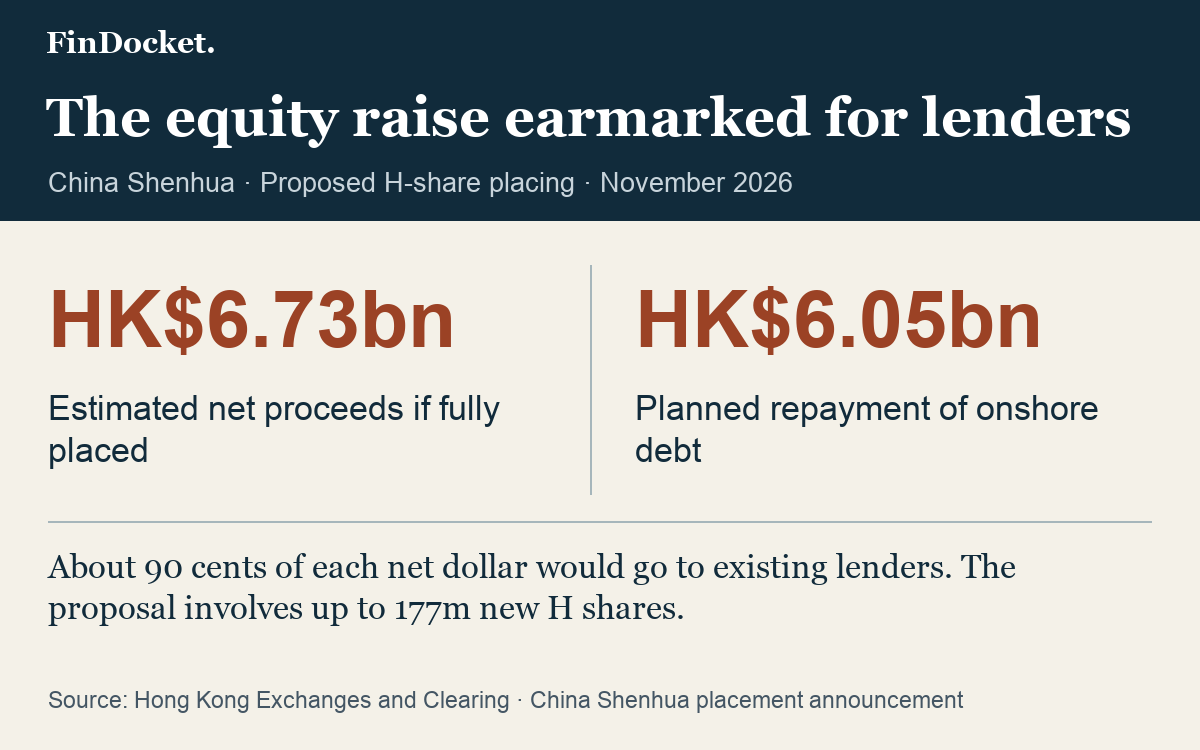
China Shenhua Energy agreed to place up to 177 million new Hong Kong-listed H shares at HK$38.10 each, a 7.7% discount to the prior close, to raise about HK$6.74 billion gross. The company said roughly 90% of net proceeds will repay onshore debt and optimize its capital structure. The placement adds less than 1% to total share capital, but its timing puts the company’s acquisition-driven borrowing and shareholder-return capacity under closer scrutiny.
The proposed shares equal about 5.24% of existing H shares and 0.82% of total issued shares, according to the Hong Kong Exchange filing. If fully placed, the transaction would raise approximately HK$6.726 billion net. China Shenhua stock fell 6.5% to HK$38.58 on November 27, closing close to the placement price after the announcement.
Why is China Shenhua raising equity now?
The placement follows a major expansion of the company’s asset base. In the first half of 2026, China Shenhua completed the acquisition of interests in 12 companies from its state-owned parent, China Energy Investment, and its subsidiary. The company’s interim report shows borrowings of RMB157.6 billion at June 30, up from RMB102.5 billion at the end of 2025. The share issue converts part of the enlarged financing need into equity and earmarks most proceeds to onshore debt reduction.
That use of funds matters. Paying down domestic debt can reduce interest expense and refinancing needs, while a small equity issue can preserve balance-sheet flexibility after an acquisition. The raise does not, on its own, establish that leverage is excessive or that liquidity is strained; it shows management is choosing equity capital alongside the company’s existing debt and cash resources.
How large is the dilution for existing shareholders?
On the total-company basis, the maximum placement is relatively small: around 0.82% of existing shares, or 0.81% of the enlarged total after issuance. The impact is more visible for H-share holders because the placement represents about 5.24% of existing H shares. The discount also sets a near-term reference price below the prior market close, a common pressure point for shareholders in a marketed equity issue.
Investors should separate share-count dilution from the economic effect of the proceeds. If debt repayment lowers financing costs and improves the company’s ability to fund operations and dividends, the capital raised may support per-share value over time. If the cash proceeds merely offset ongoing acquisition or capital-spending needs without an improvement in debt metrics, the added share count would carry a weaker return.
What does the placement mean for China Shenhua’s dividend?
The filing directs proceeds mainly toward debt repayment, not a new dividend. Any conclusion about future distributions should be tested against operating cash flow, interest expense, investment spending, debt maturity and the company’s dividend policy. China Shenhua has historically been valued partly for its large cash-generating coal and power businesses, but a balance-sheet expansion can change how investors weigh that income profile.
The relevant follow-through is measurable. Watch for completion of the placement, the amount actually raised, repayment disclosures and subsequent borrowings. Quarterly cash flow and finance costs will show whether the funding action improves the balance sheet. Future dividend declarations will reveal how management balances shareholder returns against debt reduction and investment needs.
Why did the stock fall more than the headline dilution suggests?
The market reaction can reflect more than the percentage increase in shares. A discounted placement can reset short-term price expectations, while raising equity after a large acquisition may prompt investors to reassess the financing assumptions behind that deal. The issue also targets H-share investors specifically, even though the funds support the consolidated company.
Still, the first-day drop should not be read as a verdict on the company’s long-term earnings. China Shenhua combines coal production, power generation, rail and shipping assets, so its cash generation depends on commodity prices, volumes, electricity demand and operating costs. The financing announcement changes the capital structure; it does not by itself change the underlying coal and power outlook.
For investors, the main analytical test is whether the placement improves leverage and interest coverage without weakening the company’s cash-return proposition. The discounted price and H-share dilution explain the immediate selling pressure; repayment execution, operating cash flow and dividend decisions will determine whether the raise proves constructive for shareholders.
### How much is China Shenhua raising?
The company agreed to place up to 177 million H shares at HK$38.10 each, for about HK$6.74 billion gross and HK$6.726 billion net if fully placed.
### How dilutive is the China Shenhua share placement?
The shares represent about 0.82% of existing total share capital and 5.24% of existing H shares. The larger percentage for H shares reflects that this is a Hong Kong-listed share class placement.
### What will China Shenhua use the proceeds for?
The company said roughly 90% of net proceeds will repay onshore debt and optimize its capital structure. The remainder is allocated mainly to working capital and related costs.
### Does the placement mean China Shenhua will cut its dividend?
The announcement does not state a dividend cut. Investors can assess distributions as new cash-flow, debt and dividend-policy disclosures become available.