Markets · Analysis
Fragrance Cartel Fines Put €472 Million of Compliance Costs on the Earnings Ledger
The EU fined Givaudan, dsm-firmenich and IFF €471.9 million over fragrance-sector coordination. Company disclosures show why the headline penalty translates into different earnings and cash effects.

The European Commission’s €471.9 million penalty for Givaudan, dsm-firmenich and International Flavors & Fragrances (IFF) turns a four-year fragrance-sector cartel into a significant, company-specific earnings event. The November 25 decision concerns the exchange of commercially sensitive information, including pricing and customer negotiations, related to consumer fragrances sold to Unilever. Givaudan and IFF also shared information about broader consumer and fine-fragrance businesses, according to the Commission.
The penalty is large in absolute terms, but its earnings impact cannot be read from the €472 million headline alone. Givaudan received the largest EU fine at €252.4 million, while Firmenich was fined €137.7 million and IFF €81.9 million. Separate UK penalties total more than £85 million. Each company has disclosed a different expected financial burden, reflecting provisions, settlements and exposures outside the EU and UK cases.
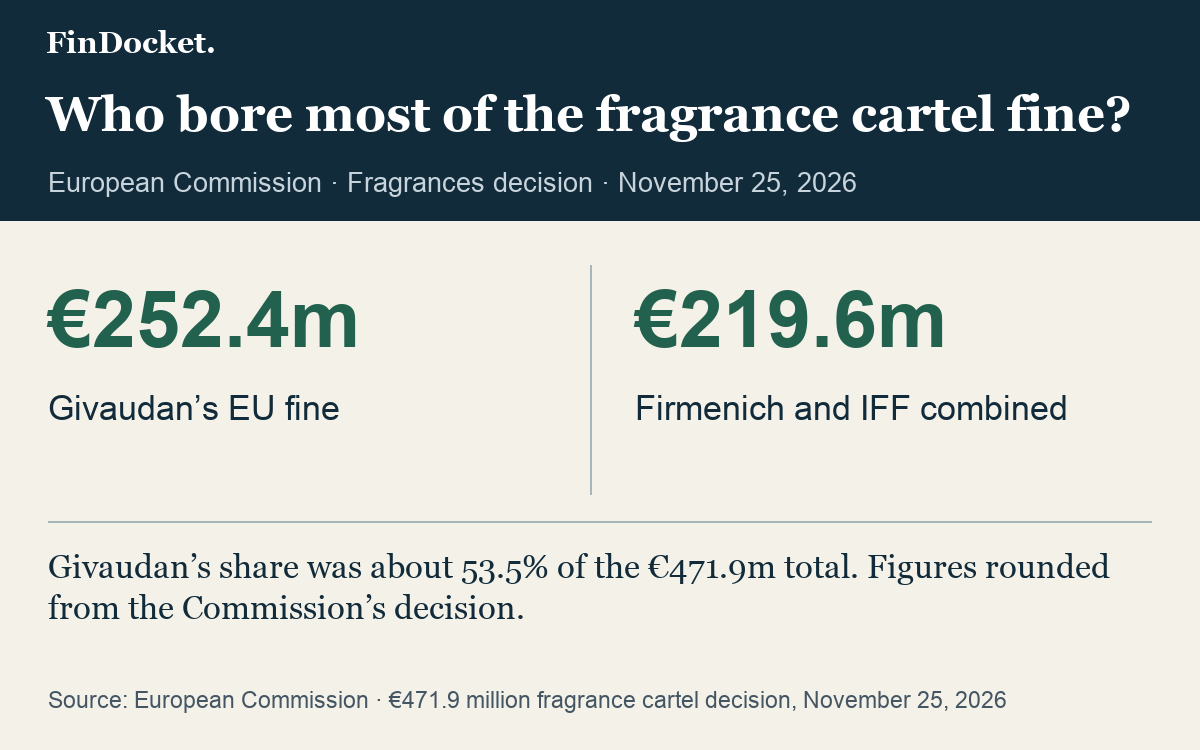
The fines and company-level financial impact
Givaudan said settlement payments and related provisions for the European Commission and UK Competition and Markets Authority proceedings total approximately CHF 375 million. It also recorded CHF 50 million of provisions for likely future obligations in jurisdictions where cases remain ongoing. The company’s disclosed aggregate is therefore broader than the EU fine alone and includes its UK resolution and estimated future obligations.
dsm-firmenich agreed to pay €137.689 million in the EU and £20.64 million in the UK. It expects a total financial impact of around €300 million, with a substantial portion recognized in 2026 income and expense and excluded from adjusted profit. The company said the authorities found Firmenich’s involvement limited to information exchanges related to one customer in consumer fragrances. That scope distinction may matter to investors evaluating the conduct findings, but it does not erase the booked financial charge.
IFF’s EU penalty is €81.9 million. Its U.S. exposure is a separate issue: the company has faced class-action litigation linked to the broader antitrust matter and recorded provisions for U.S. lawsuits in prior reporting. The Commission’s decision does not itself quantify any additional U.S. liability, and investors should separate final European settlements from claims that remain open elsewhere.
Why investors should look beyond the headline fine
Penalties are typically one-time costs, while the consequences of a competition case can extend into customer negotiations, compliance spending and management attention. The Commission said the companies coordinated around responses to Unilever’s requests for greater transparency on fragrance composition and ingredient costs. Fragrances are inputs in everyday products such as detergents, shampoo and deodorant, so the investigation reaches a large procurement relationship rather than a niche luxury market alone.
The case also signals closer scrutiny of how suppliers share market intelligence. Information exchanges can influence competition even without a formal agreement setting a final customer price. For customers, the findings strengthen the case for supplier diversification and more detailed cost transparency. For fragrance producers, demonstrating that pricing, hiring and customer information are properly controlled becomes part of protecting customer trust and future contract economics.
What remains unresolved
The EU and UK proceedings concluded through settlements, with all three companies acknowledging their participation and liability in exchange for fine reductions. The Commission applied a standard 10% settlement reduction, alongside additional cooperation discounts. Investigations in other jurisdictions remain pending, including an Indian probe reported by Reuters. Civil claims also need to be assessed independently from regulatory fines; their scale and timing are not established by the Commission’s decision.
For investors, the next useful disclosures are the exact accounting recognition, cash-payment timing, changes to legal provisions and any update on unresolved proceedings. Givaudan’s CHF 50 million provision for other jurisdictions and dsm-firmenich’s approximately €300 million total estimated impact provide a clearer starting point than comparing only the EU fine allocations. IFF’s updates on litigation and legal reserves will determine whether its smaller European penalty translates into a smaller all-in cost.
The financial read-through is therefore asymmetric. The immediate charges are measurable and largely disclosed, but the enduring cost depends on compliance changes, customer response and remaining legal claims. The EU ruling closes one major regulatory chapter while making governance and customer-pricing controls a more visible part of the investment case for the fragrance industry.
### How much did the EU fine fragrance companies?
The European Commission imposed €471.9 million in total fines: €252.4 million on Givaudan, €137.7 million on Firmenich and €81.9 million on IFF. Separate UK fines exceeded £85 million.
### What did dsm-firmenich say the case will cost?
dsm-firmenich expects a total financial impact of approximately €300 million from the EU and UK matters, with a substantial portion recognized in 2026 and excluded from adjusted profit.
### Does the EU decision resolve all fragrance-cartel exposure?
No. The EU and UK proceedings were settled, while investigations in other jurisdictions and civil litigation remain separate matters. Their ultimate financial impact has not been fully disclosed.
Sources and further reading
- European Commission — €471.9 million fragrance cartel decision, November 25, 2026
- UK Competition and Markets Authority — £85 million fragrance supplier fines
- Givaudan — settlement payments and provisions total approximately CHF 375 million
- dsm-firmenich — expected financial impact of approximately €300 million
- Reuters — EU fines Givaudan, Firmenich and IFF €471.9 million