Markets · Analysis
India–EU Trade Deal: 90.7% of Indian Export Value Set for Duty-Free Access
India expects its EU free trade agreement to take effect in early 2027. The tariff schedule creates a major opening for exporters, but implementation and compliance will decide the payoff.
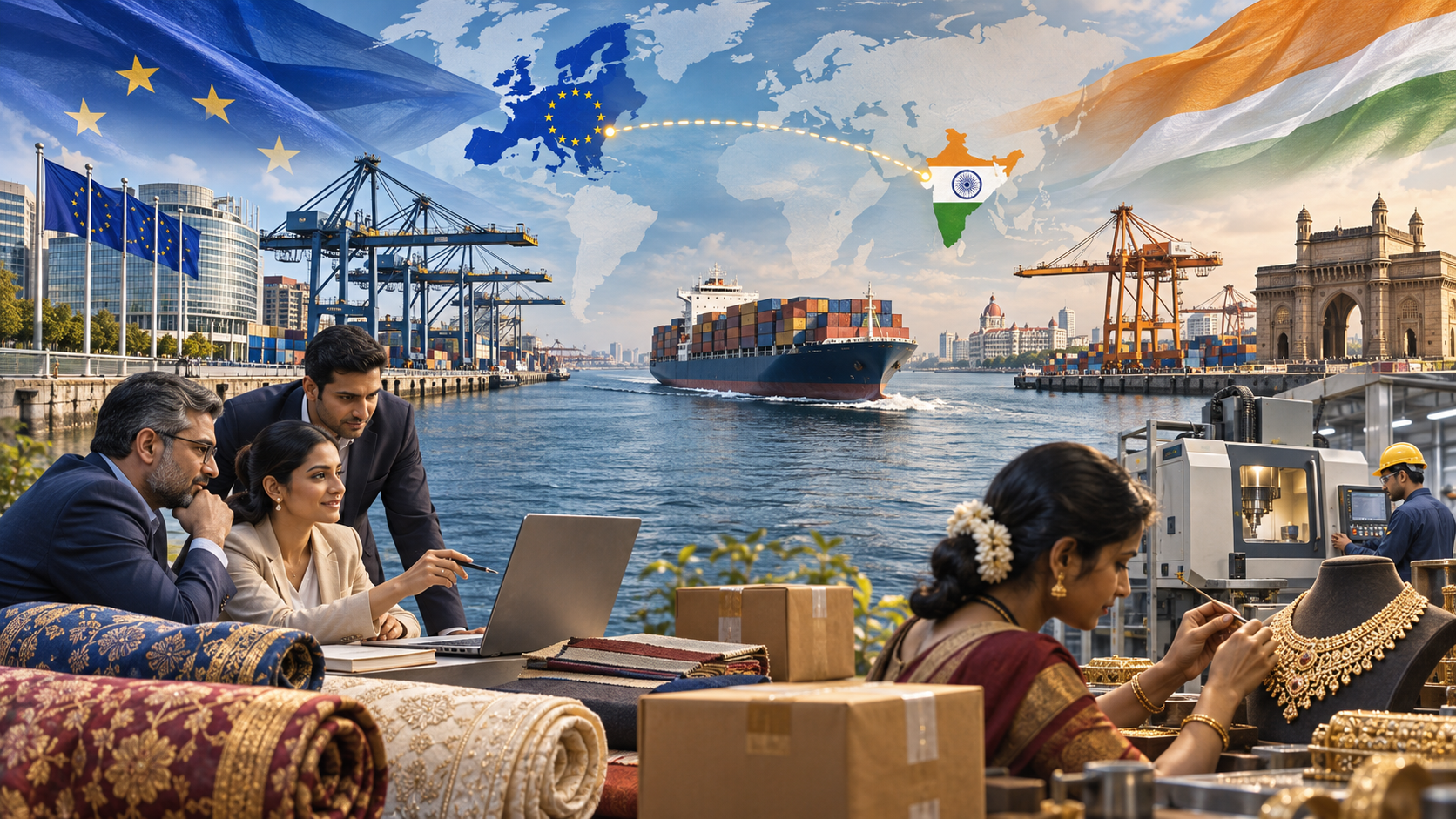
India expects its free trade agreement with the European Union to take effect in early 2027, setting up a large market-access shift for exporters across textiles, footwear, jewellery, engineering and other sectors. Under the agreed tariff schedule, duties end immediately on 70.4% of the EU’s tariff lines, covering 90.7% of India’s export value; another 20.3% of tariff lines are phased in over time.
The agreement’s commercial value now depends on implementation. The European Commission publishes the concluded legal text, while India’s Commerce Ministry says exporters are being briefed on how to use the agreements. For companies, lower duties create an opportunity; the actual payoff depends on rules of origin, product standards, customer access, pricing and the ability to deliver at scale.
What does the India–EU FTA change?
The India–EU agreement was concluded in January 2026 after long negotiations. India’s Commerce Ministry recently said the agreement is expected to come into effect in early 2027, with formal signing preparations underway. A ministry statement reported by Hindustan Times said the formal signing was being prepared for mid-December, with operationalisation expected to take several additional months after signing.
The tariff schedule phases market access rather than switching all duties off at once. Immediate duty elimination covers 70.4% of EU tariff lines and 90.7% of India’s export value. A further 20.3% of tariff lines are phased; some additional product categories receive tariff reductions or quota-based treatment, while sensitive products retain calibrated protection.
That design means exporters need to assess their products against the exact schedule. A headline percentage describes coverage across a tariff system; it does not mean every shipment from India becomes duty-free on the start date. Classification codes, origin requirements, timing and sector-specific exceptions determine the rate that applies to an individual product.
Which Indian sectors have the clearest opportunity?
The official Indian factsheet identifies labour-intensive sectors including textiles, leather and footwear, tea, coffee, spices, sports goods, toys, gems and jewellery, and selected marine products among the beneficiaries of immediate duty elimination. These industries have a plausible route to improved price competitiveness in the EU, especially where tariffs previously formed a meaningful part of the landed cost.
For jewellery, the factsheet says tariffs of up to 4% previously applied and the EU market imports about $79.2 billion of jewellery. India’s exports in the category were about $2.7 billion. Removing a duty can narrow the price gap between Indian suppliers and competitors, but it cannot guarantee new orders. Product design, retailer relationships, certification, delivery reliability and working-capital capacity remain decisive.
Textile and footwear suppliers may also gain if they can meet buyer standards and compete with established sourcing hubs. Smaller businesses could find the administrative demands more difficult than large exporters. That makes the government’s outreach and practical support for origin documentation, certification and overseas distribution economically relevant, not merely procedural.
Why implementation matters more than the signing headline
The EU legal text includes tariff schedules and rules governing how products qualify for preferential origin. Exporters must demonstrate that goods satisfy the agreement’s origin criteria; routing goods through India does not automatically make them Indian-origin products. Firms relying on imported components will need to map their supply chains to those criteria before claiming the lower tariff.
Companies also need to satisfy product-specific technical and regulatory requirements. A tariff reduction lowers one cost in the cross-border transaction, while testing, labelling, traceability, documentation and logistics continue to shape a shipment’s economics. The FTA can improve a supplier’s offer, but commercial gains depend on successful compliance and customer demand.
The bilateral scale gives the change broader significance. India’s Department of Commerce says merchandise trade with the EU was approximately $136.54 billion in fiscal 2024–25. Even modest changes in share or product mix could matter for exporters, although the agreement’s aggregate trade effects will emerge gradually as firms use the preferences and buyers adapt sourcing.
What should investors monitor in 2027?
The first milestone is the official signing and entry-into-force schedule. Next, investors can track preferential certificates, export volumes by product, market share, pricing and company commentary about orders from European customers. Listed firms’ disclosures should clarify whether tariff savings are passed through to buyers, retained as margin or used to compete for business.
The market opportunity is strongest when access changes coincide with investment in capacity, quality and distribution. If firms lack the capital or systems to meet buyer requirements, the legal preference may be underused. A slow start would not disprove the agreement’s value, but it would lengthen the time before market-access gains appear in revenue and earnings.
For Indian equities, the agreement adds a potential export catalyst at a time when companies are navigating U.S. tariff uncertainty and broader trade-policy shifts. The EU deal offers diversification of market access, but its impact should be assessed through product-level data rather than a single economy-wide export forecast. The strongest evidence will be companies converting tariff eligibility into repeat orders and durable margins.
### India–EU free trade agreement: frequently asked questions
#### When is the India–EU FTA expected to take effect?
India’s Commerce Ministry said the agreement is expected to come into effect in early 2027. The final date depends on formal signing and the steps required to operationalise it.
#### How much of India’s export value receives immediate EU duty elimination?
The agreed schedule eliminates duties immediately on 70.4% of the EU’s tariff lines, covering 90.7% of India’s export value. Additional tariff lines are phased in or receive other preferential treatment.
#### Which Indian industries could benefit from the agreement?
The government identifies textiles, leather and footwear, tea, coffee, spices, sports goods, toys, gems and jewellery, and selected marine products among the sectors benefiting from immediate duty elimination.