Markets · Analysis
Lithium Africa’s Manono West Deal Adds Ganfeng and Glencore, but Funding and Permits Come First
Lithium Africa’s conditional Manono West acquisition targets a major DRC lithium district, with up to US$15 million of proposed financing. No resource has been estimated and approvals remain outstanding.

Lithium Africa’s proposed acquisition of a controlling interest in the Manono West project puts a junior explorer into one of the world’s best-known lithium districts, with proposed investments from China’s Ganfeng Lithium and Glencore. The November 27 agreement is conditional, however, and the project has no estimated mineral resource. For investors, the announcement is first a financing and ownership transaction, then an exploration option on a geological trend near the Manono-Kitotolo district.
The company says it will acquire control of Sandstone Worldwide, which holds 70% of United Cominière, the registered holder of Manono West’s permits. After a required 10% state interest in United Cominière is issued, Lithium Africa expects an indirect project interest of about 44.1% at closing, rising to approximately 48.5% after additional share purchases. The figures show why control of the holding company should not be confused with owning 70% of the underlying project.
What the transaction finances
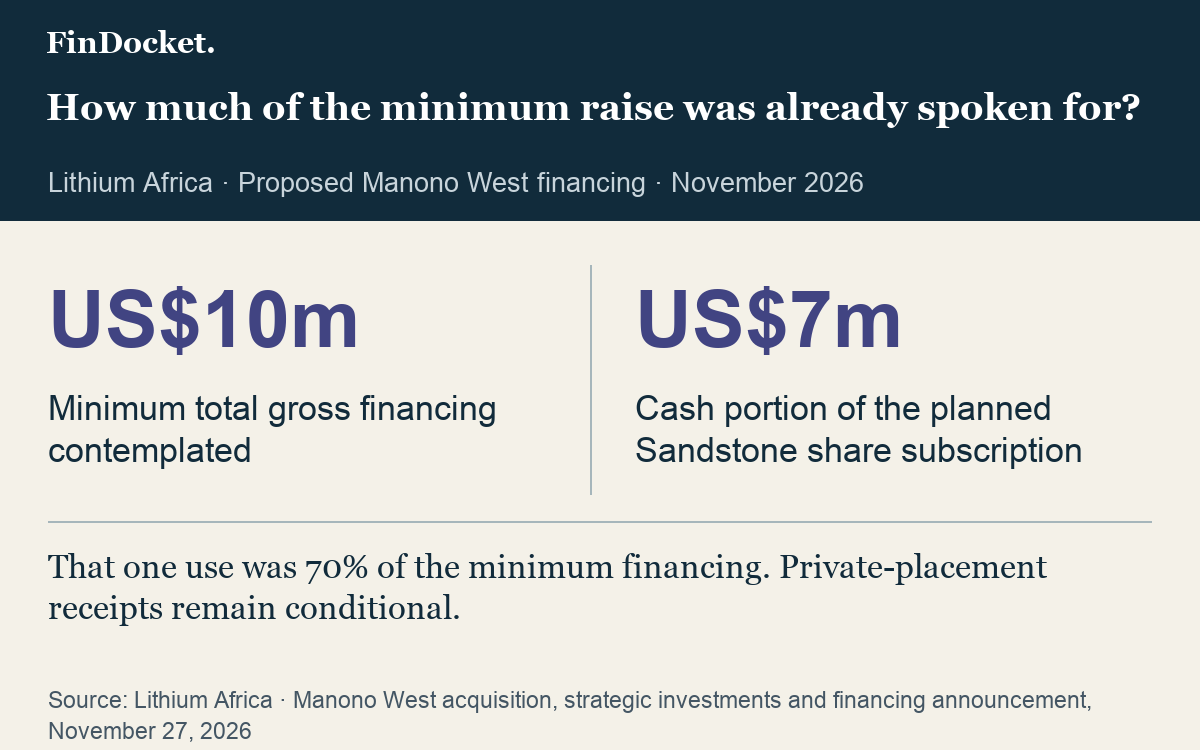
At closing, Lithium Africa plans to subscribe about US$7 million in cash for newly issued Sandstone shares and convert existing notes into additional shares. It has also agreed to buy further shares for US$800,000 after closing. A later option could require the company to acquire more Sandstone shares for US$1.7 million within 36 months. In aggregate, the proposed structure gives Lithium Africa operatorship and a path to a larger indirect stake, while leaving future funding obligations and potential share issuance in view.
The financing combines a proposed investment of up to US$3.5 million from Ganfeng, a US$1 million investment from Glencore and a private placement targeting US$5.5 million to US$10.5 million. The company expects total gross proceeds of US$10 million to US$15 million. Private-placement proceeds are to remain in escrow until transaction conditions are satisfied; if the release conditions are not met by May 24, 2027, the receipts and interest are due to be returned to subscribers.
Lithium Africa also expects Sandstone to assume US$4 million of existing debt owed to Glencore. The proposed loan is unsecured, carries interest at 10% plus one-month SOFR and matures on June 30, 2029. That borrowing adds a meaningful financing cost for an exploration-stage asset. It makes operational cash generation, financing discipline and the terms of future work programs central to the project’s investment case.
Geological promise without a declared resource
Manono West covers approximately 781.6 square kilometers across two permits in southeastern Democratic Republic of Congo. Lithium Africa says an interpreted geological trend extends about 25 kilometers across the project beneath 30 to 40 meters of cover, based on a 2017 airborne magnetic survey. The project adjoins the Manono-Kitotolo pegmatite district, which raises exploration interest but does not establish that commercially recoverable lithium exists on the company’s ground.
The company reports that an existing Lubule mine and TiTan plant have produced approximately 94 tonnes of tin-tantalum concentrate during 2026 to date. It states that the historical production has not been independently verified and is not based on a feasibility study or mineral reserve. Lithium Africa plans to fund permit fees, legacy obligations, plant work and geophysical, stream-sediment and geological programs after closing. Those activities are intended to define drill targets; they are not evidence of a lithium resource or forecast production.
The near-term value driver is therefore de-risking: completing the acquisition, resolving legacy obligations, maintaining permits and producing reliable geological results. A future resource estimate would need to establish grade, tonnage and continuity. A feasibility study would then assess whether extraction, processing, infrastructure and logistics can support an economic mine. The distance between a promising trend and a financeable lithium operation remains material.
Conditions and market implications
The transaction requires approval from the DRC mining minister for the change of control, completion of the note restructuring, at least US$10 million of aggregate financing and acceptance from the TSX Venture Exchange. The company said its shares had been halted while the exchange reviews the proposed fundamental acquisition and related filings. Closing is expected in the first quarter of 2027, but the timetable depends on those conditions.
The Ganfeng and Glencore participation provides strategic validation and supplies part of the proposed capital. It does not remove country, permitting, financing or exploration risk. Nor does it transfer those parties’ operating capabilities automatically to the project. The proposed equity raise will dilute existing shareholders, while the Glencore-linked debt adds fixed financing costs before a lithium resource is established. Royalty obligations, including a combined 2% gross-revenue royalty framework across commodities, also affect potential future project economics.
For the battery-materials market, Manono West is a long-dated exploration possibility rather than near-term lithium supply. Lithium prices and battery demand shape the potential reward, but project-level outcomes depend on resource definition, approvals, infrastructure and capital. The next meaningful catalysts are the exchange’s resumption decision, closing of the transaction and financing, and initial exploration results that can be evaluated against a technical report.
### Has Lithium Africa completed the Manono West acquisition?
No. The November 27 agreement is conditional, with DRC ministerial approval, financing, note restructuring and TSX Venture Exchange acceptance still required. The company expects closing in the first quarter of 2027.
### How much of Manono West would Lithium Africa own?
The company expects an indirect interest of about 44.1% at closing and approximately 48.5% after planned additional Sandstone share purchases. This is distinct from its proposed controlling interest in Sandstone.
### Does Manono West have a lithium resource estimate?
No mineral resource or reserve has been estimated for the project. The interpreted geological trend is an exploration target for future work, not a quantified lithium deposit.