Markets · Analysis
SSE’s Transmission Profit Doubles as Investment Raises Funding Needs
SSE’s half-year figures show transmission leading profit growth, £2.56 billion of adjusted investment and a £1.28 billion rise in net debt and hybrid capital.
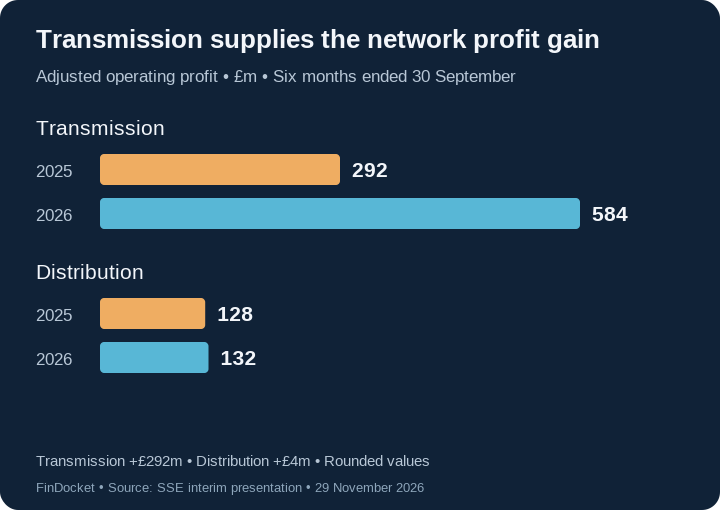
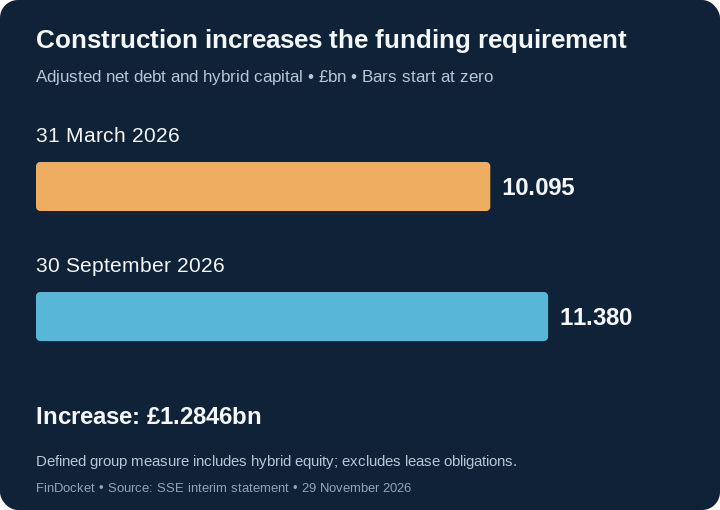
SSE’s November 18 results show how electricity network construction is changing its earnings mix. Transmission adjusted operating profit doubled to £584 million in the six months ended September 30. The same investment programme also increased the group’s funding requirement: adjusted net debt and hybrid capital rose by £1.285 billion from March.
Where did the profit growth come from?
The presentation puts network operating profit at £716 million, against £420 million a year earlier. Transmission supplied £292 million of that £296 million increase; distribution contributed the remaining £4 million.
That makes transmission responsible for approximately 99% of the network profit increase, using the rounded presentation figures. The network result is therefore principally a transmission expansion story rather than an equal acceleration across the two regulated businesses.
Networks supplied about 65% of group adjusted operating profit. Their £1.833 billion of adjusted capital expenditure represented roughly 72% of the group’s £2.564 billion total. The concentration of spending is thus greater than the current concentration of earnings—a useful distinction when judging what future delivery must achieve.
What changed in the funding position?
The statement’s reconciliation puts adjusted net debt and hybrid capital at £11,379.6 million in September, versus £10,095.0 million in March. It includes hybrid securities classified as equity in the accounts and removes specified items, including lease obligations and borrowing attributable to minority investors.
This is a defined funding measure, not an interchangeable label for every borrowing total in the balance sheet. Comparing its current value with a different debt definition would manufacture a misleading change.
The presentation reports around £6 billion of liquidity covering 15 months of financing needs. That addresses access to funding; it does not make the investment self-financing. Operating cash generation and construction expenditure still need to be assessed together as the programme advances.
Does the first half change the full-year earnings test?
October’s update had forecast adjusted EPS of 64–68p. The eventual 66.5p result sits inside that range. SSE retained full-year guidance of 168–193p, leaving an arithmetical second-half requirement of 101.5–126.5p. That is approximately 1.5–1.9 times first-half EPS.
The calculation preserves management’s seasonal framework. October’s update said a larger regulated contribution was reducing seasonality, while winter trading remained important. Doubling first-half EPS would ignore that guidance. The next test is whether asset delivery, generation performance and funding costs combine to produce the required winter earnings while construction continues at scale.