Business · Analysis
Glass Lewis Backs Vail’s Board as Oasis Proxy Fight Heads to December Vote
Glass Lewis recommends reelecting Vail Resorts’ directors ahead of a December 14 vote. The proxy fight puts investor concerns about resort performance, pricing and governance in focus.

Glass Lewis has urged Vail Resorts shareholders to reelect the company’s nine board nominees, giving management a favorable signal ahead of the December 14 annual meeting. The proxy adviser said the dissident candidates put forward by Oasis Management and independent shareholder Gregory Meyer lacked experience aligned with Vail’s strategy or had financial ties that raised independence concerns. The recommendation strengthens Vail’s position, but shareholders still decide the outcome and Institutional Shareholder Services has yet to publish its view.
Oasis, Vail’s fourth-largest investor with a 9.6% stake, is seeking board seats for former Disney CEO Bob Chapek and director Ashton Hudson. Meyer is also seeking election. All three challengers have criticized Vail’s financial performance and share-price decline. Vail shares have fallen more than 57% over five years, although they were up 7% year to date through Friday’s close. The contest therefore combines governance questions with a direct challenge to management’s strategy and operating record.
What is the Vail Resorts proxy fight about?
Oasis and Meyer argue that Vail needs stronger oversight after weak performance, operational problems and a weather-disrupted fiscal year. They have questioned pricing, customer experience and management execution. Vail’s board says it has engaged with investors, added directors and launched initiatives intended to improve resort operations and guest satisfaction. Glass Lewis concluded that the board’s recent response and strategic direction warranted investor support.
The disagreement is not simply whether Vail should cut prices or change executives. Vail’s model relies on season passes, resort operations and a portfolio of mountain destinations. Pricing affects both near-term ticket revenue and the perceived value of a pass that encourages repeat visits. If prices rise faster than service quality, customers may reassess the product; if discounts expand too far, margins and resort investment capacity can suffer. The board must show that its plan can improve guest retention and financial returns together.
Why does Glass Lewis’s recommendation matter?
Proxy advisers influence how institutional investors assess director elections, mergers and governance proposals. Their recommendations do not determine votes, but a favorable report can shape decisions among funds that hold shares across thousands of companies. Glass Lewis supported all nine Vail nominees and criticized the compensation arrangement between Oasis and Chapek, which includes $100,000 in monthly consulting fees and a forgivable $500,000 loan tied to buying Vail shares if he is elected.
Egan-Jones has also recommended voting for Vail’s nominees. ISS, the largest proxy adviser, had not issued its recommendation as of Reuters’ report. Its analysis could affect the final vote calculus, particularly for institutional owners that place weight on independent proxy research.
Who finances the nominees’ Vail shares?
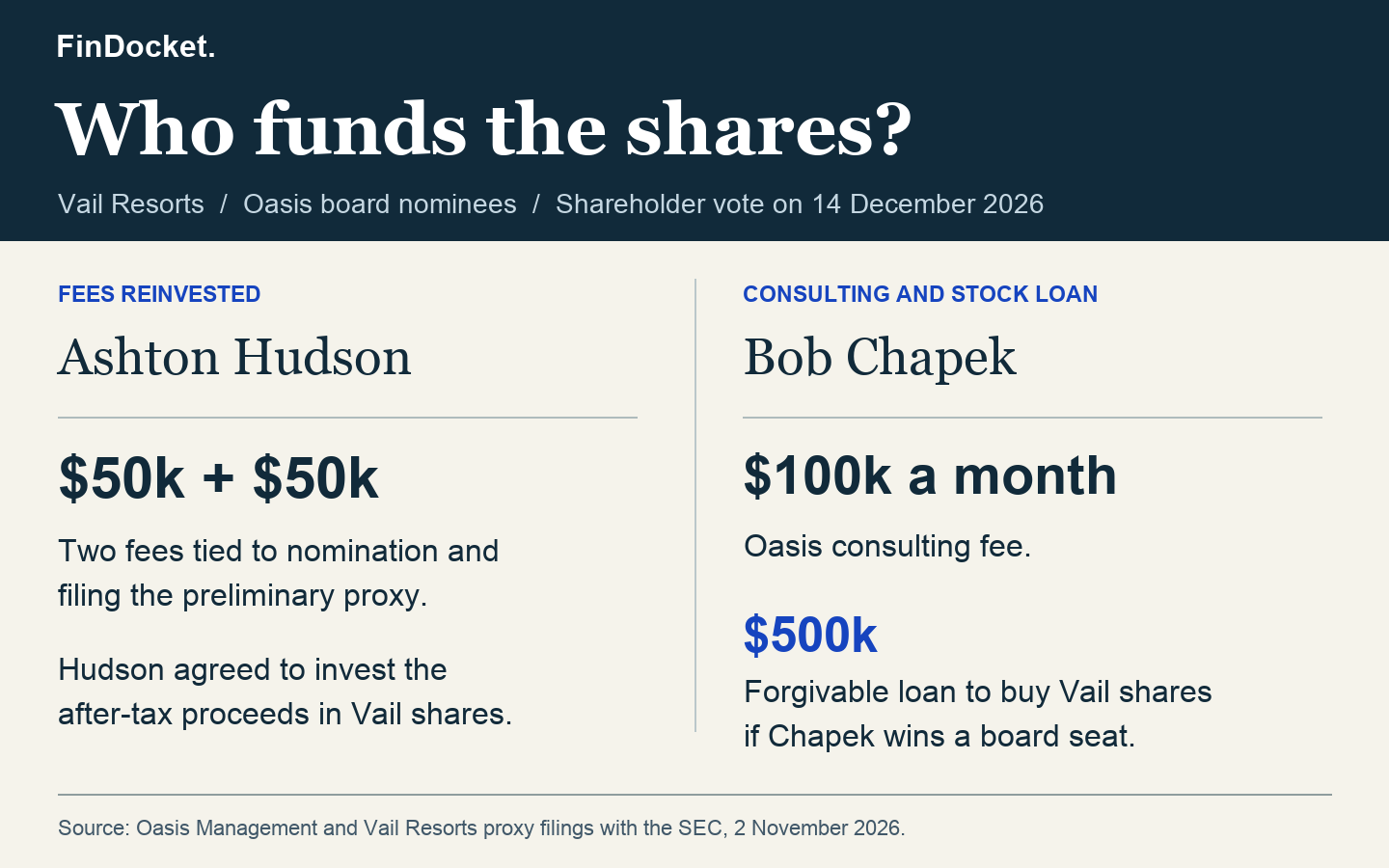
Oasis’s November 2 proxy ties Ashton Hudson’s first $50,000 fee to his nomination and his second $50,000 fee to filing the preliminary proxy. Hudson agreed to invest the estimated after-tax proceeds of both in Vail shares. His purchase obligation arises during the campaign and applies even if shareholders choose someone else.
Bob Chapek’s agreement uses a different trigger. Vail’s revised proxy describes a $100,000 monthly consulting fee from July 28 through the annual meeting. If elected, Chapek would also receive a $500,000 forgivable loan from Oasis specifically to buy Vail stock. Adding the loan principal to his consulting fees would overstate cash compensation and hide the condition attached to it.
Shareholders weighing alignment can therefore ask two concrete questions. Whose money finances the holding, and does the stock purchase depend on winning the vote? Oasis argues that share ownership aligns Chapek with investors. Vail has questioned whether compensation from the nominating investor compromises independence. The agreements establish the financial terms. How either nominee would vote as a director remains open.
What should investors watch before December 14?
The vote will determine whether Vail’s current board retains control or shareholders add activist-backed directors. Investors should watch for ISS’s recommendation, turnout from institutional holders and any new commitments from management on pricing, lift operations, capital spending and customer satisfaction.
The business fundamentals remain the ultimate test. Weather can shift visitation and revenue, but multi-year share underperformance indicates investors also want evidence that the operating model is delivering value. A board victory would give management room to execute its plan; activist seats could push for a faster strategic reset. In either case, Vail will need measurable improvement in guest experience and returns on resort investment to rebuild investor confidence.
### When is Vail Resorts’ shareholder vote?
Vail’s annual meeting is scheduled for December 14, 2026. Shareholders will vote on director candidates and other proposals.
### Who is Oasis Management nominating?
Oasis is seeking election for former Disney CEO Bob Chapek and board director Ashton Hudson. Gregory Meyer is separately seeking a seat.
### What did Glass Lewis recommend?
Glass Lewis recommended reelecting all nine Vail Resorts board nominees and criticized concerns about the dissident candidates’ qualifications and independence.
### Does the proxy adviser recommendation decide the vote?
No. Shareholders cast the votes. Proxy adviser research can influence institutional investors, but it is advisory rather than binding.
Sources and further reading
- Reuters — Glass Lewis backs Vail Resorts board
- Vail Resorts — Shareholder resources and proxy materials
- SEC — Vail Resorts 2026 definitive proxy statement
- Oasis — November 2 definitive proxy, nominee agreements
- Vail Resorts — November 2 revised proxy, nominee questionnaires
- Oasis — investor presentation, response on director independence