Business · Analysis
Coral’s Audit Delay Meets a More Immediate Margin Problem
Coral Products has pushed its accounts to mid-December while exploring funding. Earlier disclosures show sales met budget but profitability did not.
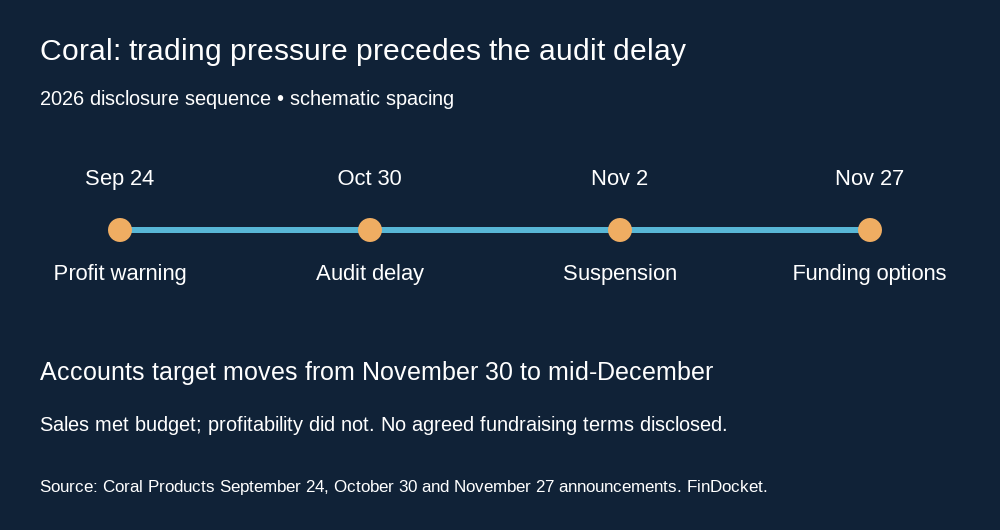
Coral Products now expects to publish its April 2026 annual accounts in mid-December, extending an audit delay that has kept its shares suspended since November 2. The November 27 update also identifies possible equity fundraising or asset sales. The more consequential operating signal predates the audit delay: first-quarter sales met budget, but profitability fell significantly short.
What does the sequence of disclosures show?
On September 24, Coral said both Chief Executive Ian Hillman and Group Finance Director Paul Rice were leaving the board. Rice continued as chief financial officer, while David Low became interim executive chairman with day-to-day responsibility. That announcement also reported first-quarter profitability below both budget and the prior year, despite sales matching plan.
The distinction points to a conversion problem between revenue and profit. It does not identify the cause. Product mix, pricing, costs and capacity utilization can produce that pattern, but the announcement does not quantify their individual contributions. Treating the shortfall as purely a sales-volume issue would go beyond the disclosure.
Why does the audit timetable matter?
The October 30 notice said Coral would miss the October 31 reporting deadline under AIM Rule 19 and targeted November 30 publication. That original recovery timetable has now slipped. The suspended share price cannot provide a fresh traded assessment of the November news.
Audit publication and an operating recovery are separate milestones. Accounts would restore a fuller financial baseline; they would not by themselves establish that the current margin shortfall has been corrected. Investors need the audited position and subsequent trading evidence to evaluate those questions together.
What has actually been announced on funding?
November’s statement says Coral remains within existing banking facilities and is closely managing working capital. It names AlbR Capital as retained corporate broker and describes funding alternatives. It supplies no agreed equity issue price, proceeds or disposal valuation. There is therefore no disclosed dilution percentage or cash inflow to calculate.
The update also says Hillman’s employment ended on November 25 and compensation discussions are ongoing. Any resulting payment remains unquantified. The next substantive disclosures need to establish available liquidity, funding terms and the current earnings trajectory. Without those figures, an apparent return to normal reporting would leave the central valuation question unresolved: how much cash the business can retain after meeting its operating and financing obligations.