Business · Analysis
Diploma’s 12% Sales-Growth Outlook Comes With a Lower Margin
Diploma’s FY2027 guidance pairs 12% constant-currency revenue growth with a 25.5% margin. A reproducible calculation shows the resulting operating-profit sensitivity.
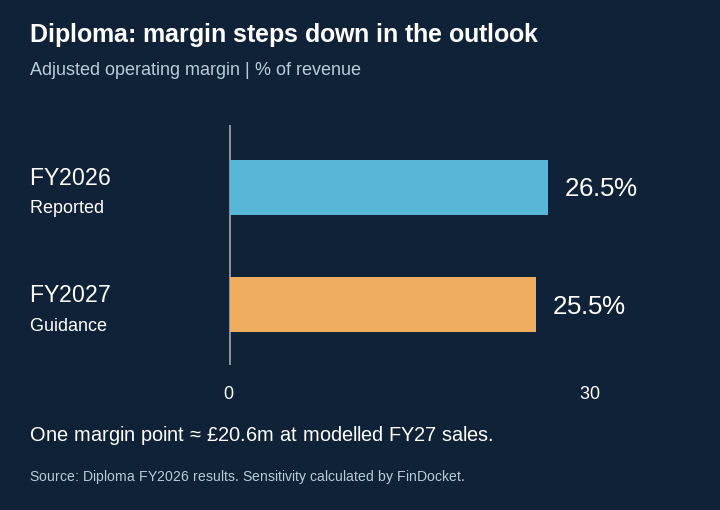
Diploma’s November 17 results set a different earnings challenge for FY2027: management expects 12% constant-currency revenue growth, but an operating margin of 25.5%, against 26.5% achieved in FY2026. Sales growth and profit growth therefore should not be treated as interchangeable forecasts.
What does the margin guidance imply?
FY2026 revenue was £1,840.3 million and adjusted operating profit was £487.1 million. Applying 12% growth to that sales base produces approximately £2,061.1 million; applying a 25.5% margin then gives approximately £525.6 million of operating profit, or 7.9% growth.
This is a FinDocket illustration of the guidance arithmetic. It holds currency effects neutral and includes no additional acquisition contribution beyond the published growth assumption. It is not a separate company profit forecast.
At that illustrative revenue level, one percentage point of margin represents £20.6 million of operating profit. That quantifies the difference between using management’s new margin assumption and simply carrying forward the FY2026 margin.
The release divides expected sales growth equally between 6% organic growth and 6% from acquisitions already announced. It attributes the lower margin to investment supporting growth and the acquisition mix. Further transactions would change the model rather than validate an unchanged calculation.
How much was already expected?
The July 16 trading update raised FY2026 organic-growth guidance from 12% to 14% and margin guidance from around 25% to around 26.5%. It also indicated approximately 42% operating-profit growth.
The final results delivered 15% organic growth and 42% adjusted operating-profit growth. The large annual profit increase consequently needs to be compared with that earlier upgraded outlook, rather than assumed to represent a fresh November surprise.
Which businesses support the next stage?
The investor presentation shows Controls revenue of £1,102.2 million and adjusted operating profit of £387.2 million, with a 35.1% margin. Seals’ margin was 19.5%, while Life Sciences delivered 20.0%. These are sector measures; central costs must still be included when reconciling to group profit.
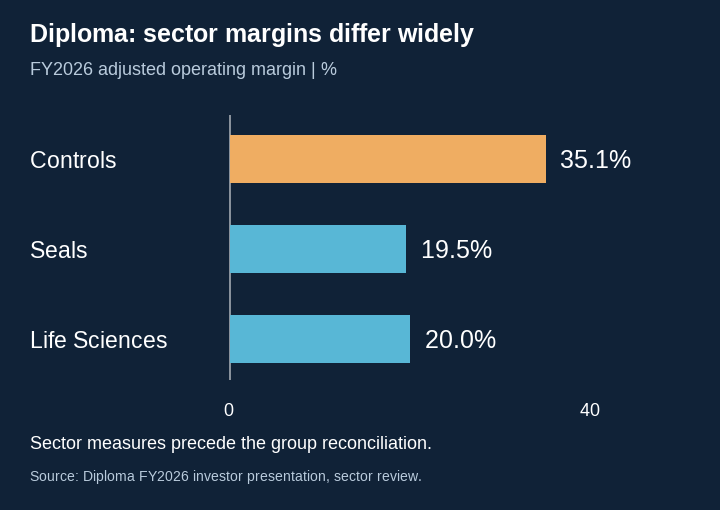
The presentation identifies aerospace, defence, space and energy as growth exposures within Controls, while Life Sciences faces short-term market and product-cycle constraints. That spread means revenue mix can influence group profitability even when each sector’s own margin holds steady.
FY2027’s early trading updates will test organic demand against tougher comparisons and show whether acquisition contributions arrive as expected. The key comparison is growth delivered at the guided margin, with cash generation and returns assessed alongside the expanded revenue base.