Business · Analysis
Focusrite’s Margin Recovery Is Stronger Than Its Adjusted Cash Flow
Focusrite’s HY27 profit improved, but its interim statement shows adjusted free cash flow falling. Tariff refunds and seasonal trading explain why definitions matter.
Focusrite’s interim results show a real improvement in trading profitability, alongside a less straightforward cash-flow comparison. For the six months to August 31, adjusted operating profit rose 14.7%, while adjusted free cash flow in the financial statement’s reconciliation fell. Tariff refunds help explain why those measures moved differently.
What improved in the audio business?
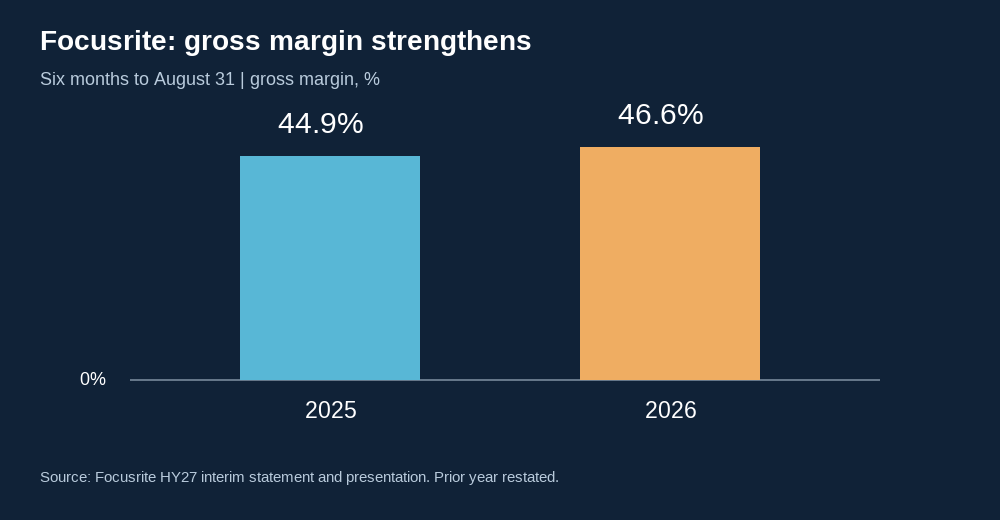
The investor presentation records a 1.7-percentage-point increase in gross margin to 46.6%, with adjusted operating margin reaching 12.3%. It identifies product-cost work, pricing and changes in distribution as contributors.
The divisional evidence is uneven. Content Creation generated £66.9 million of revenue, up 5.2% on a reported basis; Audio Reproduction produced £23.5 million, down 3.9% in the interim statement. A stronger group result therefore does not mean both businesses are expanding at the same rate.
The presentation also says the first half benefits from seasonal shipments ahead of the winter holidays. Doubling the interim profit would consequently impose a trading pattern that management does not expect. The calendar matters as much as the reported growth rate when building a full-year earnings model.
What does the cash reconciliation show?
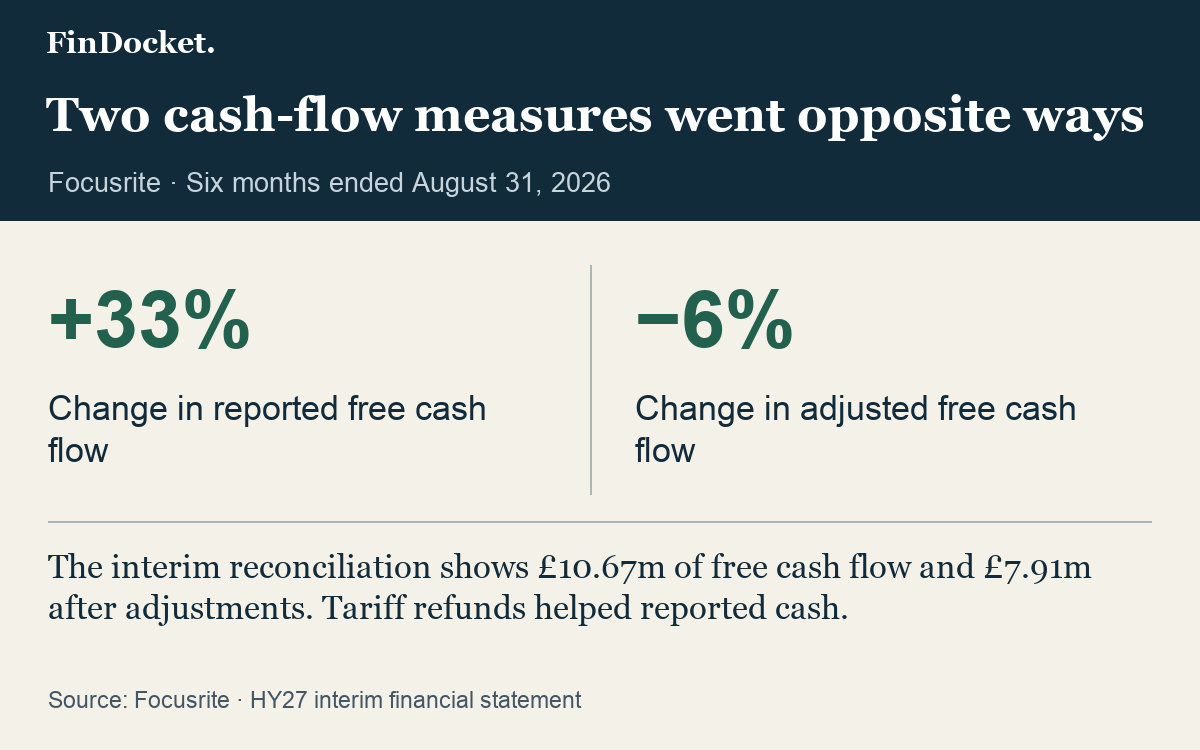
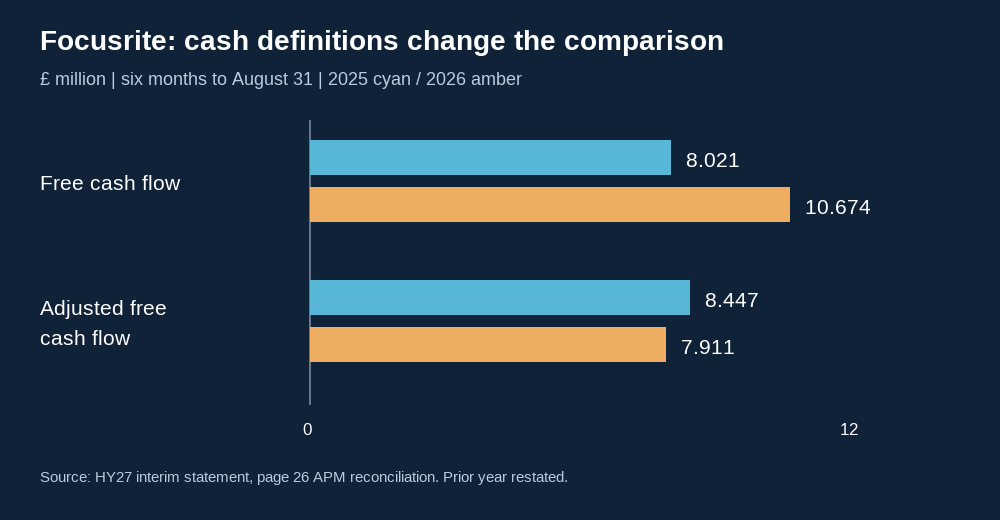
Page 26 of the financial statement reconciles free cash flow of £10.674 million to adjusted free cash flow of £7.911 million, removing £2.763 million of adjusting items. The prior-year figures are £8.021 million and £8.447 million respectively.
On that specific basis, free cash flow increased approximately 33%, while adjusted free cash flow declined approximately 6%. These are FinDocket calculations from the statement, not interchangeable growth measures. The statement separately reports £2.8 million of tariff cash refunds received.
The presentation’s cash-flow slide uses different comparative totals. An analyst should keep each reconciliation intact rather than combine a current figure from one document with a prior figure from the other. That would manufacture a growth rate without a consistent basis.
What should the next update establish?
The presentation anticipates some second-half cash outflow to support holiday-season working capital. It also expects the first product using the proprietary chip platform to ship in early 2027. These create separate tests: funding the seasonal sales cycle and converting product investment into commercial returns.
The earnings recovery has support in the margin data. Its durability will become clearer as subsequent cash generation is measured without the same refund benefit, and as the weaker division contributes to growth. Profit improvement and cash conversion should be tracked side by side through that period.