Business · Analysis
Lockheed Q3 2026: Record Backlog Meets a Funding Gap
Lockheed Martin's SEC filing separates a record missile-driven backlog from near-term revenue conversion and an F-35 contractual funding constraint.

Lockheed Martin's record backlog strengthens its long-term revenue visibility, but it does not eliminate the need for timely contractual authorization and funding. The third-quarter SEC filing places both facts in view: a major missile award expanded future work, while an F-35 production commitment began running ahead of its current authorization.
The distinction matters because an order book measures expected future sales. It does not measure cash already collected, profit already earned or the amount of production that can proceed without further contracting steps.
What did Lockheed Martin report in Q3 2026?
Third-quarter sales increased to $20.711 billion from $18.609 billion. Net earnings rose to $1.845 billion from $1.619 billion, and EPS increased to $7.97 from $6.95. Operating cash flow was $3.438 billion, with $439 million of capital expenditure and $2.999 billion of free cash flow.
Sales grew approximately 11.3%, while EPS grew about 14.7%. The stronger per-share increase reflects the combined effects of earnings growth and share count, rather than the sales increase alone.
Quarterly free cash flow was approximately 14.5% of revenue. That is a cash conversion ratio for this reporting period, not a permanent margin. Defense contracting includes payment milestones and production schedules that can move cash between quarters without equivalent changes in economic profitability.
The company can therefore produce substantial cash in a quarter while still facing a financing constraint on an individual program. Consolidated liquidity and program-level contractual authorization are related, but they are not interchangeable.
What drove the record backlog?
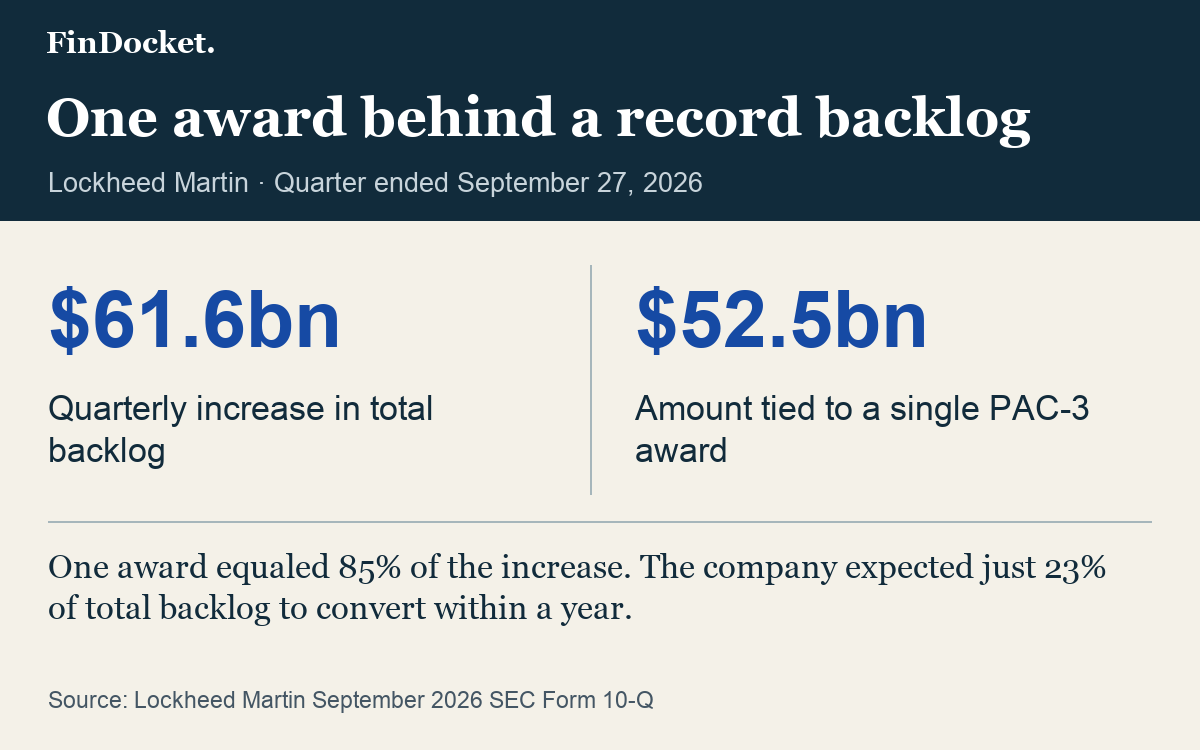
The filing reports $292 billion of backlog, up $61.6 billion during the quarter. A $52.5 billion multi-year PAC-3 Missile Segment Enhancement award was the primary contributor. Lockheed expects approximately 23% of backlog to become revenue within 12 months and about 40% within 24 months.
The missile award represents approximately 85.2% of the quarterly backlog increase and 18% of the ending total. This is a large expansion with a concentrated source, rather than evidence that every product line experienced an equivalent jump in new demand.
The conversion schedule also changes the interpretation of the headline. Applying the disclosed percentages to ending backlog implies approximately $67.2 billion within the first 12 months, another $49.6 billion during the following 12 months, and about $175.2 billion thereafter.
The second-year amount is the difference between the cumulative 40% and first-year 23%. Adding 23% and 40% would double count the initial year's expected conversion.
These are approximate allocations of the current backlog. They are not total company revenue guidance. New orders can arrive and convert during the same future reporting period, while existing contract estimates can change.
Why is a long backlog different from near-term earnings?
A long production commitment can support investment in labor, equipment and suppliers. It can also expose a manufacturer to several years of execution before the final economics are fully known.
The value of that commitment depends on the spread between customer consideration and the resources required to perform. A larger sales obligation does not automatically produce a proportionate increase in profit if staffing, materials or production complexity absorb more of the revenue.
For illustration, a one-percentage-point difference in eventual operating margin on $52.5 billion of revenue represents $525 million of operating profit over the life of that revenue. The calculation does not estimate the PAC-3 contract's actual margin. It shows why execution assumptions matter even after a major award is secured.
Timing matters as well. Profit earned several years from now carries a different present value from profit earned next quarter. A larger backlog concentrated in later periods can improve strategic visibility without producing an immediate step change in cash available to shareholders.
What is the F-35 funding issue?
The SEC filing states that costs incurred on the Lot 20 advance acquisition contract began exceeding current contractual authorization and funding during the third quarter. Production contracts for lots 20 and higher remained under negotiation.
The economic issue is the interval between spending and an enforceable, funded contractual framework. Suppliers and employees require payment as work progresses. The order opportunity does not itself settle those obligations.
Continuing to incur cost before the corresponding authorization can increase the amount of company capital committed to the program. Securing authorization can improve that position, but the timing and terms matter to the cash outcome.
This disclosure should not be confused with a statement that the F-35 program lacks demand. Demand, authorization, revenue recognition and cash collection are separate stages. A program can have strategic importance and a large future requirement while a particular production lot still needs contractual action.
How should investors compare profit with cash?
The latest quarter generated $348 million less free cash flow than the comparable period, even though earnings increased. Operating cash flow declined $290 million and capital spending increased $58 million, explaining the free cash flow difference.
That bridge is more useful than treating the cash decline as an unexplained contradiction. It identifies two mechanisms: less cash generated from operations during the quarter and more cash invested in the asset base.
A durable improvement would show earnings growth accompanied by cash collection over the relevant contract cycle. One quarter cannot settle that question, particularly when production milestones and customer payments cross reporting dates.
The practical monitoring framework is straightforward: follow the conversion of missile backlog into profitable deliveries, the contractual status of F-35 production lots and operating cash after investment. Those measures test whether greater future workload is becoming a larger stream of distributable cash.
Lockheed's results establish that revenue and earnings are growing. The deeper investment question is how effectively the company finances and executes the much larger body of work now sitting behind those results.