Business · Analysis
Marathon Petroleum Q3 2026: Cash Has Different Claims
Marathon Petroleum's SEC filing shows the SPR return obligation, MPLX's separate capital claims and the economics behind its planned $4.2 billion asset sale.

Marathon Petroleum's third-quarter 2026 results demonstrate the earnings power of its refining system, but the SEC filing also shows why a large consolidated cash balance is only the starting point for capital-allocation analysis. Future crude-return commitments, the separate economics of MPLX and a planned asset sale all affect how the reported resources can serve shareholders.
The important distinction is between cash already generated, resources belonging within a partly owned subsidiary and obligations that will require future delivery. Combining those categories into one headline number would overstate the simplicity of the financial position.
Strong refining economics created a much larger earnings base
Quarterly net income attributable to Marathon Petroleum reached $7.447 billion, or $26.59 per diluted share. Adjusted EBITDA was approximately $11.7 billion, compared with approximately $3.2 billion a year earlier. The earnings release also announced a 10% increase in the quarterly dividend.
These figures establish a substantial improvement in recognized profitability. They do not establish that the current earnings level is a permanent operating baseline. Refining is a spread business: what matters is the relationship between product realizations, feedstock costs and the expense of running and distributing through the system.
When favorable spreads meet high operating availability, earnings can expand much faster than volumes. The same operating leverage works in reverse when margins contract. Capital allocation therefore has to consider the durability of the resulting cash position separately from the durability of a single quarter's earnings rate.
Retaining some of a strong period's cash can preserve the ability to invest during a weaker environment. Repurchases can also benefit remaining owners, but the amount spent and the value obtained per share must both be evaluated. A larger authorization alone does not answer either question.
The SPR exchange includes a future physical obligation
The 10-Q says Marathon received approximately 21 million barrels of crude from the Strategic Petroleum Reserve during the second and third quarters. It is obligated to return approximately 26 million barrels from April 2027 through July 2029. The related derivative liability was approximately $1.9 billion at September 30.
The return volume exceeds the received volume by approximately 5 million barrels, or 23.8%. That is a volume comparison, not an annualized financing rate. Delivery dates, crude specifications, forward prices and the timing of receipts and returns prevent a simple barrel ratio from being treated as an interest-rate equivalent.
The exchange supplied crude during the current operating period while creating delivery requirements in later periods. That can be commercially useful, but the economic benefit must be judged alongside the cost of satisfying those future requirements.
Marathon accounts for the contracts as derivatives and recognizes fair-value changes in cost of revenues. It also disclosed derivatives used to hedge the underlying commodity-price exposure. Consequently, evaluating only the return-obligation liability would omit the effect of those hedges.
The $1.9 billion balance should not simply be added to debt as though it were an identical financing instrument. Nor should the physical obligation disappear from an assessment of future resource needs because it is classified outside borrowings. Its own delivery schedule and offsetting positions provide the relevant framework.
Working-capital releases are different from recurring profit
For the first nine months, working-capital changes excluding short-term debt provided approximately $5.45 billion of cash. The filing attributes the movement largely to commodity prices and volumes, including derivatives, with higher accounts payable partly offset by receivables and inventories.
A payable increase can support cash flow while a company processes higher-priced feedstock. It is not equivalent to an increase in cash earned per barrel. The company still has to settle suppliers according to the operating cycle.
This distinction becomes particularly useful when commodity prices move sharply. The value of inventories, invoices and purchases can change even if physical activity remains similar. A cash-flow improvement can therefore contain both genuine operating profit and a financing effect from the timing of payments and collections.
The practical test is whether internally generated cash remains strong after those balances stabilize. That does not require dismissing the cash already received. It requires avoiding the assumption that the same balance-sheet release can be repeated every quarter.
MPLX makes the consolidated balance sheet more complex
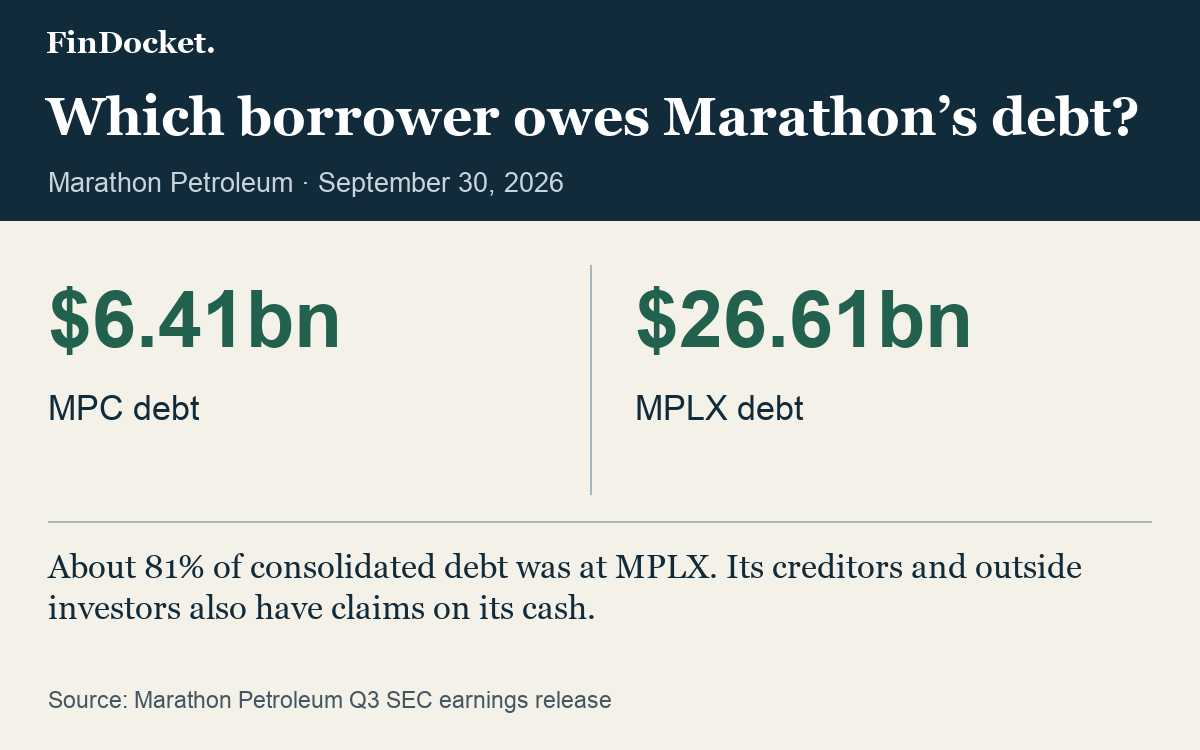
The earnings materials show $13.6 billion of cash, equivalents and short-term investments, including approximately $1.3 billion of cash at MPLX. Reported consolidated debt was $33.022 billion, comprising $6.414 billion at MPC and $26.608 billion at MPLX.
Approximately 81% of reported debt was therefore located at MPLX. That allocation matters when assessing which business generated the borrowing and which assets and cash flows support it.
Consolidation reflects control, not complete economic ownership. MPLX has outside unitholders and its own investment and distribution requirements. Its cash should not automatically be treated as fully interchangeable with parent cash available for MPC common-share repurchases.
The reverse simplification would also be misleading: removing subsidiary debt while retaining all consolidated earnings would combine inconsistent ownership scopes. A sound analysis keeps debt, cash, earnings and distributions aligned to the same entity or ownership basis.
The planned sale recycles capital across those same boundaries
Marathon and MPLX agreed to sell the St. Paul Park and Mandan refineries and associated midstream assets to CVR Energy for $4.2 billion, plus inventory value and subject to adjustments. MPC's stated allocation is $3.45 billion for refining assets; MPLX's is $750 million for logistics assets. Closing was expected at the end of 2026.
Approximately 82% of the announced base proceeds would therefore go to MPC and 18% to MPLX. The allocation prevents the entire transaction value from being mistaken for parent-level proceeds. It also means the subsequent reinvestment decisions will occur across two capital structures.
The announced midstream price represents nine times forecast 2027 EBITDA. That is a forward estimate, not proof that the same earnings would persist indefinitely. For the seller, value creation depends on the cash retained after closing adjustments and the returns earned when proceeds are redeployed.
Marathon's strong quarter expands its choices. The quality of those choices will be measured by investment returns, disciplined repurchases and the ability to meet future obligations across the refining and midstream businesses. The consolidated cash balance is substantial, but understanding who holds it and what claims accompany it is essential to evaluating its value.