Business · Analysis
Marvell Q2 FY2027 Earnings: AI Growth and Its Equity Cost
Marvell's SEC filing separates AI revenue growth from acquisition spending, capacity commitments and equity costs that determine returns for common shareholders.

Marvell's fiscal second-quarter 2027 earnings show a business expanding rapidly into data-center demand while committing substantial resources to its next generation of products. The key shareholder question is whether the resulting profit growth will exceed the cost of additional capital and ownership issued to support that expansion.
The quarter ended August 1 is the latest reported quarterly period as of November 28. Its SEC filing provides a useful separation between current sales, spending on future technology and financing. Those categories should remain distinct when judging whether the AI opportunity is improving value per common share.
What did Marvell's latest earnings show?
Quarterly revenue was $2.739 billion, up 37%, with GAAP net income of $308 million and adjusted net income of $866 million. Operating profit was $460 million versus $290 million a year earlier. Stock-based compensation rose to $326 million from $154 million, while acquired-intangible amortization declined to $215 million from $244 million.
The results establish operating progress under GAAP. They also show why the adjusted result is much larger. Share compensation and acquired technology are economically different costs, even though both can appear as noncash adjustments in the current period.
Equity compensation transfers a claim on the business to employees. Amortization allocates an earlier acquisition price over accounting periods. Neither necessarily requires the same quarter's cash payment, but each relates to resources that shareholders supplied or surrendered.
A useful valuation framework therefore asks two questions separately: how much cash can the operating business produce, and how much of that business will each common share own after compensation and financing? Stronger company-wide results create shareholder value only to the extent that the benefit remains attractive after those claims.
Why data-center growth raises the return hurdle
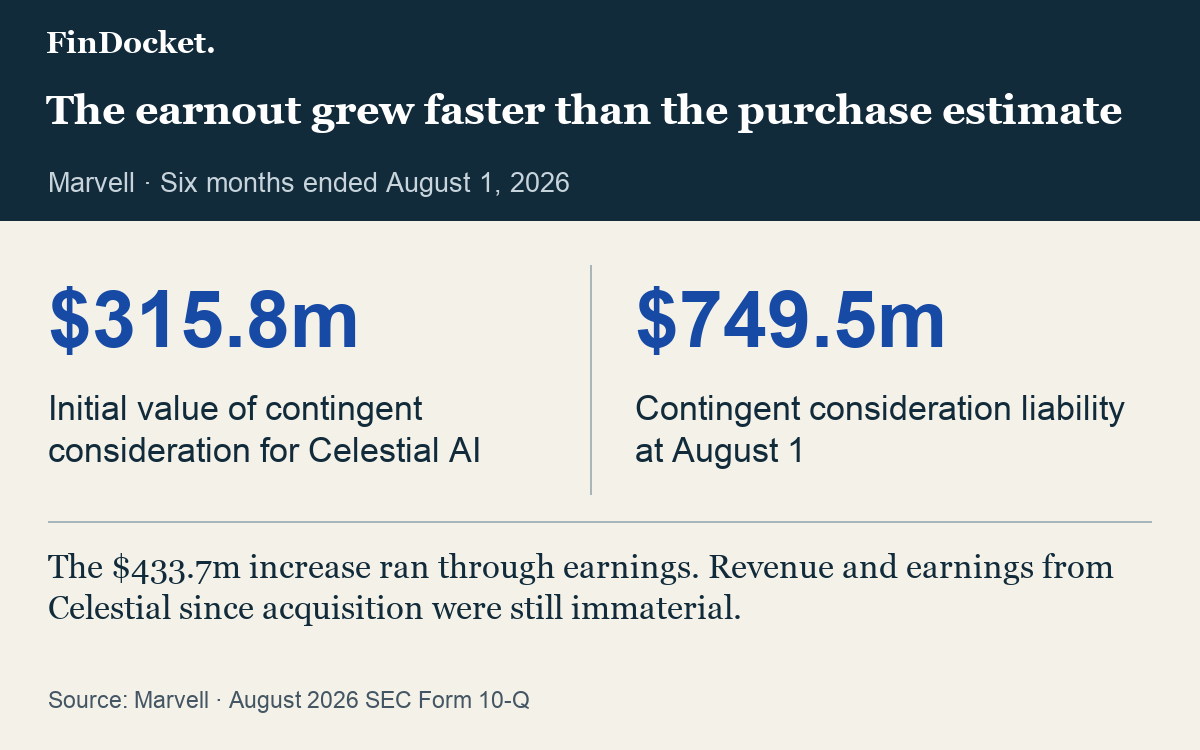
The 10-Q reports data-center revenue of $2.172 billion versus $1.491 billion a year earlier. Marvell acquired Celestial AI for approximately $3.534 billion of total consideration; its revenue and earnings since acquisition were not material. The acquisition included $1.929 billion of common shares and contingent consideration initially valued at $316 million.
These disclosures distinguish the current revenue engine from an investment intended to strengthen future products. Treating the acquired technology as though it already explains today's growth would credit the transaction with an outcome the filing does not establish.
An acquisition can still be valuable before it contributes meaningful sales. The economic case rests on future customer adoption, development timelines and margins. The purchase price creates a hurdle: future cash generated because of the acquisition must justify the capital committed and the ownership transferred.
Share consideration makes that hurdle easy to overlook. Issuing stock preserves cash, but it gives sellers a permanent participation in future earnings. For existing shareholders, the relevant return depends on whether the acquired opportunity adds more value than the fraction of the combined company surrendered to obtain it.
What do contingent payments mean for earnings?
The filing records a $434 million first-half increase in the fair value of Celestial's contingent consideration liability. These changes run through other expense. Additional payments depend on specified revenue milestones.
A higher contingent liability can have a counterintuitive interpretation. Improved expectations for an acquired business may increase the estimated payout to its former owners, creating an accounting expense at the same time that the commercial outlook improves.
That does not make the expense irrelevant. It reflects a larger expected claim on the value created. Removing the valuation movement can help compare operating performance, but the acquisition return must still include the ultimate consideration paid.
The distinction is between measuring the product business and measuring the investment made to own it. A company can improve its underlying operations while transferring a material part of that improvement to sellers through contractual earnouts. Shareholders should evaluate the retained benefit after the agreement's full economics.
Does a fabless model eliminate capital needs?
Non-current capacity reservation prepayments increased to $487 million from $279 million at fiscal year-end. NVIDIA invested $2 billion in convertible preferred stock, initially convertible into approximately 21.8 million common shares. The preferred shares have no redemption rights and participate in dividends on an as-converted basis.
Outsourcing manufacturing changes where productive assets sit; it does not remove the need to secure production. A supplier may require deposits or reservation payments before delivering wafers and other inputs. Those payments commit cash ahead of customer revenue and must earn a return through future shipments.
Equity financing can support that investment without creating a conventional repayment date. Its cost appears through shared ownership rather than scheduled principal. The absence of redemption rights is therefore relevant to liquidity, while potential conversion is relevant to per-share economics.
The correct assessment weighs the productive opportunity created with the financing against the participation granted to the investor. Calling the funding either free capital or ordinary debt would miss the transaction's actual structure.
How much cash supported the strategy?
First-half operating cash flow was $1.244 billion. Property and equipment purchases were $282 million, cash acquisitions $1.271 billion, buybacks $400 million and dividends $108 million. Employee share-settlement withholding consumed another $365 million; technology-license payments also drew cash.
The figures show why operating cash flow alone cannot describe the expansion's funding. Some investment appears in operating assets, some in physical capital, some in acquisitions and some through shares issued directly to sellers. No single cash-flow subtotal captures the total economic consideration.
Similarly, a repurchase program does not establish that the common share count is shrinking. New acquisition shares, employee awards and convertible securities can offset purchases. The investor's task is to reconcile the ownership denominator alongside cash distributions.
Marvell's current business is generating more operating profit while funding a larger technology ambition. The next test is converting that ambition into cash earnings that grow faster than the claims issued to finance it. Data-center demand provides the opportunity; disciplined development, acquisition returns and per-share execution determine the portion ultimately retained by common shareholders.