Business · Analysis
M.P. Evans’ Output Gains Outrun Crop Growth as Buyback Expands
M.P. Evans reports 13% oil-output growth against 8% processed-crop growth. The figures point to extraction gains as palm oil prices hold broadly steady.
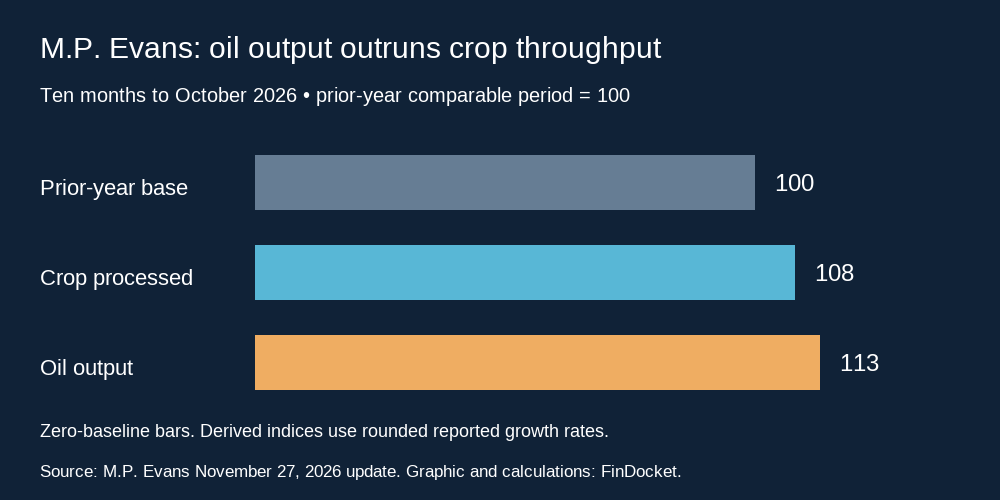
M.P. Evans reported 13% growth in crude palm oil output for the ten months through October, ahead of the 8% increase in crop processed. Its November 27 announcement also allocated another £2 million to share repurchases. The operating distinction is important: more oil is being produced per unit of crop, while realized selling prices remain broadly steady.
How much does extraction contribute?
Dividing the reported output-growth factor of 1.13 by the processed-crop factor of 1.08 implies an approximately 4.6% relative improvement in oil output per tonne processed. This calculation uses rounded growth rates, so it is an approximation, not the company’s disclosed absolute extraction rate.
The group says it continues to limit purchases of lower-margin outside crop. Production growth therefore cannot be read simply as greater throughput. The mix of crop entering the mills and the oil recovered from it are both relevant to profitability.
What do the earlier results establish?
The September interim release reported first-half oil output of 192,300 tonnes against 172,800 tonnes a year earlier. Group palm-product costs fell to $409 per tonne from $446, while gross profit increased to $78.9 million from $63.4 million. These are first-half figures, not updated ten-month earnings.
The cost reduction was $37 per tonne, or 8.3%, calculated from those reported amounts. It provides a measurable baseline for November’s statement that higher production has further reduced unit costs. The latest announcement does not quantify the new unit-cost level, so extending the first-half margin mechanically across the full year would overstate the available evidence.
Is the improvement dependent on higher prices?
The ten-month ex-mill-gate oil price was $866 per tonne, compared with $873 at June. That is a 0.8% decline in the cumulative average, rather than a standalone second-half price. The result supports an efficiency-led interpretation of the update, although final profit still depends on realized sales, costs and shipment timing.
Management notes possible production carryover into 2027. Oil produced and oil dispatched can differ around year-end, so the January crop, pricing and production update should help establish how much of the operating improvement converts into 2026 sales.
The extra £2 million buyback allocation follows an October £3 million budget. An allocation authorizes purchases; it does not establish that all the cash has already been spent or that an equivalent amount of shares has been retired. For shareholders, the most useful next evidence is actual repurchase execution alongside the final production and pricing figures.