Business · Analysis
Navient Q3 2026: Earnest Growth and the Valuation Bridge
Navient's SEC filing separates Earnest's lending growth from immediate fair-value gains, legacy loan-sale profits and elevated credit provisions.

Navient's third-quarter 2026 results show rapid lending growth at Earnest alongside an earnings base heavily influenced by loan sales, credit estimates and a new fair-value election. The operating direction and the reported profit need to be analyzed separately before they can be joined into a coherent investment thesis.
The central question is whether new loan production can replace the earnings of a changing legacy portfolio at an attractive return on capital. Origination growth answers the question of demand. Collections, funding costs and realized sale proceeds determine the value of that demand to shareholders.
What did Navient earn in Q3 2026?
The earnings release reports GAAP net income of $15 million, or $0.16 per diluted share. Non-GAAP Core Earnings were $3 million, or $0.03. Earnest originations increased 77% to $1.4 billion, including $870 million of refinance loans, $479 million of in-school loans and $46 million of personal loans.
The gap between the two earnings measures is material relative to either number. Management excludes certain derivative-accounting and tax effects from Core Earnings. That reconciliation improves transparency, but the word “core” does not mean every remaining component is recurring cash income.
The growth mix matters as well. Refinancing an existing education loan, funding a student through school and testing personal lending involve different cash-flow schedules and credit behavior. Combining them into a single growth rate is useful for production scale, but insufficient for estimating a sustainable margin.
Why did new loans create an immediate gain?
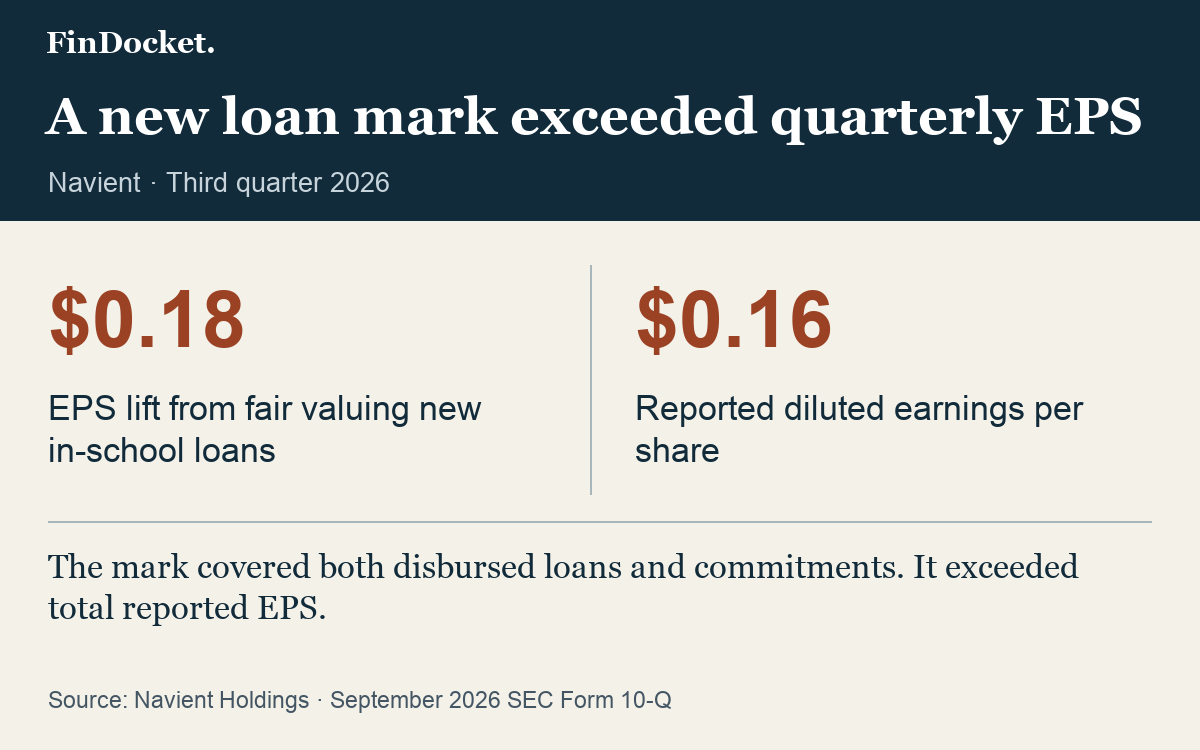
The quarterly filing says in-school loans originated from July 1 use fair-value accounting. Of $479 million originated, $226 million was disbursed and $253 million represented future commitments. Valuation at 105% of par produced a $23 million gain: $11 million attached to funded loans and $12 million to commitments.
The accounting recognizes an estimated economic value above the amount to be advanced. It is not a cash sale to an outside buyer, and part of the gain precedes the actual loan disbursement.
A positive valuation can reflect attractive contractual pricing relative to expected credit costs and market return requirements. The investment result is realized only as the loan is funded, serviced, collected or sold. Subsequent changes in those expectations will also affect fair value.
Calculated from the disclosed split, slightly more than half the gain related to commitments. That is why funded principal, approved production and recognized profit need separate schedules. Treating the entire origination total as cash already lent would overstate current deployment; treating the gain as collected borrower cash would overstate current realization.
How should different origination accounting be compared?
The release reports that the in-school valuation gain increased EPS by $0.18, while provisions on newly originated refinance and personal loans reduced EPS by $0.13. Both effects appear within reported earnings, including Core Earnings.
Different accounting models can cause similar new lending activity to move current profit in opposite directions. One portfolio recognizes a fair-value estimate, while another records an expected-loss provision and earns interest over time.
That does not make either treatment a complete measure of the loan's lifetime return. Investors need a consistent economic comparison: expected collections minus principal advanced, funding, acquisition and servicing costs, assessed against the capital committed and time required.
Simply removing the provision from one product while retaining the valuation gain from another would favor both sides of the comparison. A sound model should either preserve the reported accounting with a detailed reconciliation or build a common cash-flow framework across products.
What did legacy-loan sales contribute?
Navient's release identifies $162 million of gains from selling approximately $750 million of legacy private education loans. The gain included $91 million associated with an original acquisition discount. Separately, it recorded a $178 million legacy-loan provision for elevated losses expected to persist longer, and $33 million of refinance-loan provision mainly tied to older underwriting vintages.
Subtracting the acquisition-discount component leaves roughly $71 million of the sale gain. That calculation is a decomposition of reported income, rather than an estimate of economic sale profit or recurring earnings.
The discount component reflects the relationship between the carrying basis and amounts realized. It is different from generating a new customer fee or recurring interest spread. Repeating the gain requires another eligible portfolio and a buyer willing to pay an acceptable price.
The higher legacy provision points in the other direction. It recognizes that the retained portfolio's expected collections are weaker than previously estimated. The sale gain and provision can coexist because they apply to different asset pools and carrying values. Netting them into one headline would conceal what changed in each.
Why does held-for-sale classification matter?
The filing reports that moving $1.0 billion of in-school loans to held for sale released $42 million of allowance. In contrast, classifying $1.4 billion of legacy loans as held for sale produced a $29 million provision increase. These classifications preceded completed disposal of those portfolios.
The opposite effects show that the accounting result depends on each portfolio's existing carrying value and applicable measurement framework. A classification change can alter earnings before final cash proceeds arrive.
For forecasting, sale preparation, sale execution and cash release should be distinct events. Expected pricing can change between them. The resulting capital available for reinvestment depends on proceeds, liabilities associated with the assets and transaction costs, rather than the gross balance announced for sale.
What changes under Navient Holdings?
The filing says the October 28 reorganization created Navient Holdings above Navient LLC and Earnest. Shares converted one for one and retained ticker NAVI. Navient LLC assumed the listed-note obligations; Earnest's parent was subsequently distributed to the new holding company. Immediately after reorganization, consolidated assets and operations were unchanged.
The legal structure is relevant to where obligations and ownership sit. It does not itself generate a new consolidated earnings stream or remove existing debt from the group.
Navient's stronger production gives it more opportunities to allocate capital. Its reported profit still depends substantially on portfolio actions and estimates. The decisive evidence will be new vintages earning satisfactory returns after funding and losses, alongside legacy assets releasing capital at values consistent with the amounts recognized today.