Business · Analysis
Northrop Q3 2026: Contract Estimates Shape the Profit
Northrop Grumman's Q3 SEC filing quantifies favorable contract-estimate adjustments and separates an equipment sale from recurring operating cash.

Northrop Grumman's third-quarter 2026 earnings demonstrate how contract estimates can influence current profit in a long-duration defense business. The SEC filing reports a significantly larger favorable net adjustment to expected contract economics than in the prior-year quarter.
These adjustments belong to the business model. They update the profit recognized on work already performed when the expected outcome of a contract changes. Their size nevertheless matters when assessing how much quarterly improvement came from current activity and how much came from reassessing the economics of earlier progress.
What did Northrop report in Q3 2026?
Sales increased to approximately $11.1 billion from $10.4 billion. Net earnings were approximately $1.124 billion, compared with $1.100 billion, and EPS rose to $7.89 from $7.67. The company reported an 11.4% consolidated operating margin and a 12.1% segment operating margin, with backlog of approximately $110 billion.
Sales growth of about 7% therefore produced a much smaller increase in net earnings. The difference shows why a larger order book and higher revenue should not be translated directly into an equivalent EPS growth rate.
The full earnings bridge includes the profitability of contracts, corporate and pension items, taxes and share count. Contract estimates are a particularly important part because they can alter the amount of profit recognized without an equivalent change in the work performed during the current period.
How much did contract-estimate adjustments contribute?
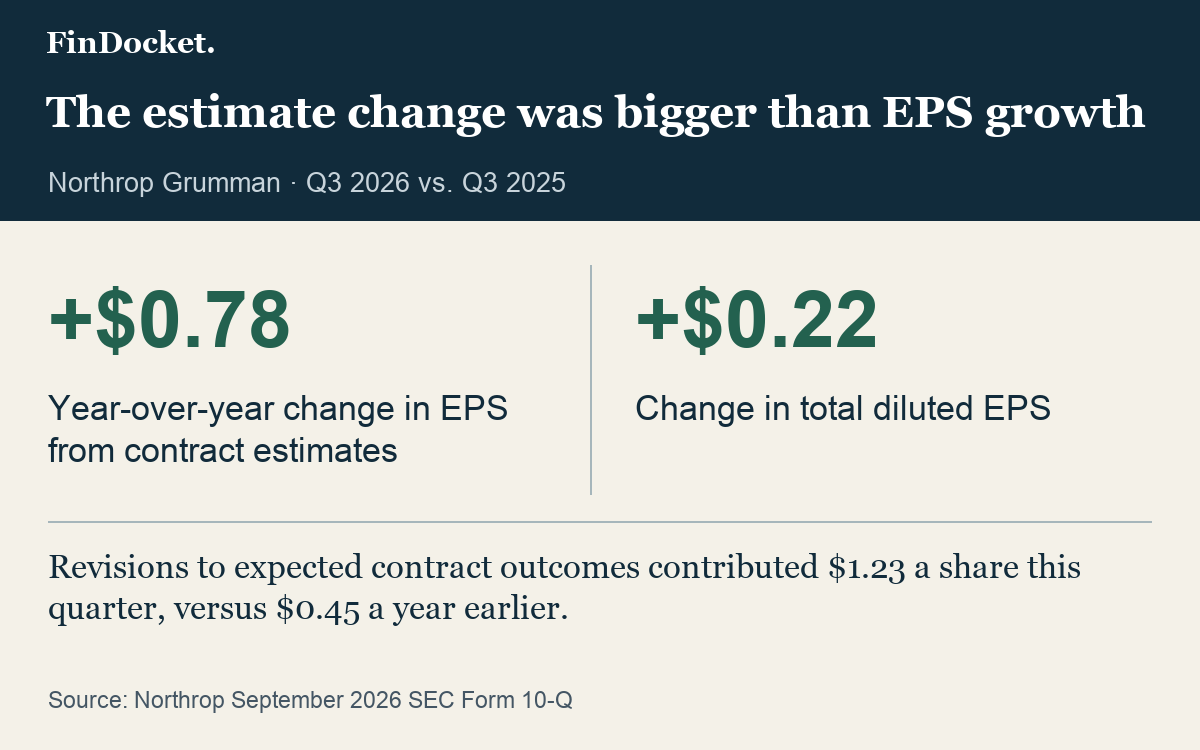
The SEC filing reports $482 million of favorable and $261 million of unfavorable quarterly estimate-at-completion adjustments. The net contribution to operating income was $221 million, compared with $81 million a year earlier. The after-tax current contribution was $175 million, or $1.23 per share, versus $0.45 per share previously.
The net operating contribution increased $140 million. Favorable adjustments increased $49 million, while unfavorable adjustments declined $91 million. Both sides of the estimate distribution helped improve the net result.
That decomposition matters. A stronger net figure does not necessarily mean every program improved. It can result from more favorable revisions, fewer adverse revisions or a mixture of both. The gross unfavorable amount remains relevant even when the net contribution is positive.
The $1.23 current EPS contribution equals approximately 15.6% of reported quarterly EPS. This is the contribution from the disclosed estimate adjustments, rather than an estimate of unusual or nonrecurring profit.
Contract-estimate revisions recur in this industry. Removing them entirely would not create a complete picture of ordinary defense earnings. Their magnitude and direction are still essential to understanding the quarter.
Why changes in estimates affect current earnings
For a contract recognized over time, management estimates total revenue and the cost required to complete the work. The expected margin informs how much profit is recognized as performance progresses.
If the expected completion cost falls, the company may recognize a favorable adjustment reflecting the revised economics of work already completed. If expected cost rises, an unfavorable adjustment can reverse previously recognized profit or recognize an expected loss.
The adjustment can therefore be economically justified while making quarterly comparisons uneven. It updates information about the contract; it is not necessarily a cash payment received during the quarter.
An analyst needs to distinguish the cash earned through billing and collection from the accounting profit recognized through revised expectations. Those measures should converge over the life of a successful contract, but they can differ substantially in an individual reporting period.
The most important test is whether estimate changes prove durable as programs progress. A favorable revision that later reverses has a different economic meaning from a sustained improvement supported by lower completion cost.
Aeronautics carries much of the estimate swing
The filing allocates net estimate adjustments of $124 million to Aeronautics Systems, compared with negative $66 million previously. That is a $190 million favorable swing. Other segments and eliminations offset part of that improvement at the consolidated level.
The Aeronautics swing is larger than the company's total $140 million improvement in net estimate adjustments. This shows why segment analysis is necessary: progress in one part of the portfolio can coexist with less favorable revisions elsewhere.
The figures do not isolate the margin of any single aircraft program. They aggregate the effect of multiple contracts and revisions. Assigning the entire change to one well-known program would overstate what the disclosure establishes.
For forecasting, the appropriate response is to examine program mix, execution and the history of revisions. Applying the quarter's aggregate favorable contribution as a permanent percentage of revenue would assume a consistency that the comparison itself does not demonstrate.
The cash measure also includes a discrete equipment sale
The filing reports nine-month operating cash flow of $1.369 billion, capital expenditure of $775 million and $371 million of proceeds from selling equipment to a customer. Adjusted free cash flow includes the sale proceeds and totals $965 million.
Operating cash less capital spending alone is $594 million. The equipment proceeds account for approximately 38.4% of adjusted free cash flow. They are recorded in investing activities, consistently with the original acquisition of the asset as capital expenditure.
The inclusion has a clear commercial rationale: the money came from a customer transaction. Its classification and discrete nature still matter when estimating a recurring annual cash rate. Repeating the latest adjusted figure without another similar transaction would assume cash generation not established by ongoing operations alone.
What should define the next earnings test?
Northrop's backlog provides commercial visibility, while the estimate disclosures reveal how execution translates that opportunity into profit. The next assessment should follow the direction of contract revisions, the profitability of current work and the timing of customer collections together.
A stronger result would combine durable program economics with cash generation after the investment needed to deliver. Favorable estimates can be part of that outcome, but their contribution should remain visible.
Northrop's quarter is a reminder that defense earnings are partly a measurement of expected contract completion. The shareholder return ultimately depends on fulfilling those expectations and collecting the cash they imply.