Business · Analysis
NRG Q3 2026: The $4 Billion Sale Changes the Baseline
NRG's Q3 SEC filing explains why its $4 billion generation sale, expected impairment and buyback plan must be reconciled with 2027 guidance that excludes the deal.

NRG Energy's third-quarter 2026 results show the earnings contribution of a larger generation portfolio. Its announced $4 billion asset sale creates a second decision: whether exchanging part of that portfolio for debt reduction and share repurchases improves the economics for continuing shareholders.
The most important starting point is a footnote. NRG's new 2027 guidance does not reflect the expected impact of the announced sale. Treating that forecast as a completed post-sale earnings outlook would combine incompatible assumptions.
What did NRG report in Q3 2026?
NRG reported net income of $561 million and operating cash flow of $1.097 billion. Adjusted net income was $983 million and adjusted EPS was $4.68, compared with $2.78 per share a year earlier. Management attributes the improvement in part to the acquired LS Power portfolio and stronger realized market economics.
Adjusted EPS increased approximately 68%. That is a strong increase, but it reflects both operating conditions and a changed asset base. It should not be interpreted as growth from an unchanged collection of plants and customers.
The difference between adjusted earnings and reported net income also makes the reconciliation relevant. Hedge valuation and other adjustments can move reported results without matching the timing of customer cash receipts or the settlement of the underlying contracts.
The announced sale monetizes a specific earnings stream
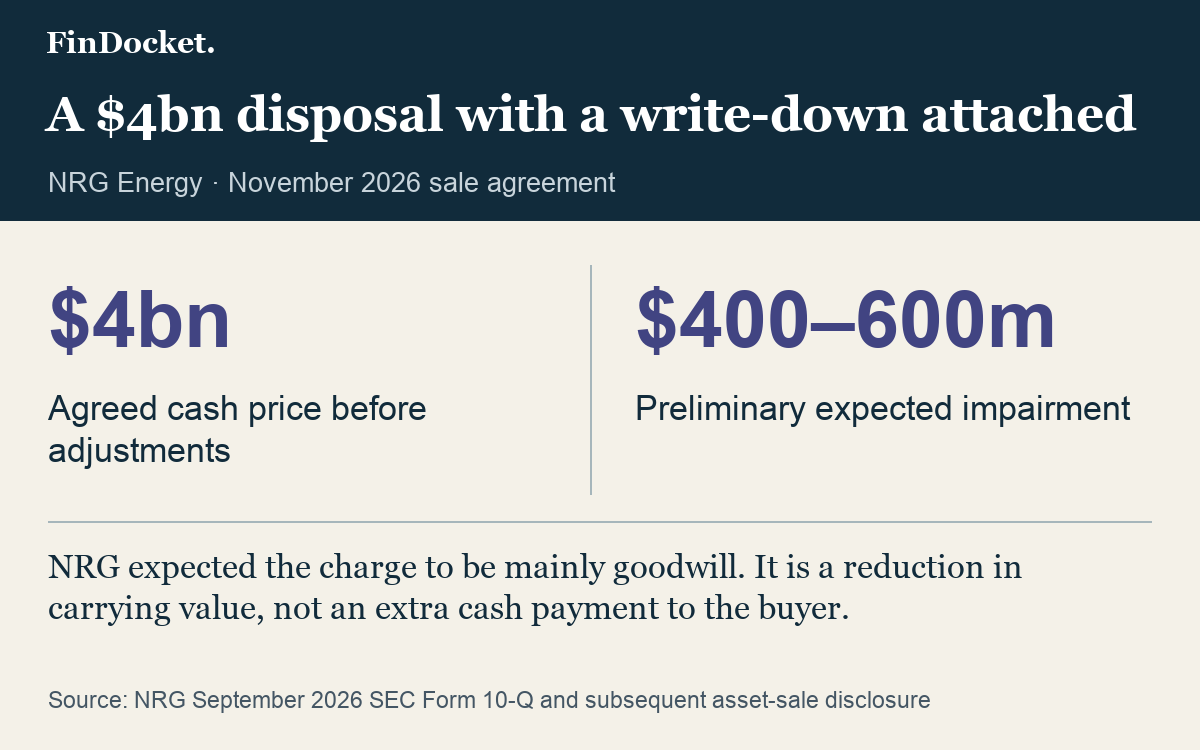
On November 9, NRG agreed to sell six natural-gas generation assets totaling approximately 4.9 gigawatts to LS Power for $4 billion in cash, subject to adjustments. The announcement gives an implied 2027 valuation of eight times adjusted EBITDA.
That multiple implies approximately $500 million of annual adjusted EBITDA associated with the valuation calculation: $4 billion divided by eight. It is not the same as $500 million of net income or cash available to common shareholders.
The assets require maintenance, financing and other costs. A sale therefore removes both an earnings stream and the capital obligations attached to it. The right comparison values what is relinquished against what can be achieved with the net proceeds.
A simple cash-per-megawatt calculation produces approximately $816,000 per megawatt of announced capacity. That is a transaction scale indicator. It does not establish whether any individual plant is cheaply or expensively valued, because plants differ in market access, efficiency, age, contracts and maintenance requirements.
A sale and an impairment can occur together
The 10-Q says NRG expects a preliminary $400 million–$600 million impairment when the assets are classified as held for sale in the fourth quarter, primarily related to goodwill.
That expected charge does not mean the company will pay another $400 million–$600 million in cash to complete the sale. It reflects a reduction in accounting carrying value under the company's preliminary assessment.
Equally, describing the impairment as noncash does not make it irrelevant. It signals that the amount recoverable through the transaction is below the applicable carrying value after the accounting allocation. Investors still need to ask whether the original capital deployed and the proposed disposal together produced an attractive economic result.
The midpoint of the expected charge is $500 million, approximately 12.5% of announced cash proceeds. This is a scale comparison between a potential accounting adjustment and a transaction price. It is not a tax rate, a fee estimate or a calculation of the deal's cash loss.
The distinction prevents a common analytical mistake: subtracting the impairment from proceeds as if it were an additional closing payment, while also treating the charge as evidence that no value was lost. Neither interpretation follows from the disclosure.
The guidance starts before the sale adjustment
NRG's 2027 forecast includes adjusted EBITDA of $5.5–$6.0 billion, adjusted EPS of $8.05–$10.05 and free cash flow before growth of $2.9–$3.4 billion. The release explicitly excludes the expected sale impact.
The implied $500 million EBITDA from the transaction multiple is approximately 8.7% of the $5.750 billion guidance midpoint. That provides a useful indication of the operating scale being monetized.
It is not a complete forecast of post-sale EBITDA. Closing timing, corporate cost allocations, retained arrangements and other assumptions can change the actual effect. Nor can the same percentage simply be applied to EPS, because debt reduction and share repurchases affect the income and share-count calculations differently.
The appropriate post-sale bridge begins with the business earnings removed, adds financing savings and other retained effects, then applies the revised share count. Until that bridge is available, the original guidance and the capital-allocation plan should remain visibly separate.
Debt reduction competes with repurchases for proceeds
NRG says the transaction supports $3 billion of share repurchases across 2026 and 2027. Upon closing, it plans an additional $2 billion of debt reduction, bringing planned 2027 debt reduction to $3 billion. Remaining proceeds are reserved for contracted growth or further debt reduction.
The additional closing-linked debt reduction equals half of the announced gross sale price. That is before considering adjustments, taxes, timing and other uses. It demonstrates why the entire $4 billion cannot also be counted as buyback capacity.
Repurchases can improve EPS by reducing shares, while debt reduction can improve earnings through lower financing costs and strengthen future funding capacity. The value of the combined allocation depends on repurchase prices, borrowing costs and the cash generation of the retained business.
A higher EPS figure alone would not establish a superior outcome if it were achieved by relinquishing attractive long-duration cash flows at an inadequate price. Conversely, selling assets can improve shareholder economics even while reducing total EBITDA if the proceeds are deployed productively.
What will establish whether the exchange works?
NRG needs to connect the sale's closing terms with a revised earnings and cash framework. The useful evidence will include net proceeds, earnings removed, debt actually retired, shares actually repurchased and spending on the retained portfolio.
The quarter shows stronger operating performance. The asset sale asks a different question: whether a smaller generation footprint can support more value per share after the proceeds are allocated. The answer lies in that completed financial bridge, not in counting sale cash as additional value while leaving the sold assets' earnings untouched.