Business · Analysis
Occidental Q3 2026: Debt Falls, Preferred Costs Stay
Occidental cut principal debt to $10 billion. Its Q3 SEC filing shows the remaining preferred dividend burden, OxyChem tax payments and common-shareholder economics.

Occidental Petroleum's third-quarter 2026 results mark a substantial reduction in debt and a clearer path to retaining more operating cash. The next question for common shareholders is how much of that cash remains after the rest of the financing structure and the obligations retained from selling OxyChem.
A smaller debt balance improves financial flexibility. It does not eliminate preferred dividends, convert asset-sale proceeds into recurring earnings, or erase the cash costs associated with a divested business.
Debt reduction creates a recurring cash benefit
Occidental's SEC filing reports principal debt falling to approximately $10 billion from $20.4 billion at year-end. The corresponding annualized interest on outstanding debt declined to approximately $655 million from $1.24 billion.
That is a reduction of roughly 51% in principal and 47% in annualized interest. The implied annual interest saving is approximately $585 million before considering taxes, further debt changes or other financing effects.
The difference between those percentages reflects the mix of debt retired and debt remaining. Reducing principal does not necessarily reduce interest in exactly the same proportion because individual obligations carry different rates.
The saving has a different quality from an asset-sale gain. Retiring a borrowing reduces future contractual interest requirements. A gain on a disposal records the difference between proceeds and carrying value at one point in time. Both can improve reported financial results, but only the former directly reduces the ongoing financing bill.
The annualized saving also differs from interest already avoided during 2026. Borrowings retired at different dates do not deliver a full year's reduction immediately. The year-end run rate is more useful for examining the next period's funding structure than for reconstructing the current year's interest expense.
Preferred dividends remain a substantial claim
The quarterly schedules show $169 million of preferred dividends and $509 million for the first nine months. Quarterly adjusted income from continuing operations was $2.135 billion before outside ownership and preferred dividends, leaving $1.951 billion attributable to common stockholders.
Annualizing the quarterly preferred dividend produces approximately $676 million. That is slightly more than the company's $655 million annualized debt-interest figure. Combined, the two represent an illustrative annual financing cash claim of about $1.331 billion before common dividends.
This is not an accounting equivalence between debt and preferred equity. Interest and preferred dividends have different legal priority, tax treatment and redemption terms. The comparison instead shows the scale of the cash claim remaining above common shareholders.
Preferred dividends consumed approximately 7.9% of quarterly adjusted continuing income before the preferred and minority deductions. Debt reduction improves the common-shareholder opportunity, but preferred distributions still reduce what reaches that residual ownership interest.
It would also be incorrect to deduct the preferred dividend again from adjusted income already labeled attributable to common stockholders. The schedules have made that subtraction. The purpose of examining it separately is to understand the financial structure, not to count the cost twice.
OxyChem proceeds came with taxes and a smaller business
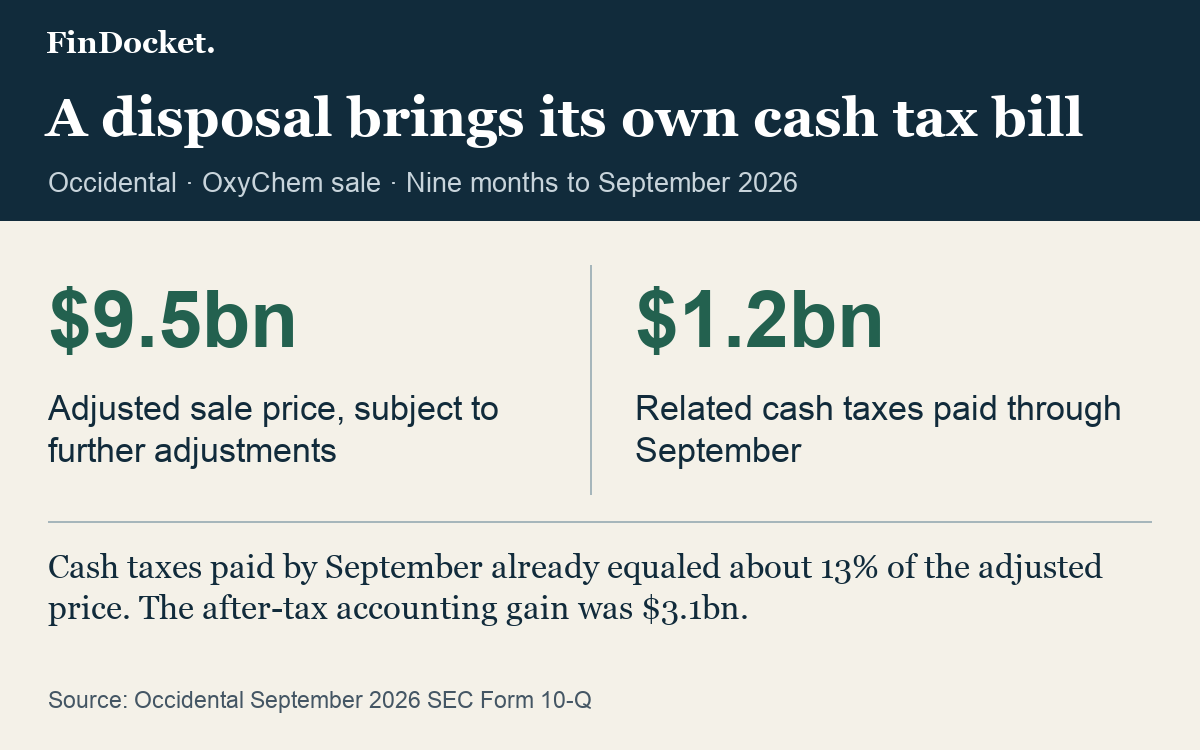
The January completion announcement described $9.7 billion of cash consideration for OxyChem, subject to adjustment. The subsequent filing reports an adjusted sale price of $9.5 billion, a roughly $3.1 billion after-tax gain and approximately $1.2 billion of related tax payments through September.
Using the adjusted sale price and the tax payments made so far leaves an illustrative $8.3 billion difference. It is not a final net-proceeds calculation: transaction adjustments, other cash flows and future obligations must be considered separately.
This distinction matters when interpreting the source of debt repayment. The company monetized an operating business and used the financial capacity to simplify its balance sheet. It did not generate the entire repayment amount from recurring petroleum operations alone.
The sale also changes comparability. OxyChem's historical operations and the disposal effects are presented as discontinued operations. Continuing operating cash is therefore the more useful starting point for assessing the retained business, while discontinued cash movements remain relevant to total liquidity.
Discontinued operations still use cash
For the first nine months, continuing operating cash was approximately $10.6 billion and capital expenditure approximately $4.5 billion. Discontinued operations used approximately $1.4 billion of operating cash, primarily reflecting the sale and subsequent tax payments.
A simple subtraction leaves approximately $6.1 billion of continuing cash after the stated capital expenditure. Incorporating the discontinued operating use reduces that analytical amount to approximately $4.7 billion before other investment and financing movements.
The difference illustrates why an operation disappearing from the continuing income statement does not mean every related cash obligation has disappeared. Taxes, retained liabilities and indemnification arrangements can remain with the seller after ownership transfers.
Occidental's filing explicitly identifies post-closing indemnification rights held by Berkshire Hathaway. Those rights are separate from ordinary interest and dividend payments. Their existence belongs in the assessment of residual obligations, even though they do not imply that every potential claim will produce a payment.
The retained business is producing substantial cash
The quarterly schedules report approximately $4.1 billion of continuing operating cash and $2.8 billion of free cash flow before working capital. Production averaged 1.427 million equivalent barrels daily. Adjusted common EPS from continuing operations was $1.91 versus reported EPS of $1.61, with derivatives losses driving much of the difference.
Those results support the proposition that debt reduction is accompanied by meaningful operating capacity. They do not make a cash measure before working capital identical to cash available after every corporate claim.
The next stage should be evaluated through continuing cash after investment, the actual interest saving realized, preferred distributions and remaining disposal-related payments. Those measures establish the resources available for common dividends, repurchases and new development.
Occidental has materially improved its financing position. The economic benefit to common shareholders now depends on converting that improvement into retained cash while the smaller operating portfolio funds its own investment. The debt milestone is substantial; the full common-shareholder calculation includes the preferred layer and the cash obligations that survived the OxyChem sale.