Business · Analysis
ONEOK Q3 2026: Less Debt, a New Claim on Cash Flow
ONEOK's Q3 SEC filing explains Apollo's $9 billion investment, its contractual cash distributions and the noncash tax benefit behind reported earnings growth.

ONEOK's third-quarter 2026 results show an important change in its capital structure. Apollo's $9 billion investment helped finance an acquisition and substantial debt extinguishment while leaving ONEOK in control. The trade-off is a new contractual allocation of operating cash flow and earnings to the outside investor.
The quarter also contains a large noncash tax benefit. Reading the financing terms alongside the earnings reconciliation produces a more useful picture than either the debt-reduction or profit-growth headline alone.
Apollo's investment is equity, but it carries specific economics
The completed transaction gave Apollo a nonvoting Class B minority interest in ONEOK Holdings, structurally subordinate to operating-company debt. The SEC filing reports that ONEOK retains control and presents the Class B units within noncontrolling interests in equity.
That classification matters. The units are not conventional senior borrowings with the same creditor position. Their subordination can improve the protection of debt holders and support the company's conventional credit measures.
For common shareholders, however, equity classification does not mean there is no economic cost. Another investor now holds contractual rights to a portion of cash generation before the residual reaches ONEOK's parent-level ownership interest.
The right comparison is therefore the cost and flexibility of this arrangement against the alternatives available to fund the acquisition and reduce debt. Replacing one form of capital with another can improve credit quality while still creating a meaningful claim on future resources. Those outcomes are compatible.
Cash distributions and the capped return are separate calculations
During the initial contractual period, Class B distributions are generally 15% of defined cash flow from operations, with provisions for 20%. The 20% rate applies when the agreement's leverage ratio exceeds 4.5 times. The base return begins at 7.01% for nine years and increases later.
The percentage distributed is not identical to the return earned. The filing explains that distributions above income attributed to the investor reduce its outstanding investment balance. Part of a cash payment can therefore represent repayment of invested capital rather than current-period investment income.
On the original $9 billion balance, 7.01% corresponds to approximately $630.9 million annually before changes in that balance. This is a scale illustration, not a forecast of annual cash distributions. Actual distributions depend on the agreement's cash-flow definition and the applicable allocation percentage.
For example, a hypothetical $6 billion of contractual cash flow would produce a $900 million allocation at 15%, versus $1.2 billion at 20%. The $300 million difference shows how the distribution percentage can change the pace at which cash reaches the parent and the investor's balance is reduced. This example does not use ONEOK's reported GAAP operating cash as though it were automatically identical to the contractual definition.
Debt reduction does not remove the whole financing burden
ONEOK reported extinguishing nearly $5.5 billion of debt principal in September. That is a real reduction in conventional financing claims and future exposure to those instruments.
The economic assessment still needs both sides of the transaction. Debt repayments reduce interest and refinancing requirements. Class B allocations reduce cash otherwise available to the parent, while distributions above the attributed return can reduce the investor's future claim.
A useful future bridge will compare interest saved, income allocated to Class B, cash paid to the investor and the decline in its outstanding balance. Looking at only one of those measures would miss part of the trade-off.
Common shareholders benefit if the combination of acquired cash generation, lower debt costs and financing flexibility outweighs the new claim. The transaction's size alone does not establish that result. The operating returns earned with the capital are central to whether the structure creates value.
The tax benefit explains much of the earnings increase
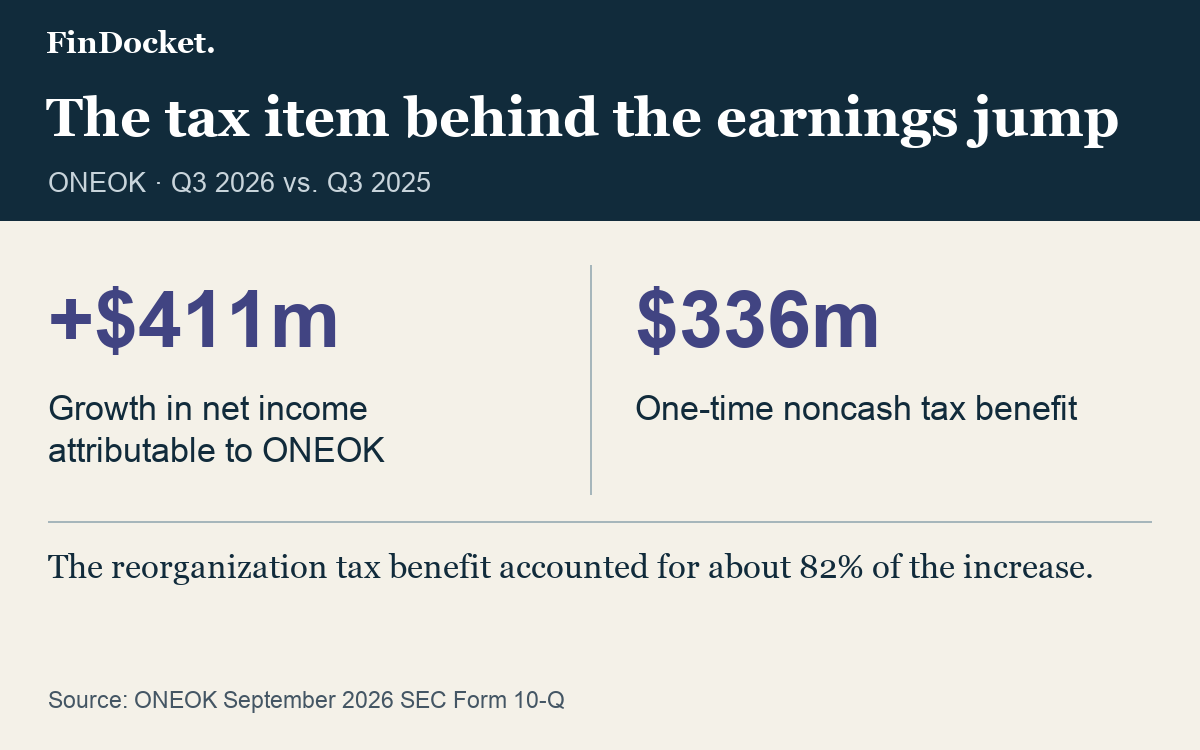
Quarterly net income attributable to ONEOK increased to $1.350 billion from $939 million. The current result includes a one-time $336 million noncash tax benefit associated with the reorganization. Adjusted EBITDA was $2.24 billion, up approximately 6%.
The $336 million benefit equals approximately 82% of the $411 million increase in attributable earnings. Subtracting it from current attributable income gives an illustrative $1.014 billion, approximately 8% above the prior figure.
That calculation isolates one disclosed item. It is not a full adjusted-earnings reconciliation and does not remove every other difference between the periods. It does show why the approximately 44% reported earnings increase should not be interpreted as the same rate of recurring operating growth.
A tax-balance remeasurement can recognize an economic benefit without producing an equivalent immediate cash receipt. Its value and its timing are separate questions. The operating businesses must still collect cash and earn returns on the capital deployed.
Volume growth did not produce uniform segment improvement
The earnings release reports higher volumes across several businesses, but the resulting earnings pattern was mixed. Natural Gas Liquids adjusted EBITDA declined to $718 million from $748 million, while Refined Products and Crude increased to $685 million from $582 million.
The latter business's $103 million increase included an $87 million increase from optimization and marketing activity. That component represented approximately 84% of the segment's net improvement, before considering the other positive and negative contributors in its bridge.
The mix matters because volumes, contractual fees and commercial optimization do not have identical earnings behavior. Higher throughput can support fixed-cost absorption, while inventory timing, blending opportunities and price differentials can materially change the profit retained from that activity.
The next operating test is whether the enlarged asset system produces sustained incremental cash after its operating costs and capital requirements. That cash must support both conventional financing obligations and the Class B allocation before reaching the residual owners.
ONEOK's quarter strengthened its conventional credit position and expanded its operating platform. The shareholder-return test now requires a broader financing lens: the investment balance outstanding to Apollo, the cash allocated to it and the recurring earnings beneath the tax benefit. Those measures will reveal whether the new structure improves the cash economics of the common shares as effectively as it improves the debt headline.