Business · Analysis
Oracle Q1 FY2027 Earnings: Prepayments and AI Funding
Oracle's SEC filing reveals how customer prepayments fund AI capacity, why cash-flow comparisons can double-count them, and the milestones behind its funding plan.

Oracle's fiscal first-quarter 2027 earnings demonstrate rapid cloud infrastructure growth and a financing model increasingly supported by customers paying before services are delivered. The important analytical task is separating the value of that funding from the earning power of the infrastructure it finances.
Customer prepayments provide real liquidity. They also create future service obligations. Oracle's disclosures show why a record operating cash-flow number can coexist with negative free cash flow, and why combining differently adjusted cash measures can produce an overly flattering result.
What did Oracle's latest quarterly results show?
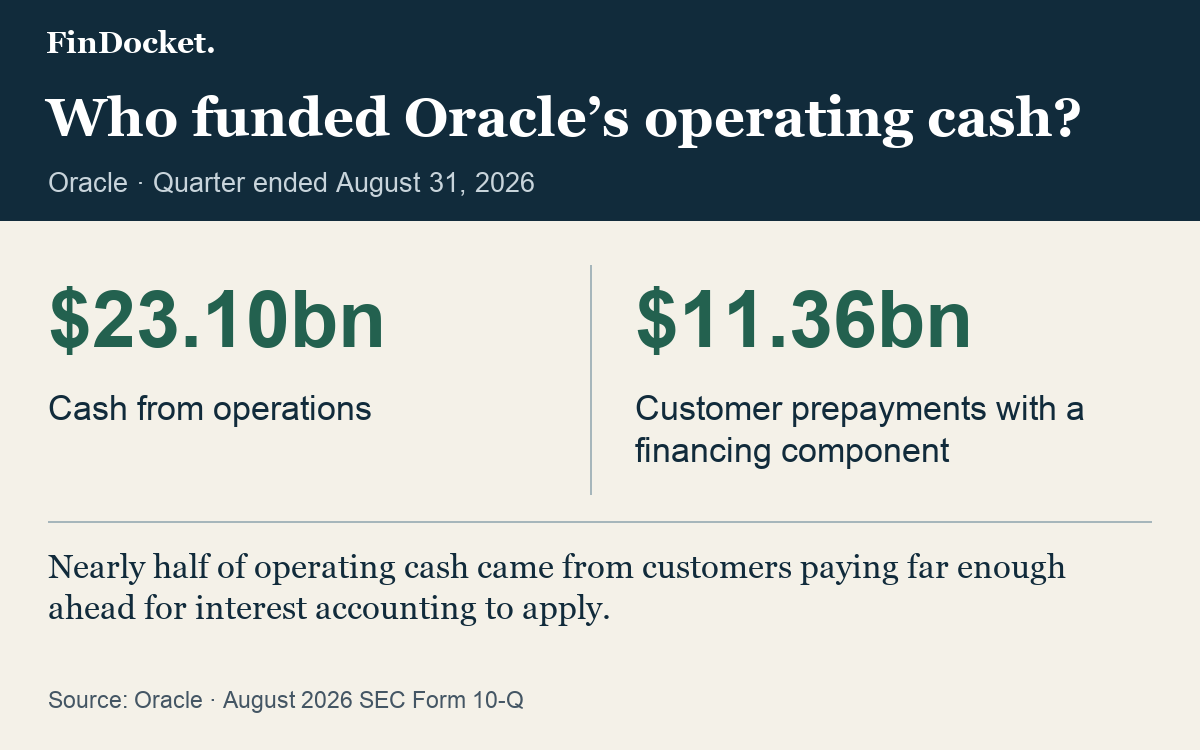
Revenue was $19.345 billion, with cloud infrastructure revenue of $7.388 billion, up 121%. Operating cash flow was $23.103 billion, capital expenditures $28.499 billion and free cash flow negative $5.396 billion. Oracle also disclosed supplemental net cash outlay for capital expenditures of $17.966 billion.
The infrastructure growth establishes demand for the capacity Oracle is building. It does not by itself establish the return on that capacity. That requires enough revenue over the assets' productive lives to cover operating costs, replacement investment and the cost of financing.
The difference between capital spending and net cash outlay answers a separate question: how much cash Oracle must supply after specified funding arrangements. Lower net outlay can improve liquidity without reducing the amount of equipment and other productive resources the business needs.
That distinction becomes especially important when comparing Oracle with software companies whose expansion requires much less physical capital. Similar revenue growth rates can involve very different funding needs and very different future replacement obligations.
Why customer prepayments change the cash interpretation
The SEC filing identifies $11.363 billion of customer prepayments with a significant financing component inside operating cash flow. It says the related financing effect is recognized separately as interest expense and reflected in deferred revenue over the performance period. No comparable prepayments were received in the prior-year quarter.
Receiving cash before delivering services reduces the amount Oracle needs to obtain elsewhere. Economically, customers finance part of the infrastructure and the interval before delivery. This can be a valuable feature of a growing cloud business.
The receipt is still different from collecting money for work already completed. Future revenue recognition can occur without another equivalent cash receipt because the customer has already paid. Future service costs, meanwhile, must still be funded as the obligation is performed.
That means the cash benefit should be tracked through the full contract cycle. Rapidly growing advances can support construction today. The later cash profile depends on continuing advances, the pace of service delivery and the margin earned on those services.
Where can double-counting occur?
Oracle's supplemental net-outlay calculation deducts the same customer prepayments from capital spending and incorporates other short-term capital-related financing cash flows. The company presents this measure to explain the funding required for capital expenditure.
Subtracting that net outlay directly from unadjusted operating cash flow would give credit for the customer advance twice: once as an operating receipt and again as a reduction in the investment being funded.
FinDocket's reconciliation removes the identified advance from operating cash before making that comparison. The resulting operating amount is $11.740 billion; subtracting net outlay of $17.966 billion leaves negative $6.226 billion. This is an analytical funding calculation, not Oracle's reported free cash flow.
It differs from reported free cash flow because it also captures the other capital-related financing adjustment. The point is consistency: a funding benefit can reduce the amount of cash needed, or increase the cash shown as available, but it cannot do both in the same calculation without an offset.
The same principle applies to other infrastructure businesses. Comparing a gross operating inflow with an investment number already net of that inflow can make an externally supported expansion appear internally funded.
What does the long-term backlog establish?
Oracle reported $664 billion of remaining performance obligations, with 13% expected as revenue within twelve months. It also disclosed $288 billion of additional data-center lease commitments not yet reflected on the balance sheet, generally commencing from fiscal Q2 2027 through fiscal 2029 for fifteen-to-nineteen-year terms.
Backlog and lease commitments describe different sides of the capacity plan. Customer contracts support future sales visibility. Supplier and property commitments establish the resources needed to serve those sales. Their timing and profitability determine the financial result.
Comparing the two headline totals as though the difference were profit would ignore operating expenses, equipment replacement, contract duration and the time value of money. A dollar of distant revenue is not equivalent to a dollar of near-term cash obligation.
The useful analysis matches customer performance schedules with capacity delivery and payment dates. Delayed infrastructure can postpone revenue; accelerated construction can pull spending ahead of collections. Contracted demand reduces uncertainty about opportunity while leaving execution and funding requirements economically important.
What did the October funding plan change?
At Investor Day, Oracle targeted positive free cash flow during the second half of fiscal 2028 and at least $30 billion in fiscal 2029. It limited planned additional capital-market funding through fiscal 2030 to $20 billion, excluding debt refinancing, split between equity and gross debt. That is additional to the first-quarter $20 billion equity raise. Management expects vendor financing, customer hardware and prepayments to reduce upfront cash needs.
These targets make the transition testable. Revenue growth must translate into operating receipts, capital spending must eventually moderate relative to those receipts, and alternative funding must arrive on the schedule assumed in the plan.
The capital-market limit also does not describe every economic commitment. Refinancing, leases, vendor arrangements and customer advances have different terms and are treated differently in the plan. Assessing financing capacity requires looking across those categories rather than interpreting one limit as total future obligations.
Oracle has demonstrated strong demand and access to substantial customer funding. The shareholder return now depends on turning that funding into productive capacity at margins sufficient to cover its full cost. Tracking consistent cash measures is essential to judging whether the transition is progressing toward the stated free-cash-flow milestones.