Business · Analysis
Pets at Home’s Profit Recovery Includes a Petplan Exit Benefit
Pets at Home’s HY27 results show a retail recovery and stronger cash flow. The Petplan exit payment and veterinary cash comparison sharpen the investment case.
Pets at Home’s November 25 results show a retail-led recovery, but the headline profit increase includes a benefit that will not recur. Group pretax profit rose from £36.2 million to £52.2 million for the 28 weeks to October 8. The legacy Petplan agreement contributed £5.3 million of revenue, against £1.8 million a year earlier.
How much does Petplan affect the comparison?
The interim statement says the latest income follows the final settlement of remaining rights and obligations. It classifies the revenue within ordinary business activities while explicitly describing the exit-related income as non-recurring. Statutory and underlying pretax profit are identical for both interim periods.
That is an important distinction: an “underlying” label does not automatically remove every income stream that cannot repeat. The presentation’s profit bridge identifies a £3.5 million year-on-year Petplan contribution within the £16 million group profit increase. That represents approximately 22% of the improvement, calculated by dividing £3.5 million by £16 million.
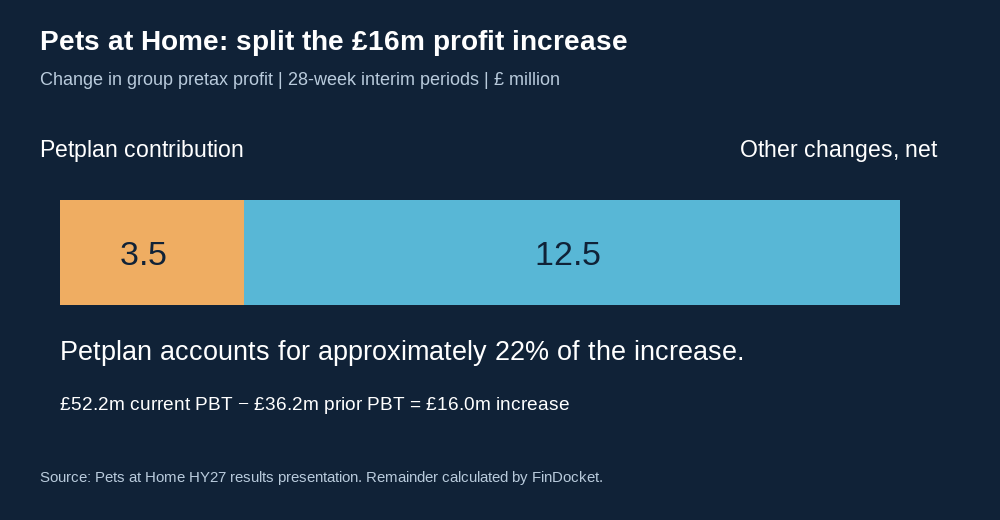
The calculation does not negate the retail recovery. It establishes the portion of the growth bridge that should be distinguished when assessing repeatable performance. Treating the full increase as a recurring run rate would embed the exit benefit into future expectations.
Which division delivered the cash improvement?
The presentation records retail free cash flow of £17 million, a £28.1 million improvement. Veterinary free cash flow fell £7.7 million to £45.9 million. Central and insurance cash flows remained negative.
Retail’s improvement therefore exceeds the group’s £21.7 million cash-flow gain. It offset weaker cash generation elsewhere rather than merely contributing its share to a uniform recovery.
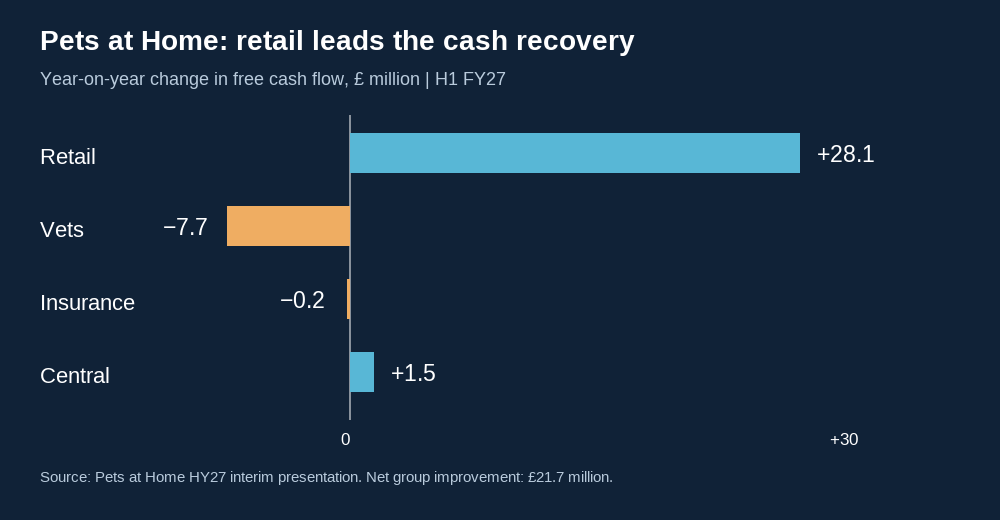
Profit and cash also diverged within Vets. Higher earnings alongside lower cash generation call for a working-capital comparison, rather than an assumption that weaker cash means weaker customer demand. The presentation provides the divisional cash bridge needed to keep those questions separate.
What does the outlook require?
Management now expects full-year underlying pretax profit at the top of the published analyst range of £90 million–£101 million. The statement identifies that range as analyst expectations, rather than a new fixed profit commitment.
The strategy presentation targets a sustainable retail pretax margin above 5% over the medium term. Delivering that ambition requires further operating progress after the Petplan exit benefit drops out of the comparison. The next reporting periods should establish whether sales, margin recovery and cash generation continue together on that cleaner basis.