Business · Analysis
Quanta Q3 2026: The Backlog Mix Matters as It Grows
Quanta's Q3 SEC filing shows performance obligations growing faster than total backlog, while acquisitions and working capital reshape revenue and cash flow.

Quanta Services' third-quarter 2026 backlog is larger, and its composition has changed in a useful way. Remaining performance obligations grew faster than the broader backlog measure, increasing their share of the total. That distinction offers more information than the record headline alone.
The quarter also shows strong organic expansion and unusually favorable working-capital performance. Together, these developments strengthen the operating picture while making it important to distinguish contracted work, estimated future activity and cash timing.
What did Quanta report in Q3 2026?
Revenue increased to $12.01 billion from $7.63 billion. Net income attributable to common stock rose to $694.9 million, or $4.55 per diluted share, from $339.4 million, or $2.24. Adjusted EPS increased to $6.06 from $3.33.
Revenue grew approximately 57%, while reported net income more than doubled. The reported net-income-to-revenue ratio increased from approximately 4.4% to 5.8%, using the rounded release figures.
This broad ratio captures more than project execution because financing, tax and acquisition-related costs also affect net income. Nevertheless, it shows that growth in the business was accompanied by a higher share of revenue reaching the bottom line.
The adjusted EPS increase was approximately 82%, below the growth in reported EPS. The reconciliation therefore matters to the comparison; adjusted and reported growth rates are not interchangeable descriptions of the same result.
Remaining performance obligations grew faster than backlog
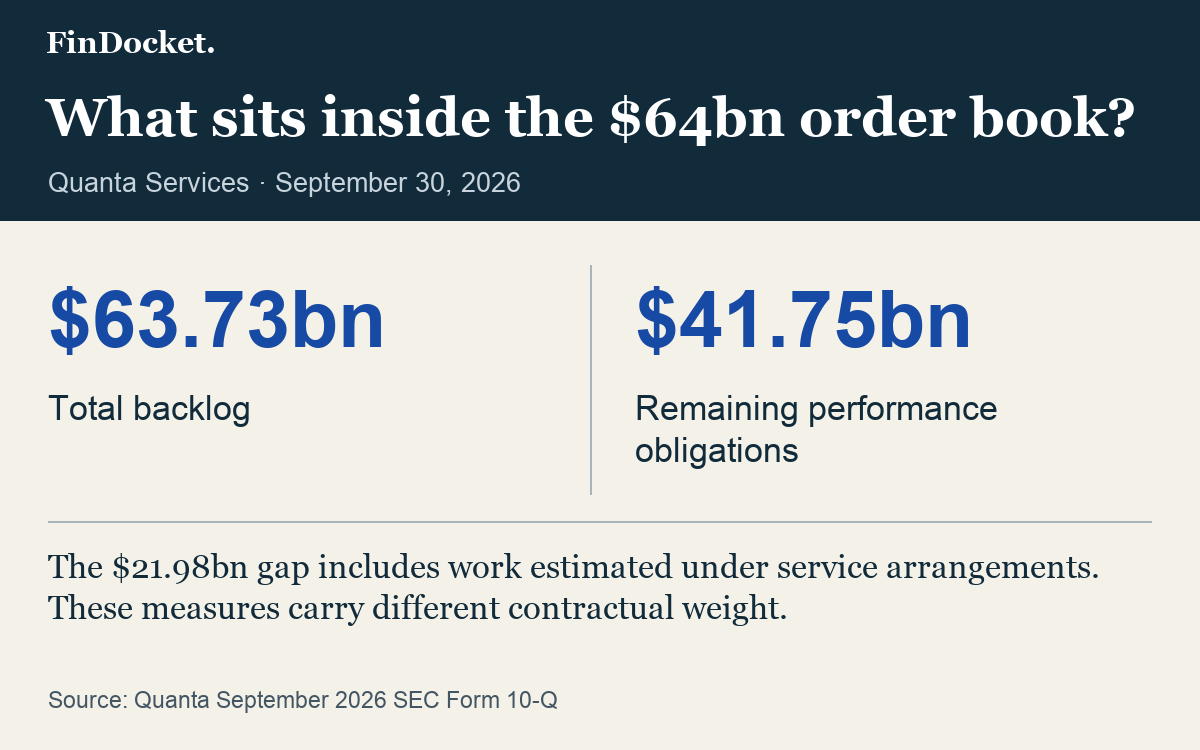
The 10-Q reports remaining performance obligations of $41.75 billion, compared with $23.76 billion at year-end. Total backlog was $63.73 billion, up 44.9% from year-end. Quanta's backlog methodology also includes estimates under master service agreements, including renewals, and certain non-fixed-price contracts.
Performance obligations increased approximately $17.99 billion, or 75.7%. The implied year-end backlog was approximately $43.98 billion, based on the stated growth rate and rounded current balance.
That places performance obligations at approximately 65.5% of current backlog, compared with approximately 54.0% at year-end. The increase of roughly 11.5 percentage points indicates that the accounting performance-obligation measure represents a larger share of the commercial pipeline.
The residual between total backlog and performance obligations is approximately $21.98 billion today, versus approximately $20.22 billion at year-end. Thus, most of the backlog increase is represented by the expansion in performance obligations rather than only growth in the broader estimated component.
The mix improvement is useful, but it is not a guarantee
Remaining performance obligations and backlog answer related questions with different measurement rules. Their relationship helps assess the composition of the opportunity, but it does not turn every contract into an unconditional cash receipt on a fixed date.
Project timing, scope changes, permitting, customer decisions and execution requirements can still affect revenue recognition. A larger performance-obligation balance improves visibility into committed work under the accounting framework. It does not establish the margin that Quanta will retain after completing that work.
The useful next step is to connect the balance to service delivery and economics: when work begins, how resources are scheduled, whether pricing covers costs and when customers pay. A record backlog can create both revenue opportunity and demand for additional crews, equipment and working capital.
Near-term work is substantial, but it is not full-year guidance
Quanta expects approximately 67% of September performance obligations to become revenue within the following 12 months. The supplement reports approximately $38.4 billion of 12-month backlog and $63.7 billion of total backlog, including approximately $1.3 billion associated with third-quarter acquisitions.
Applying 67% to $41.75 billion gives approximately $27.97 billion of expected near-term performance-obligation conversion. That is below the broader 12-month backlog because the latter includes additional estimated activity under Quanta's methodology.
Neither figure should be substituted mechanically for a calendar-year revenue forecast. The measurement starts at September, some revenue can come from work awarded later and project schedules can change. The comparison is valuable because it separates the accounting obligation base from the wider expected workload.
The acquired backlog is also a distinct contributor. Buying a business adds its project pipeline to the consolidated total. The resulting increase should be analyzed alongside organic awards rather than treated as though all backlog was generated by the pre-acquisition business.
Organic growth remains strong after acquisitions are removed
The operational supplement identifies approximately $1.555 billion of quarterly revenue from businesses acquired within the preceding 12 months and approximately $10.460 billion of organic revenue under its definition.
Comparing that organic amount with prior-year revenue of approximately $7.631 billion produces growth near 37%. Acquisitions therefore account for an important part of reported expansion, but they do not explain the majority of the increase in quarterly revenue.
The acquired revenue is approximately 13% of current quarterly sales. It represents roughly 35% of the total dollar revenue increase, based on the rounded figures. These calculations help separate the sources of growth without assuming the acquired and legacy businesses carry identical margins or funding requirements.
Cash collection needs to be read through Quanta's definition
The supplement reports approximately $1.454 billion of quarterly operating cash flow, $1.199 billion of free cash flow and 50 days sales outstanding, compared with 66 days a year earlier. Its DSO calculation nets contract liabilities against receivables and contract assets.
The 16-day improvement is meaningful, but the measure reflects more than the age of invoices awaiting collection. Advance customer funding can improve the net working-capital calculation as well as cash receipts from outstanding invoices.
The sustainable benefit depends on contract terms and project mix continuing to support favorable funding. Investors should follow collections, advances and delivery obligations together rather than assuming every reduction in net DSO represents a permanent acceleration in invoice payments.
Quanta's quarter combines strong operating growth with a more substantial performance-obligation base. The next test is converting that workload into retained margins and cash while preserving the execution capacity required to deliver it.