Business · Analysis
Regeneron Q3 2026: Sanofi Changes the Profit Baseline
Regeneron's SEC filing explains why collaboration revenue outgrew drug sales. We analyze the Sanofi development-balance reset, Eylea transition and Q4 upfront.

Regeneron's third-quarter 2026 revenue increased 36%, but the most important explanation lies in its collaboration economics. Stronger Dupixent sales combined with the disappearance of an old development reimbursement obligation, allowing more collaboration profit to reach Regeneron's income statement.
This creates a higher earnings baseline rather than a growth rate that can be repeated indefinitely. The company also expects a separate $1 billion Sanofi upfront payment to enter fourth-quarter revenue. Investors need to distinguish recurring commercial expansion, a permanent change in retained economics and a transaction-specific payment.
Why did collaboration revenue grow so quickly?
The Form 10-Q shows Regeneron's share of Sanofi commercialization profits before the legacy reimbursement deduction rising to $2.5749 billion from $1.7236 billion. The prior-year quarter then deducted $268.1 million for previously funded development expenses; the current quarter had no deduction.
The development balance was fully repaid by June 30. Consequently, the reported profit share increased from $1.4555 billion to $2.5749 billion, materially faster than the increase in the underlying pre-deduction profit share.
The bridge is revealing. Approximately $851.3 million of the $1.1194 billion increase came from higher pre-deduction collaboration profits. The eliminated reimbursement deduction supplied the remaining $268.1 million, or approximately 24% of the increase.
Commercial growth therefore accounts for most of the improvement. The balance repayment still makes a substantial contribution and changes how the year-over-year result should be interpreted.
The underlying profit-share increase was approximately 49%, while the reported post-deduction increase was approximately 77%. Neither calculation is the growth rate of Dupixent product sales. They measure different layers of a collaboration with its own expenses, revenue mix and contractual obligations.
A higher baseline is economically real
The disappearance of the deduction is valuable. Regeneron no longer has to use part of its recognized profit share to settle that particular historical development balance. The retained economics improve even without another equivalent change in product demand.
However, a step-up in the earnings level produces a temporary boost to the growth comparison. Once the company compares quarters that both have no deduction, that source of percentage growth disappears. The higher profit level remains, but the anniversary no longer adds incremental growth.
A forecast that compounds the current reported profit-share growth rate would overstate the mechanism. A stronger model forecasts the underlying collaboration profits first, then applies the relevant contractual deductions. Once a historical balance reaches zero, it should remain absent rather than becoming a new recurring source of growth each year.
Regeneron also continues to fund agreed development work under the collaboration. Repayment of the old balance does not mean future research becomes free or that all partner product revenue flows through to shareholders.
Dupixent sales are not Regeneron consolidated revenue
The earnings announcement reports global Dupixent sales of approximately $6.54 billion, recorded by Sanofi. Regeneron instead records collaboration revenue reflecting its economics under the agreement, including its profit share and manufacturing reimbursements.
Regeneron's total quarterly revenue was approximately $5.116 billion, including $2.724 billion from Sanofi collaboration revenue. Adding Dupixent's global product sales to that consolidated total would double-count economic activity and combine different reporting entities.
The distinction also affects margin analysis. A collaboration profit share is already downstream of expenses incurred in commercializing the products. Direct product revenue arrives before the manufacturer's associated costs. A shift toward collaboration revenue can therefore change consolidated margins without a corresponding change in the gross margin on directly sold products.
The useful question is how much economic profit Regeneron retains from the partnership and how much cash it collects, rather than whether partner-reported sales can be added to its top line.
Eylea HD growth still offsets an older franchise's decline
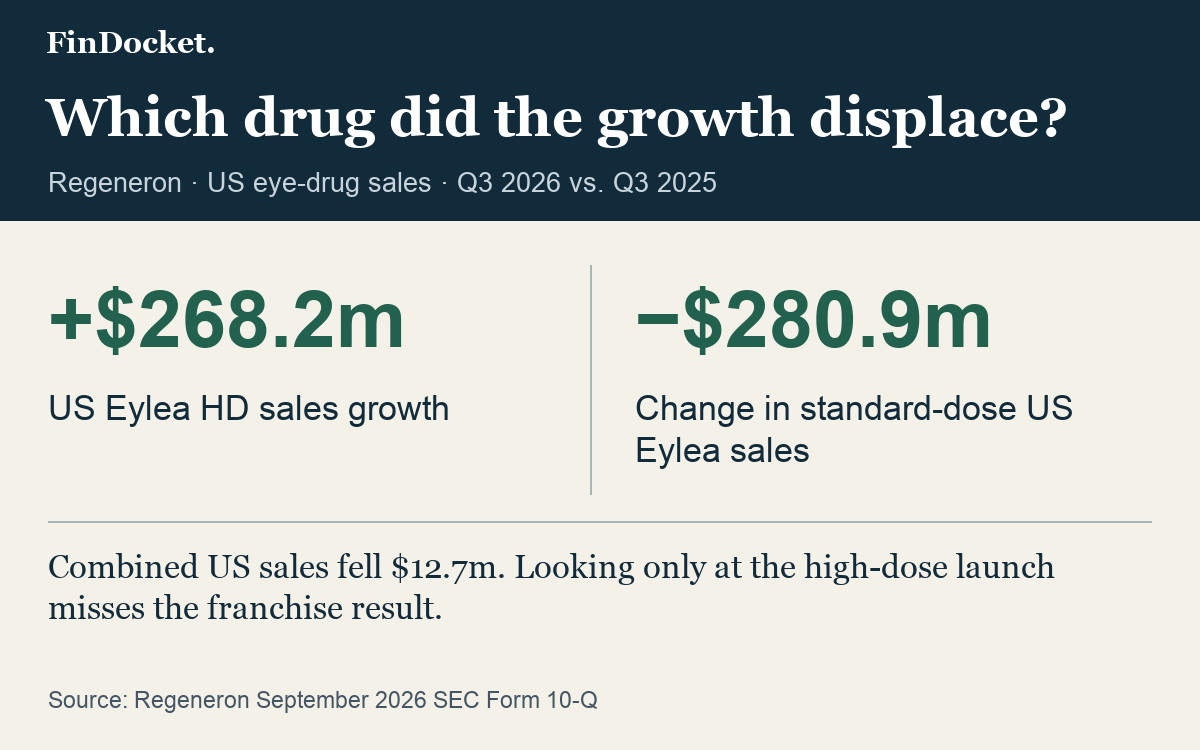
The earnings tables show U.S. Eylea HD sales of $698.8 million versus $430.6 million, while standard-dose Eylea fell to $399.7 million from $680.6 million. Combined U.S. sales consequently declined to $1.0985 billion from $1.1112 billion.
The HD formulation added $268.2 million, but the older formulation lost $280.9 million. Approximately 95% of that decline was offset, leaving a modest combined contraction rather than franchise growth.
That is a different commercial story from the HD product's standalone percentage increase. Successful migration to a newer formulation can defend a franchise while also moving revenue out of its older product. The economic outcome depends on the combined revenue, profitability and durability of the retained customer base.
Future analysis should therefore track both formulations together before judging whether product conversion is creating additional demand. A rising HD mix is strategically useful, but the combined franchise determines how much revenue is available to support research and profit.
Q4 has another distinct revenue event
The filing says the October collaboration expansion generated a $1 billion upfront payment to be recognized in fourth-quarter collaboration revenue. Additional payments of up to $7 billion depend on development, regulatory and sales milestones.
The upfront is a concrete transaction payment. The milestone ceiling represents conditional future opportunities. Treating both as current recurring revenue would misstate the agreement's economics and timing.
The upfront recognition will also affect the comparison with this quarter. Any Q4 growth assessment should identify that contribution before interpreting the remainder as an acceleration in ongoing drug commercialization. Its value belongs in the capital and partnership analysis, while its recurrence must be assessed separately.
Regeneron enters that quarter with stronger commercial profit retention and a rapidly expanding collaboration business. The decisive task is to measure those recurring economics after the development-balance reset, while keeping product migration and deal payments visible. That approach captures the improvement without turning a changed baseline into an implausible perpetual growth assumption.