Business · Analysis
Renew’s Stronger Second Half Meets a £15 Million Acquisition Writedown
Renew’s FY2026 results show a stronger second-half operating margin, while Full Circle’s goodwill impairment exposes a separate acquisition test.
Renew Holdings’ November 24 results reveal a sharper improvement in second-half profitability than the full-year margin suggests. But a £15 million Full Circle goodwill impairment means the acquisition record needs scrutiny alongside the operating performance.
How much stronger was the second half?
The engineering group reported FY2026 revenue of £1,177.5 million and adjusted operating profit of £77.9 million. Its May interim report recorded £589.0 million and £33.4 million respectively for the first half.
Subtracting those rounded figures gives second-half revenue of approximately £588.5 million and adjusted operating profit of £44.5 million. The implied margin rose from 5.7% to approximately 7.6%, despite almost unchanged half-on-half sales. These are FinDocket calculations, rather than separately reported second-half measures.
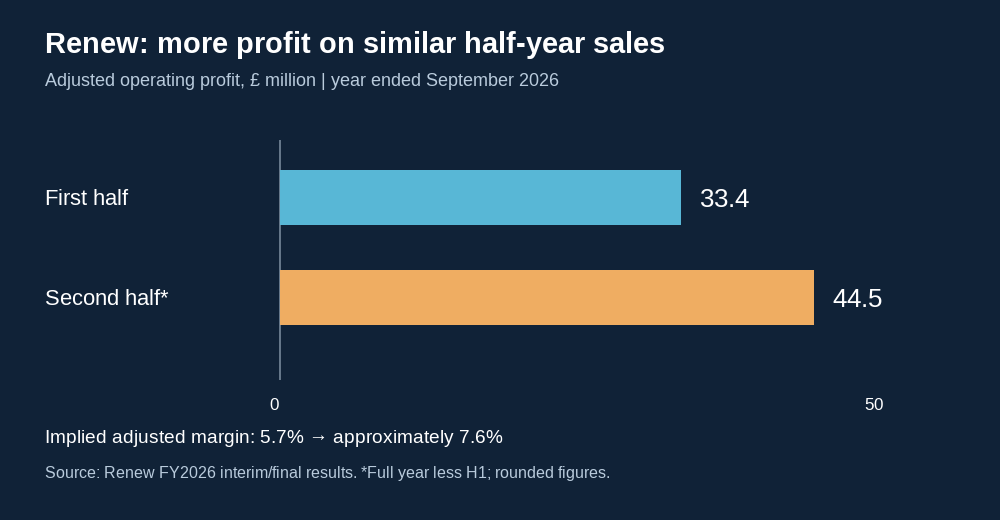
The same subtraction for FY2025 produces second-half revenue of £546.8 million and adjusted operating profit of £40.1 million. That puts estimated second-half FY2026 profit growth near 11%, ahead of sales growth near 8%. The comparison supports an improvement in operating profitability; it does not establish that the second-half margin will persist through FY2027.
What changed after the interim report?
In May, Renew reported 2.2% organic growth and expected acceleration in the second half. The November release puts full-year organic growth at 3.5%. The direction matches management’s earlier expectation, although those two percentages alone cannot yield an exact second-half organic growth rate without the relevant revenue bases.
The interim order book was £945 million, supported by framework positions. At September it reached £1,002 million. The £57 million increase provides another comparison point for the next reporting period, separate from the revenue already recognised.
May’s report also described subdued rail renewals activity and record emergency-response maintenance. That distinction matters when interpreting infrastructure spending: the mix between planned renewals and reactive work can change even when the overall customer investment programme remains substantial.
Why does the impairment matter?
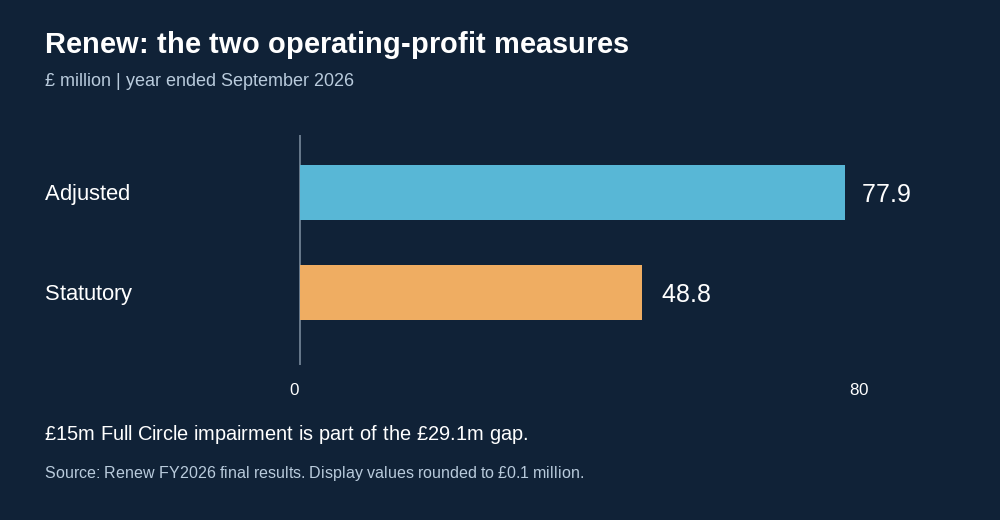
Full-year statutory operating profit fell to £48.8 million while adjusted operating profit increased. Renew attributed the Full Circle impairment to reduced forecast cash flows, predominantly following weaker French trading. It expects the turnaround to improve profitability in 2027 and beyond.
A goodwill charge does not consume current-period operating cash. It does revise the value supported by an acquired business’s expected cash generation. Both statements belong in the investment assessment.
The next results need to answer two distinct questions: whether the stronger operating margin continues, and whether Full Circle delivers the cash flows behind its revised carrying value. Growth elsewhere in the group does not, by itself, answer the acquisition question.