Business · Analysis
ResMed Q1 FY2027: MatrixCare Funds a Capital Reset
ResMed's SEC filing separates MatrixCare sale proceeds from recurring cash. We analyze shareholder returns, operating margins and the gap behind EPS growth.

ResMed's first quarter of fiscal 2027 combined growing sleep-health demand with a major redistribution of capital following the MatrixCare sale. The transaction provided both a reported earnings gain and cash to support shareholder returns. Those effects should be distinguished from recurring operating performance.
The clearest reading is that the core franchise continued growing while the company used a portfolio sale and accumulated financial resources to accelerate capital returns. The quarter does not establish that the latest distribution pace can be funded entirely by recurring cash generation.
What does the operating comparison show?
ResMed reported revenue of approximately $1.415 billion, up 6%, or 7% on its core constant-currency measure. GAAP diluted EPS increased 23% to $2.92, while non-GAAP diluted EPS increased 14% to $2.91.
Operating income tells a slower-growth story. GAAP operating income was approximately $453 million versus $447 million, and non-GAAP operating income was $506 million versus $482 million. Reported operating margin fell to 32% from 33.4%, while the non-GAAP margin declined to 35.8% from 36.1%.
That is a crucial distinction. Both measures show operating profit growth below the rate of sales growth, so the operating business did not produce the leverage implied by the much faster EPS increase.
The smaller decline in the adjusted margin indicates that specified expenses explain part of the reported compression. It does not eliminate the remaining pressure. Growing sales at a slightly lower adjusted margin can still create more profit, but it represents a different economic outcome from simultaneous sales growth and expanding operating margins.
Gross-margin progress was absorbed below gross profit
Non-GAAP gross margin increased by 50 basis points to 62.5%. Research and development spending rose to approximately $103 million from $89 million, while reported selling, general and administrative expense increased to approximately $315 million from $282 million.
The combination explains how gross-margin progress can coexist with operating-margin pressure. Manufacturing efficiency and product economics affect gross profit. Research, commercial investment, transformation and administrative costs determine how much remains as operating income.
Higher spending can support future growth. The return depends on the eventual contribution generated by the projects, customer relationships and capabilities being funded. Current expense growth should not automatically be characterized as deterioration, but neither should it be treated as profitable investment before the results arrive.
The current quarter therefore provides two distinct observations: favorable progress at the gross-margin level and a larger claim on that profit from operating expenses. Future performance needs to show whether those additional costs create sustained revenue and earnings benefits.
MatrixCare changed reported earnings without becoming operating growth
The SEC filing states that ResMed completed the MatrixCare sale on September 1. It recognized a preliminary $62 million pretax gain in other income. The business and sale gain remained within continuing operations, rather than being classified as discontinued operations.
That treatment matters for interpreting headline EPS. Continuing operations can contain a gain from selling a business even though that gain is not recurring profit from selling devices, masks or software subscriptions.
The sale gain also sits below operating income. It can raise pretax profit and EPS without improving operating margin. The reported combination of strong EPS growth and modest operating-profit growth is consequently consistent with the accounting location of the transaction.
The non-GAAP reconciliation removes the divestiture gain while adding back specified costs. This helps explain why reported and adjusted EPS were almost identical even though they describe different collections of gains and expenses. Similar totals do not mean the adjustments were immaterial or that the two earnings bases were economically identical.
How much recurring cash funded shareholder returns?
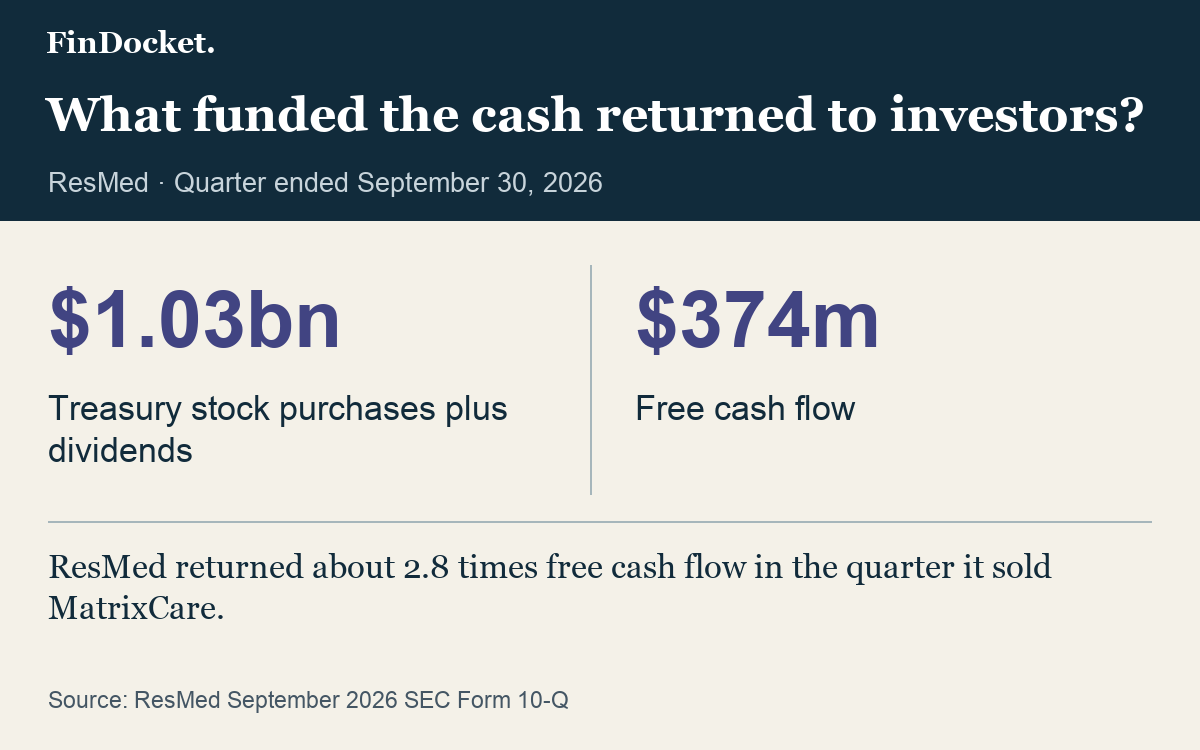
Quarterly operating cash flow was approximately $422 million, compared with $457 million. Free cash flow declined to $374 million from $414 million. The filing records $936.4 million of treasury-stock purchases in the cash-flow statement, $95 million of dividends and $250 million of debt repayment.
Repurchases and dividends together used approximately $1.031 billion, or roughly 2.8 times quarterly free cash flow. The gap against free cash flow alone was approximately $657 million, before the debt repayment and other investing or financing activity.
That calculation identifies the source-of-funds issue precisely. The distribution rate exceeded the amount generated from operations after capital expenditure during the quarter. Financing it therefore required sale proceeds, existing cash or other financial resources.
This is not inherently a poor allocation. Selling an asset can release capital that earns a better return through repurchases, debt reduction or investment elsewhere. The economic test is what shareholders gave up and what they received in exchange.
Sale proceeds are available once
ResMed received approximately $470 million of net cash at closing, with $8 million placed in escrow. The cash-flow statement reported $451 million of proceeds after subtracting cash divested with MatrixCare.
Using the cash-flow amount, divestiture proceeds plus quarterly free cash flow totaled approximately $825 million. That remained approximately $206 million below cash repurchases and dividends, before the $250 million debt repayment.
The sale proceeds and the $62 million accounting gain should not be added together as separate sources of cash. The gain measures proceeds relative to the disposed carrying value and related accounting effects; the proceeds measure the actual receipt.
The transaction also removes future MatrixCare earnings and cash from the portfolio. That makes a lower post-sale revenue base a structural change, not automatically a demand decline. Assessing the remaining business requires comparisons that reflect the sale and then tests whether the released capital earns an adequate return.
ResMed maintained its full-year outlook for 5%–7% core constant-currency revenue growth and non-GAAP EPS of $12.00–$12.25. The next test is stronger operating conversion within the remaining portfolio. The capital reset is tangible; its lasting value depends on recurring profit growth and the return earned on the cash released.