Business · Analysis
Sallie Mae Q3 2026: Record Lending, Lower Sale Profits
Sallie Mae's record originations accompanied a quarterly loss and lower guidance. Analyze loan-sale timing, credit provisions, collections and funding.

Sallie Mae's third-quarter 2026 loss came during a record lending season. That is the central tension in its earnings: new business creates acquisition costs and expected-loss provisions immediately, while loan sales and future collections determine how much of that investment returns to shareholders.
The quarter also contained a sharp decline in loan-sale gains and a continuing collection problem. Those items deserve separate treatment. Strong origination demand does not offset weak realized credit performance automatically, and the timing of sales can move quarterly profit substantially without a matching change in the underlying production franchise.
What changed in Sallie Mae's Q3 results?
The earnings release reports a $0.19 loss per common share, versus earnings of $0.63. Private education originations reached $3.4 billion, up 15%, with graduate lending up 119% following federal PLUS reform. Net interest income declined to $339 million from $373 million; non-interest income fell to $36 million from $173 million.
Calculated from those rounded income figures, the two revenue categories together declined $171 million. That provides a more complete starting point than explaining the loss solely through the cost of record originations.
Growth can burden a quarter, but the revenue generated from the existing portfolio and asset-sale program still matters. The investment case requires an explicit bridge from new production to the timing and amount of eventual earnings, including the balance sheet needed between origination and collection or sale.
How much did loan-sale timing affect profit?
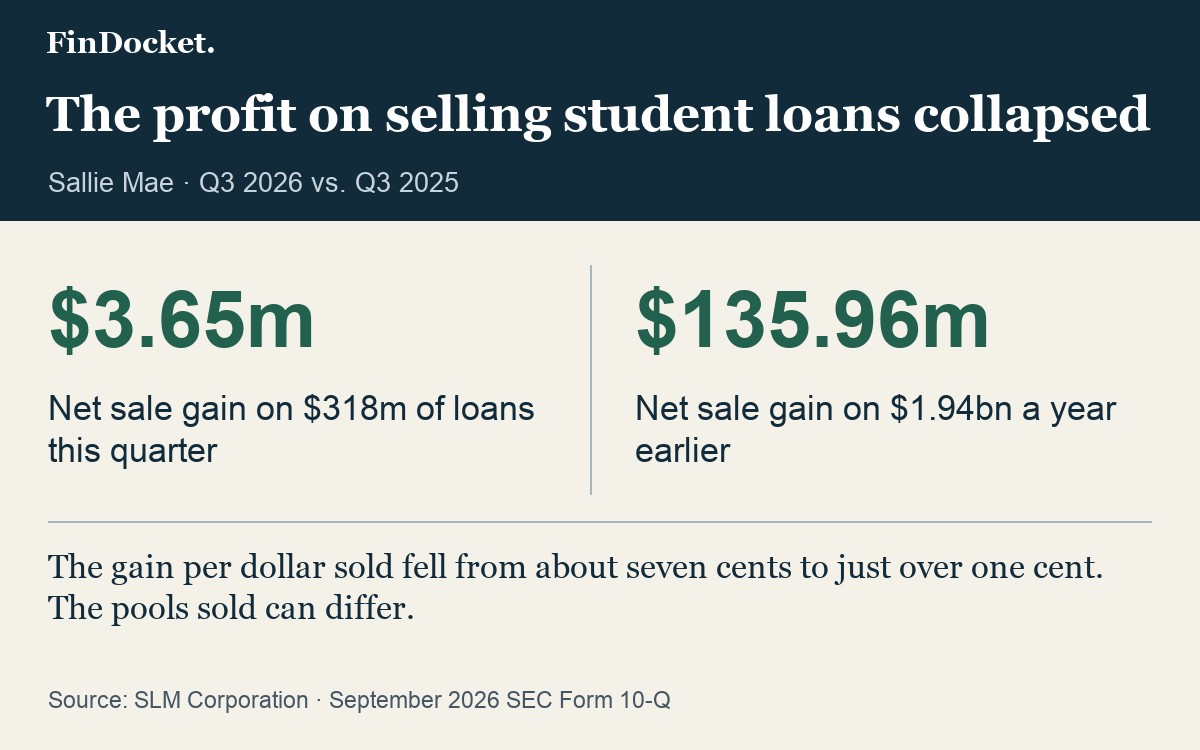
The quarterly filing reports $318 million of private education loans sold, including capitalized interest, versus $1.936 billion a year earlier. Net sale gains declined to approximately $4 million from $136 million. The filing also records reductions to the loan-loss provision from sales of $9.0 million, versus $118.8 million.
The roughly $132 million decline in sale gains accounts for most of the decline in non-interest income. The smaller reserve release adds another earnings effect, recorded through a different line.
These are related economic consequences of asset sales, but they should remain visible separately in an earnings model. The gain compares proceeds with the carrying amount under the applicable accounting. The reserve release reflects expected losses removed from the retained portfolio when the associated exposure leaves it.
Extrapolating a single quarter's gain would therefore create a fragile forecast. A sale-dependent earnings model needs assumptions for volume, portfolio characteristics, buyer pricing and the allowance attached to the assets. The comparison period's large sale contribution also makes this quarter's headline decline look different from a pure deterioration in ongoing interest spreads.
Why do unfunded commitments matter?
The filing divides the $213.7 million total credit provision into $60.4 million for loan losses and $153.2 million for unfunded commitments. In the prior-year quarter, those amounts were $24.7 million and $154.8 million, respectively.
The distinction prevents a misleading explanation. Calculated from the filing, approximately $35.7 million of the year-over-year increase came from the loan-loss component, while the unfunded component declined slightly. The latter was large in absolute terms in both periods.
An approved education loan can require disbursements later in the academic cycle. Expected losses on that commitment can therefore affect earnings before the full asset appears as funded principal. The resulting provision is economically connected to future exposure, even though the related cash funding and interest collections occur on a different schedule.
Investors should track funded balances and commitments together. Looking only at loans already on the balance sheet understates the production pipeline and the resources needed to fulfill it. Looking only at the provision overstates what has already become a realized credit loss.
What does the collection problem mean for credit quality?
Management attributes increased defaults partly to third-party debt-resolution practices affecting some borrowers it considers able to pay. The SEC filing says Sallie Mae paused most third-party recovery activity while developing a different approach. The earnings release reports $90 million of net charge-offs and says borrower adoption of its new strategies has been slower than anticipated.
Management's explanation identifies a behavioral and servicing issue, but the economic loss remains with the loan owner. A borrower's measured ability to pay does not produce cash unless the payment is actually collected.
Changing recovery practices can also alter timing. Lower recoveries today may reflect a deliberate pause, a reduced collection opportunity or both. The next useful evidence is the cash recovered and the progression of affected borrowers through repayment, modification and default.
The distinction between underwriting and servicing is essential here. Strong initial credit characteristics can support a lending thesis, while execution after origination still determines realized returns. A forecast should test both rather than assuming one guarantees the other.
Does funding capacity equal completed loan sales?
The quarterly filing reports $900 million outstanding under a new warehouse facility, with $600 million of additional capacity. The pledged loans remain on the consolidated balance sheet because the financing did not qualify as a sale.
A warehouse provides time and funding to hold eligible assets before their disposition. It does not complete the disposition or lock in the ultimate sales margin. The lender continues to carry assets and financing costs while preparing or awaiting the transaction.
For shareholders, the relevant sequence is origination, interim financing, sale or retention, and eventual capital release. Each stage has different economics. Borrowing proceeds increase liquidity and debt together; they are not operating profit.
What does the revised outlook imply?
Sallie Mae cut full-year EPS guidance to $1.95–$2.05 from $3.10–$3.20. It retained 12%–14% origination growth guidance and raised expected net charge-offs to $400–$420 million from $365–$385 million. Quarterly non-interest expense rose to $221 million from $180 million.
The midpoint earnings reduction is approximately 37%, despite an unchanged lending-growth range. That divergence makes the issue clear: more volume has not translated into the earnings previously expected.
The next test is conversion. Sallie Mae must turn its record production into satisfactory sale proceeds or sustained interest returns, improve collections and cover the operating resources committed to expansion. Demand is already visible. The missing proof is the retained shareholder return on that demand.