Business · Analysis
Serabi’s Q3 Profit Falls Despite Higher Gold Revenue
Serabi’s quarterly EBITDA fell as costs absorbed higher revenue. A Coringa trucking limit now shapes the miner’s year-end production outlook.
Serabi’s November 27 results show why higher gold revenue does not automatically translate into higher mining profit. Third-quarter revenue increased to $45.834 million from $41.996 million, while EBITDA fell to $16.320 million from $21.858 million. Those figures imply revenue growth of 9.1% and an EBITDA decline of 25.3%, calculated by FinDocket.
What happened to quarterly margins?
Dividing EBITDA by revenue gives a Q3 margin of 35.6%, against 52.0% a year earlier: a contraction of approximately 16.4 percentage points. The comparison isolates the latest quarter rather than blending it with stronger earlier trading.
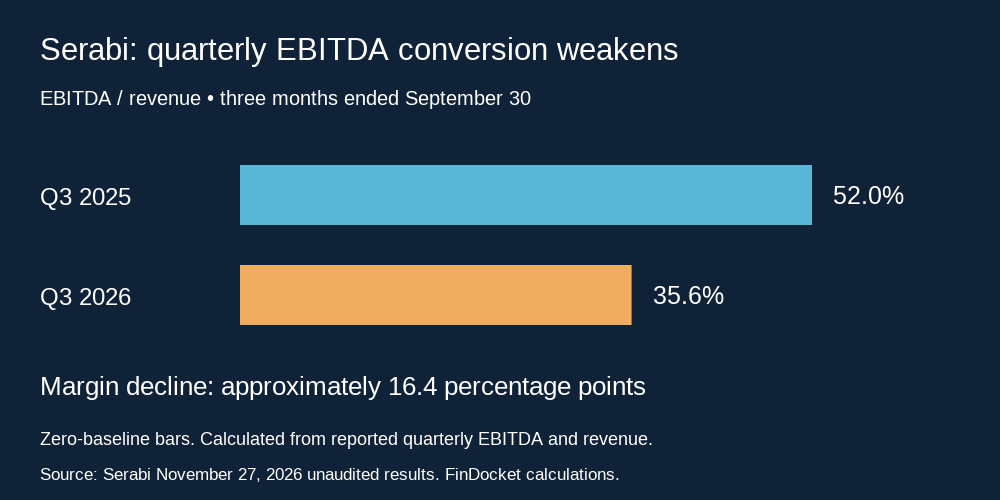
Nine-month profit after tax still rose to $39.9 million from $34.9 million. That cumulative improvement and the weaker latest quarter can both be true. A valuation based only on year-to-date growth would miss the deterioration in the most recent earnings period.
What constrains the next quarter?
The company’s revised annual production guidance is 39,000–40,000 ounces. It assumes December suspension of Coringa ore trucking to Palito when the existing 100,000-tonne allowance is reached. The current GUIA licence expires January 29, 2027; permanent operating-permit work remains in progress.
The tonnage ceiling and licence expiry are separate constraints. Extending a date would not by itself prove that additional trucking tonnage has been authorized. The decisive disclosure is the actual permission granted and its operating scope.
What should the next disclosure establish?
Management reported $63.2 million of September-end cash and no debt. That balance provides financial capacity, but it does not remove the production constraint. Cash held at a reporting date also differs from cash generated during a quarter.
The next assessment should pair the permitting decision with shipped ounces, unit costs and quarterly EBITDA conversion. Higher prices can support revenue while an interruption lowers throughput and leaves more fixed cost to absorb per ounce. The present figures establish a profitable miner with a weaker quarterly margin; the operating authorization will determine how much production capacity it can use next.