Business · Analysis
SKF Vertevo’s Listing Puts the Automotive Margin Plan on Its Own
SKF Vertevo is set to trade on December 1 after a one-for-five distribution. Its margin and leverage targets define the new standalone investment case.
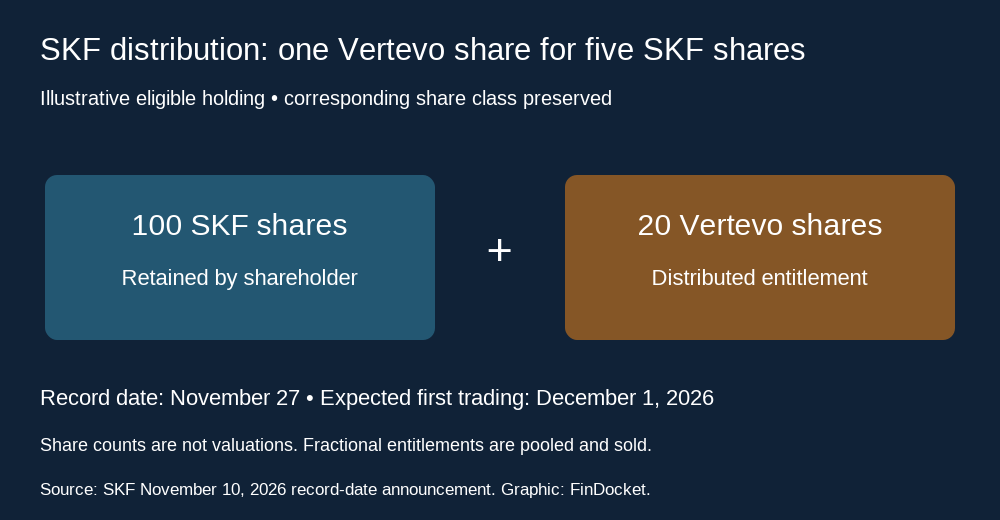
SKF Vertevo is expected to begin trading on Nasdaq Stockholm on December 1, following the November 27 distribution record date. SKF shareholders receive one Vertevo share for every five SKF shares of the same class. The separation gives the automotive business its own market valuation and makes its published profitability targets directly accountable to a separate shareholder base.
What changes in a shareholder’s account?
SKF’s November 10 notice says the last trading day carrying the distribution right was November 25; SKF shares have traded without that right since November 26. The new shares use the short names SKFVER A and SKFVER B. Fractional entitlements are pooled and sold, with proceeds distributed proportionately through Euroclear.
An eligible holding of 100 SKF shares of one class therefore produces 20 corresponding Vertevo shares. That ratio does not mean the automotive operation represents one-fifth of the parent’s value. A share-count ratio establishes units of ownership, while market prices determine their value.
Which financial targets matter?
Vertevo’s listing release targets adjusted operating margin above 6% in the medium term and at least 8% over the long term. It also targets net debt below one times adjusted EBITDA and says listing net debt should be around zero after certain subsequent transactions. Those are management objectives and an expected opening position, rather than achieved future results.
On an illustrative SEK10 billion revenue base, a two-percentage-point margin increase adds SEK200 million of operating profit before changes in the sales base. That sensitivity shows why execution on margins can matter independently of headline revenue growth. It is not an estimate of Vertevo’s revenue or earnings.
The targets also call for adjusted returns on capital employed of 10%–13% in the medium term and above 15% longer term. Profitability and capital efficiency must therefore be assessed together: higher operating profit can still deliver weak returns if the assets and working capital required to produce it expand too quickly.
How should investors compare the split companies?
The October distribution resolution says SKF’s automotive segment moves into discontinued operations and assets and liabilities held for distribution in its third-quarter reporting. Comparing the remaining company’s continuing revenue with an earlier group total would mix different business boundaries.
A shareholder’s economic comparison should likewise include both retained SKF stock and the new Vertevo entitlement, plus any fractional proceeds. Looking only at the parent’s ex-distribution price can mistake a transfer of value between securities for a loss in the combined holding.
After listing, separate reporting should establish operating margins, cash conversion and standalone costs. The market’s first pricing decision will allocate value between two businesses; the subsequent results will establish whether the automotive operation’s margin and capital-return ambitions justify that allocation.