Business · Analysis
Snowflake Q2 FY2027 Earnings: AI Demand and Supplier Costs
Snowflake's SEC filing connects accelerating consumption growth with AI supplier minimums, cloud commitments and the cash economics behind fiscal 2027 guidance.

Snowflake's latest earnings show accelerating demand for its data platform. The SEC filing also describes a growing commitment to buy the infrastructure and AI services needed to deliver that demand. The investment case depends on matching those supplier obligations with profitable customer consumption.
As of November 28, the latest reported quarter ended July 31. Snowflake is scheduled to report its October quarter on December 2. The July results establish the starting point for assessing whether stronger AI adoption can produce both revenue growth and cash returns after the cost of supplying those workloads.
What did Snowflake report for fiscal Q2 2027?
Product revenue reached $1.492 billion, up 37%, with net revenue retention of 126%. GAAP operating loss was $263 million, compared with adjusted operating profit of $237 million. Product gross margin was 70.9% under GAAP and 74.7% adjusted. Management raised full-year product revenue guidance to $6.070 billion and adjusted operating margin guidance to 14.5%.
The results provide evidence of customer demand, but gross margin is the first bridge between demand and economic value. A workload that generates additional revenue also consumes computing, model access, storage or other delivery resources. Its contribution depends on the price charged relative to those costs.
Operating profit then asks whether the remaining contribution covers research, selling and administration. Growing consumption can improve that relationship when the platform serves more activity without a matching increase in overhead. It can also require more engineering and commercial spending before the full benefit arrives.
The GAAP and adjusted operating results answer different versions of that cost question. The gap should be reconciled before treating either as a complete measure of owner earnings. Expanding adjusted margins demonstrate progress under management's definition; closing the GAAP loss requires covering the expenses excluded from that measure as well.
Why consumption changes the meaning of backlog
The filing says revenue is generally recognized as customers consume resources, rather than evenly through a subscription term. Remaining performance obligations were approximately $9 billion, with about 54% expected to become revenue within twelve months based on historical consumption. Customers can sometimes roll unused capacity into renewed contracts.
A contract establishes a commercial relationship and future purchase obligation. It does not necessarily prescribe the precise quarter in which the customer will run a workload. That distinction makes contracted revenue valuable for visibility without making it identical to a fixed quarterly subscription schedule.
For an investor building a forecast, the useful sequence is commitment, deployment and consumption. A large commitment may precede an extended implementation. An existing customer may also consume rapidly and return for more capacity earlier than originally expected.
The expected conversion of backlog is therefore a model of behavior, rather than a complete schedule of invoices and revenue. Comparing consumption growth with backlog growth can reveal a change in that behavior, but neither measure should replace the other.
What did Snowflake commit to AI suppliers?
The company amended a three-year AI service agreement to a $390 million minimum purchase commitment, with $270 million remaining at July 31. Annual shortfalls must be paid. A cloud infrastructure agreement carries a $6 billion five-year minimum commitment, while an amendment extends certain storage obligations into 2036.
These agreements create a mismatch worth analyzing: the supplier can have a contractual floor while the timing of customer consumption remains flexible. A minimum is inexpensive when enough profitable demand uses the purchased capacity. It becomes a cost burden when activity falls below the level needed to absorb it.
Long-term commitments can also improve economics. A supplier may offer better pricing or access in exchange for predictable spending. The return depends on whether those benefits exceed the value of the flexibility surrendered.
The commitment totals should not be added together indiscriminately. Contract periods differ, and some services accessed through public cloud providers may count toward the AI agreement. A valid liquidity analysis must map payment dates and overlapping credit provisions before estimating incremental cash requirements.
Can efficiency help customers while slowing revenue?
The 10-Q explains that improved compression, processors and compute optimization can reduce resources required for existing workloads. Growth then depends partly on additional workloads offsetting that efficiency.
That relationship is fundamental to usage-based pricing. Making a query cheaper to run can lower the bill for the same task. The business benefits when the lower cost encourages enough extra activity, improves retention or attracts new customers.
An illustrative example makes the threshold clear. If revenue per unchanged workload falls 20%, workload volume must rise 25% simply to preserve revenue. The calculation divides the original revenue level by the new 80% price level. This is a general sensitivity, not a projection of Snowflake's pricing.
The profit result depends on delivery cost as well. If the supplier cost per workload falls faster than customer pricing, contribution can improve even without equivalent revenue growth. If pricing falls faster than input cost, more activity may produce weaker margins. Measuring AI adoption without its delivery economics misses this distinction.
Why quarterly cash flow needs a wider view
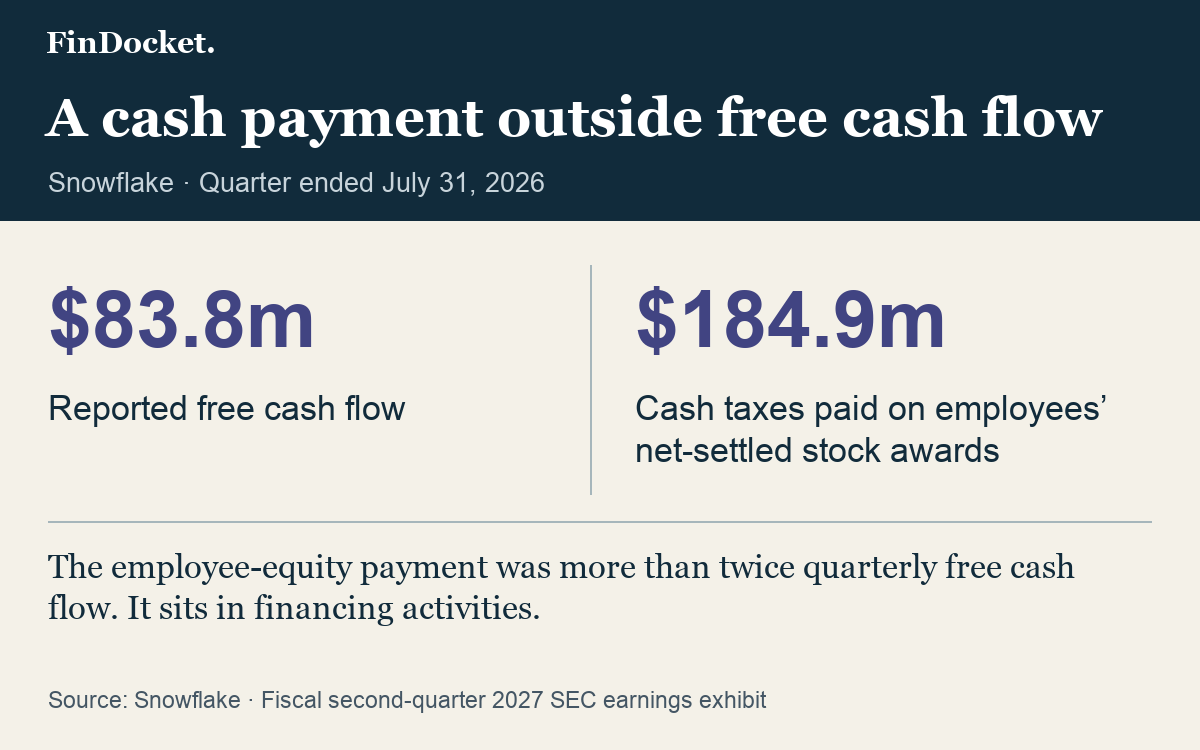
Quarterly free cash flow was $83.8 million and adjusted free cash flow $92.3 million. First-half amounts were $316.6 million and $357.8 million. Snowflake's reconciliation excludes $184.9 million of quarterly employee equity tax settlement cash classified in financing. The filing also describes historically stronger free cash flow in the first and fourth fiscal quarters.
The weak seasonal quarter should not be annualized mechanically. Nor should a positive adjusted subtotal be treated as the cash remaining after every equity-related payment. Collection timing, payroll-tax timing and the settlement of share awards each affect different lines of the statements.
The practical test is a full operating cycle: customer collections must cover supplier spending, personnel and investment, with enough retained value to compensate shareholders. Strong consumption growth gives Snowflake a larger revenue base over which to spread platform development. The supplier commitments make utilization and unit margins more important as that base expands.
The December report will offer the next measurement of that balance. The strongest evidence would combine continued consumption growth with healthy delivery margins and cash conversion consistent with the annual plan. Adoption establishes the opportunity; profitable utilization determines the return.