Business · Analysis
S&P Global Q3 2026: Index Profit and the Capital IQ Review
S&P Global's SEC filings reveal index growth, minority ownership claims and slower underlying EPS growth. Analyze its continuing businesses and Capital IQ review.

S&P Global's third-quarter 2026 results show strong growth in its index franchise alongside a significant portfolio change and a new strategic review. The most useful financial reading distinguishes profit generated by the consolidated businesses from the portion attributable to S&P Global shareholders.
That distinction is particularly important in Indices, where minority ownership affects the profit retained. It also matters at the company level, where asset-sale gains and repurchases produced faster reported EPS growth than the increase in adjusted net income.
How strong was the underlying earnings increase?
The earnings release reports revenue of $3.678 billion, up 7%, and GAAP diluted EPS of $4.45, up 26%. Adjusted EPS increased 9% to $4.58, while adjusted net income increased 4%. A disposition gain in Energy supported the GAAP result, and a lower diluted share count amplified per-share growth.
The difference between adjusted income and adjusted EPS growth identifies the role of the denominator. More earnings and fewer shares both improve EPS, but they are distinct sources of growth with different conditions for repetition.
The asset-sale contribution also differs from recurring operating profit. Selling a business or investment can realize value, but that gain cannot be projected as though it were revenue earned from serving the same customers next quarter.
The recurring result is therefore more restrained than the headline GAAP EPS growth. That does not negate the value realized through the transaction; it clarifies what the continuing operating platform must generate on its own.
What changed in the company's reporting perimeter?
The release says the Mobility spin-off became effective July 1, creating Mobility Global as an independent public company. Its historical results have been reclassified as discontinued operations, with continuing-operation comparisons recast.
The distinction prevents an invalid comparison between the latest smaller business perimeter and an unrecast historical total that included the separated operation. Revenue, margins and earnings need to be compared on the same basis.
For shareholders who received the distributed company, the overall economic interest also extends beyond the remaining S&P Global shares. Evaluating the continuing company and evaluating the combined value of the separation are related but different tasks.
A continuing-operations analysis asks what earning power remains. A separation analysis also considers the distributed business, transaction costs, capital arrangements and the loss or retention of shared services. Mixing the two can make a reporting change look like an operating change.
Why is Indices central to the growth story?
The 10-Q reports Indices revenue of $554 million, up 20%. Asset-linked fees increased to $375 million from $303 million. Segment operating profit reached $388 million, compared with $313 million, with a reported 70% operating margin.
Asset-linked fees contributed $72 million of the $92 million revenue increase, or approximately 78%. That calculation shows the importance of the assets supporting licensed index products to the quarter's growth.
Those assets can increase through investment flows, market appreciation or both. The associated fees should not be interpreted solely as evidence of new customer mandates or higher pricing.
The strong margin shows the earning capacity of the benchmark and licensing model at the segment level. It still needs to be translated into the economic interest attributable to the parent company's shareholders.
How much index profit belongs to S&P Global?
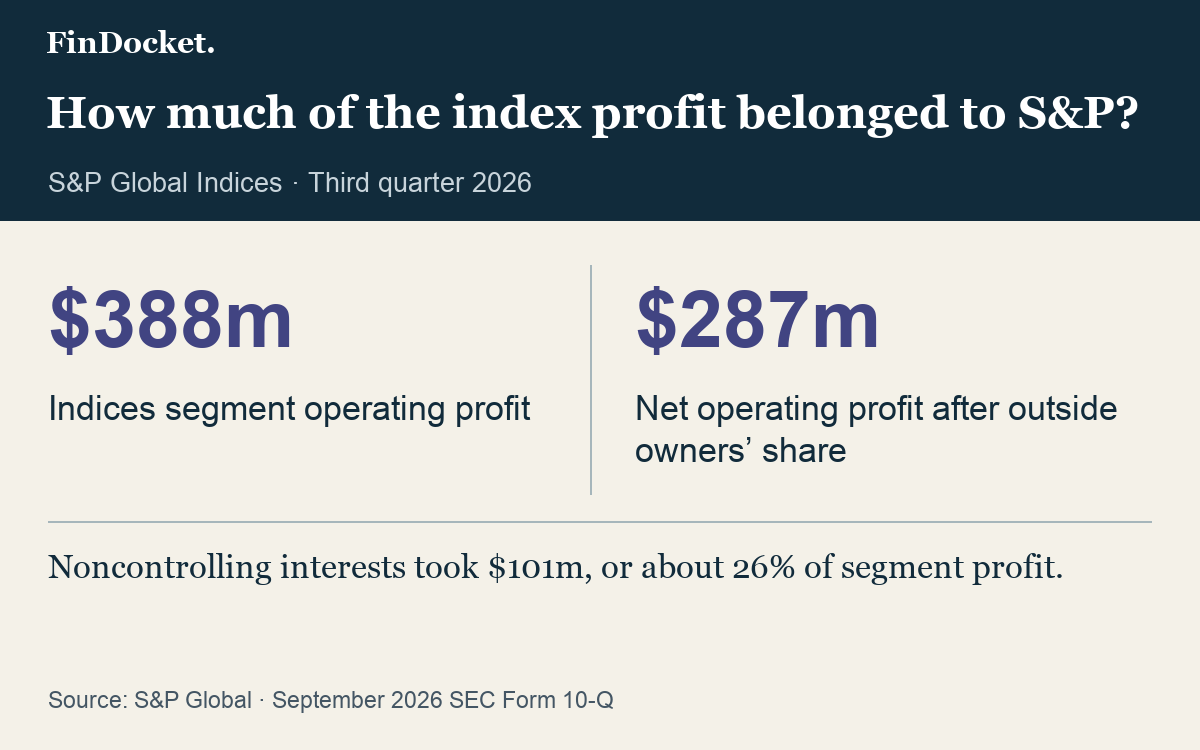
The 10-Q deducts $101 million of net operating profit attributable to noncontrolling interests from the $388 million segment operating profit, leaving $287 million of net operating profit. The prior-year net figure was $230 million.
Approximately 26% of the reported segment operating profit was attributable to minority interests under this presentation. Using the full $388 million as though it all belonged to S&P Global common shareholders would overstate the retained contribution.
The net contribution still increased approximately 25%, demonstrating strong growth after the specified ownership allocation. The ownership adjustment changes the amount, rather than eliminating the operating improvement.
This principle is important in valuing partially owned businesses. Consolidation can include all revenue and expenses because of control, while another investor retains an economic claim on part of the earnings. A sum-of-the-parts valuation must align the earnings used with the ownership being valued.
What does the revenue mix imply about resilience?
The 10-Q reports subscription revenue increasing 6% to $1.719 billion. Ratings transaction revenue increased only 1% to $677 million, while non-transaction revenue increased 4% to $594 million.
The components therefore moved at different rates. A subscription relationship has different drivers from fees tied to new debt issuance, while non-transaction ratings revenue includes ongoing services and other activity.
A diversified information business can benefit when one market slows and another expands. That diversification should be measured through actual segment and product contribution rather than assumed from the number of businesses owned.
For forecasting, recurring subscriptions provide one base, transaction activity another and asset-linked fees a third. Each needs its own assumptions about retention, pricing, activity and market values. A single consolidated growth rate hides the sensitivity of those components.
What does the Capital IQ review mean financially?
The earnings release announces a review of alternatives, including possible separation, for Capital IQ and associated data businesses. S&P Global expects to retain RatingsDirect, RatingsXpress and Enterprise Solutions, while the exact perimeter remains under review.
The announcement does not establish a sale price or completed transaction. The financial question is whether a different ownership structure creates more value after separation costs, lost shared benefits and the capital needed by each resulting business.
A potential transaction also changes what would remain in the parent. An analyst should avoid combining a hypothetical disposal value with earnings that still include the same business, since that would count the asset twice.
S&P Global's quarter demonstrates strong index economics and continued subscription growth. The next return test is how well it converts those earnings into value for its own shareholders while reshaping the portfolio. Ownership allocations, continuing-operation comparisons and the eventual terms of any Capital IQ transaction will determine that result.