Business · Analysis
Synchrony Q3 2026: Better Credit, Lower Retained Earnings
Synchrony's SEC filings explain why better charge-offs did not lift earnings: reserve comparisons, retailer sharing and costs absorbed the improvement.

Synchrony's third-quarter 2026 earnings illustrate why better borrower performance does not automatically translate into higher bank profit. Charge-offs improved, but the prior year's reserve release created a difficult comparison, retailer payments increased and operating expenses rose.
The central issue is the amount of program economics retained by Synchrony. Its partner model provides distribution and customer access, while sharing some of the resulting performance. A forecast that gives shareholders the full benefit of improving credit would miss that contractual structure.
Why did Synchrony's earnings fall despite better credit?
The SEC earnings release reports net earnings of $892 million, down $185 million, and diluted EPS of $2.68, versus $2.86. Net interest income increased $89 million, but retailer share arrangements rose $72 million, credit provision increased $120 million and other expense grew $123 million.
The first two changes largely offset: the additional partner sharing absorbed roughly 81% of the increase in net interest income. This is an aggregate earnings bridge, not a statement that those specific income dollars were contractually paid directly to partners.
Adding the higher provision and operating expense then explains why an improvement in one part of the lending model did not become higher consolidated earnings. The profit equation includes funding, credit, distribution and the resources needed to run the programs together.
EPS declined less than total earnings, indicating that the per-share denominator cushioned the comparison. That can support owners' results, but it does not eliminate the underlying reduction in profit produced by the business.
How did reserve accounting outweigh lower charge-offs?
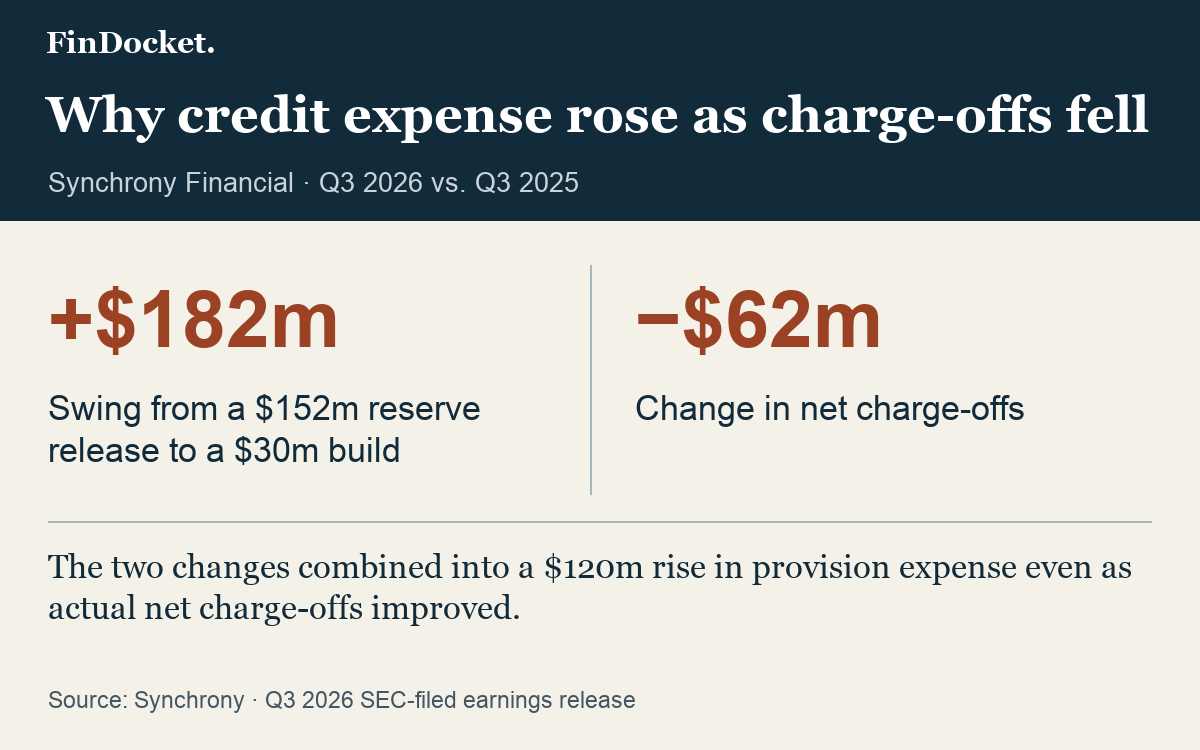
The release identifies a $30 million reserve build, compared with a $152 million release a year earlier. Net charge-offs fell $62 million. That combination increased provision expense by $120 million, while the net charge-off rate improved to 4.79% from 5.16%.
The reserve swing added $182 million to the expense comparison. Lower charge-offs offset $62 million, leaving the reported $120 million increase. The bridge demonstrates that higher provision expense did not mean realized credit losses deteriorated during the quarter.
Reserve releases recognize a reduction in the allowance judged necessary for future losses. They improve current earnings without creating a new stream of interest income. Once a large release enters the comparison period, subsequent earnings need additional operating improvement simply to replace that benefit.
The opposite timing can occur while balances grow. A lender can experience better current collections and still recognize a reserve build to support its remaining exposure. Provision expense and charge-offs consequently answer different questions about the portfolio.
The next earnings model should keep those questions separate. It should estimate losses realized on the loan book and the allowance needed for the balance sheet, then reconcile the two. Repeating the prior year's reserve benefit as an ongoing source of earnings would overstate the operating base.
Why do partners receive part of the credit improvement?
Synchrony's quarterly filing says the increase in retailer share arrangements reflected program performance, including lower net charge-offs. The release describes this as sharing the improvement with partners.
That structure aligns participants around the economics of their joint programs. Partners contribute customer relationships and the purchasing environment. Synchrony supplies underwriting, financing and servicing. Sharing the result can support the durability of those relationships.
For equity holders, the implication is specific: gross credit savings are not necessarily equal to retained credit savings. A forecast should incorporate the applicable program-sharing economics rather than applying the entire decline in losses to pretax profit.
The same mechanism can provide some offset when program performance weakens, depending on the arrangements involved. Its exact effect requires the actual contractual formulas and portfolio mix. A single fixed retention assumption applied across all outcomes would be too crude.
The quality of the distribution franchise should therefore be assessed after partner economics. Attractive customer access is valuable when the contribution retained after sharing provides an adequate return on lending capital and the operating platform.
Why did spending growth exceed loan growth?
The filing reports purchase-volume growth of 8.0%, average loan growth of 2.4% and loan yield of 21.69%, down 20 basis points. Higher payment rates limited receivable growth, while lower assessed late fees pressured yield. Funding costs declined to 3.93% from 4.20%.
Purchase volume measures activity through the programs. Loans measure unpaid balances remaining after repayments. Faster purchases can coexist with much slower loan growth when customers repay more quickly.
That distinction has two sides. Faster repayments can support credit performance and release funding capacity. They can also reduce the time balances earn interest, limiting the revenue generated from a given amount of purchase activity.
Lower late-fee incidence similarly combines customer behavior with revenue effects. A healthier repayment pattern can improve losses while reducing fee income. Evaluating either outcome alone would miss the total customer economics.
Lower funding costs supported the spread, but the asset-yield and balance changes still need to be modeled. An interest-rate forecast should follow both sides of the balance sheet, including the timing of deposit repricing and customer repayment behavior.
What do capital returns contribute to the investment case?
The filing reports $2.9 billion of nine-month share repurchases and $314 million of common dividends. Deposits supplied 83% of funding at September-end, while the earnings release reports a 12.9% common equity Tier 1 ratio.
Repurchases reduce the share count when they exceed issuance, helping distribute earnings across fewer claims. They create value when the price paid is attractive relative to the earning capacity and capital required by the business.
The capital ratio and funding structure define the capacity supporting those decisions. Neither guarantees an unlimited distribution stream. Loan growth and the capital retained for credit exposure remain part of the allocation equation.
Synchrony's credit improvement was real. Its lower earnings were also real. The quarter is best understood through the bridge between them: reserve timing, partner sharing, asset monetization and operating costs determined how much of the improving credit performance shareholders actually retained.