Business · Analysis
Terreno Q3 2026: Termination Fees and Development Returns
Terreno's SEC filing reveals the effect of termination fees on cash NOI growth. Analyze coastal development economics, new equity and dividend funding.

Terreno Realty's third-quarter 2026 results show growing earnings per share and strong rent increases on newly commenced leases. Two details sharpen the assessment: termination fees supplied a meaningful part of same-store cash income growth, and a newly completed New York development has an initial lease considerably shorter than its long-term physical life.
Those features do not negate the growth. They establish what needs to be sustained. Recurring rents must replace irregular fees, and development returns must survive renewal or replacement of the first tenant. The company's cash and equity funding provide the other half of that analysis.
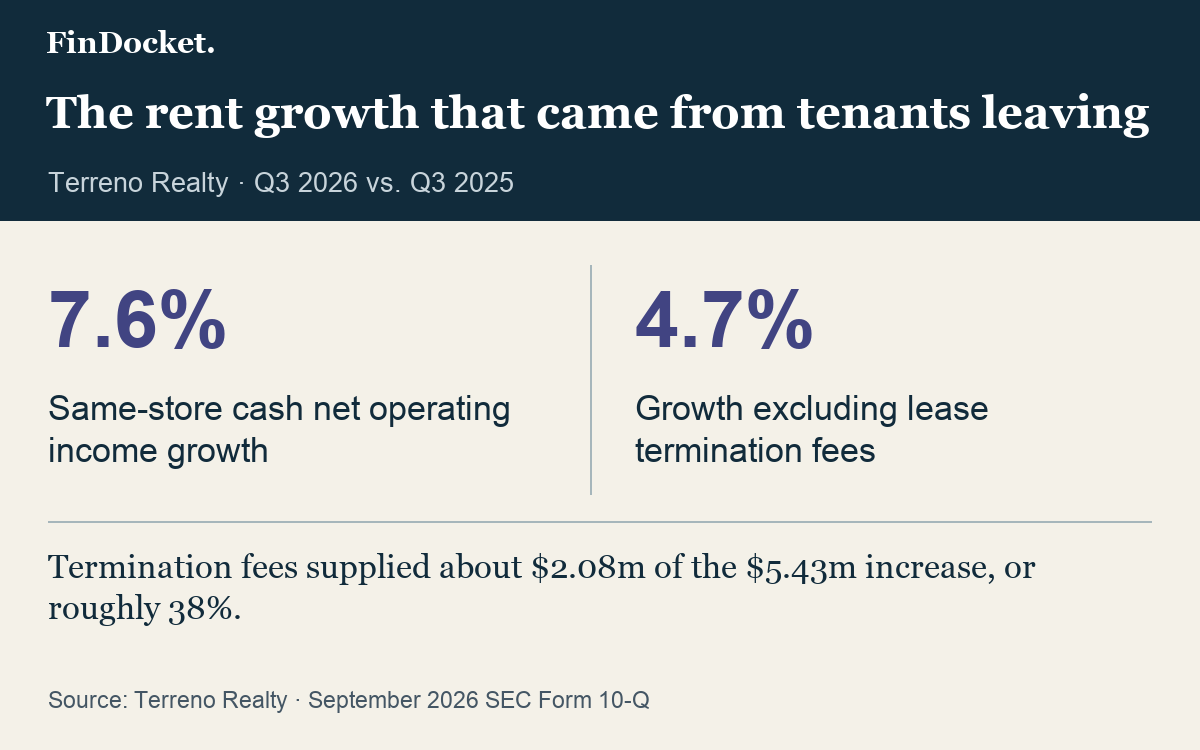
How much cash NOI growth came from termination fees?
The 10-Q reports quarterly cash-basis same-store NOI of $76.385 million versus $70.959 million, up 7.6%. Excluding termination fees, the comparison is $74.239 million versus $70.889 million, up 4.7%. Both are non-GAAP property measures.
Termination fees increased by approximately $2.08 million. That accounts for about 38% of the $5.43 million increase in the reported cash comparison. The recurring-rent picture is therefore positive, but less rapid than the unadjusted percentage suggests.
A termination payment compensates a landlord for ending a contract. It provides real cash at the time received. It does not automatically establish an equal recurring rent stream for future quarters, and the subsequent economics depend on whether the property is re-leased quickly at an attractive rate.
The 4.7% comparison excluding these fees is the cleaner starting point for judging the existing pool's income progression. It still includes other operational timing and portfolio-specific influences. Treating it as the base prevents a temporary settlement from being mistaken for a permanent increase in rental earning capacity.
Are existing shareholders benefiting from the expansion?
Quarterly FFO attributable to common shareholders was $78.519 million, up 13.8%. Diluted FFO per share increased 7.5% to $0.72. Net income fell 34.1% to $68.105 million as property-sale gains decreased. FFO is non-GAAP and removes those gains and real estate depreciation.
The difference between total and per-share FFO growth reflects the larger equity base participating in earnings. An expanding portfolio can produce double-digit total growth while delivering a more modest gain to each share. The positive per-share result is therefore more informative than asset growth alone.
The decline in net income answers a different question. A smaller sale gain reduces reported profit even when rental earnings improve. Disposal gains depend on what was sold and its accounting basis, so they should be assessed as capital outcomes rather than used to measure the recurring rent trajectory.
Terreno's operating update reports six million shares issued during the nine months for $398.9 million of gross proceeds. No shares were repurchased. This equity supplied cash for growth while increasing the denominator against which future property earnings must be measured.
What is the return on the completed Queens development?
Whitestone Logistics in College Point, Queens, represents $98.8 million of expected investment and a 6.4% estimated stabilized cap rate. Its 81,000-square-foot building, plus two indoor parking floors, was fully leased to an e-commerce tenant. The initial lease runs from July 2026 to July 2029.
At the estimated rate, the investment corresponds to approximately $6.32 million of annual stabilized property income. That is a property-level calculation, before corporate overhead and financing. It is not a guaranteed cash return or an estimate of shareholder profit.
The relatively short initial term makes residual leasing economics particularly important. The update identifies renewal options, but also permits termination with six months' notice in specified circumstances during the initial term. A fully leased development therefore does not provide the same contractual certainty as an unconditional long-duration lease.
The asset's coastal location and specialized configuration must support value beyond the first contract. Indoor parking can be useful for urban delivery operations, yet the ultimate return depends on continued demand and future rent. The economic assessment needs both the opening yield and the cost of keeping the building productive after the initial tenant decision.
Does the wider pipeline have leasing support?
Terreno reported three projects under development or redevelopment with $165.1 million of expected total investment, approximately 70.6% pre-leased. Its quarterly new and renewed cash rents increased 27.7%, with operating-portfolio tenant retention of 66.7%.
Pre-leasing reduces the amount of space entering completion without contracted demand. It does not remove the spending required to finish projects or the timing gap before collections begin. A project can be substantially committed and still consume capital for several more quarters.
The combination of strong rent spreads and moderate retention also deserves attention. Replacement tenants can pay more while requiring vacancy, commissions or improvements. The relevant return is the higher rent after those costs and any period without payment, rather than the spread in isolation.
How much cash remains after the dividend?
Nine-month operating cash was $218.062 million versus $201.596 million. Common dividends consumed $165.716 million. Construction spending was $48.299 million, while additions to buildings, improvements and leasing costs were $62.396 million.
Operating inflow grew 8.2%. Subtracting dividends leaves approximately $52.3 million. Deducting both identified property-spending lines produces a deficit of roughly $58.3 million before acquisitions, sales and financing. This is an analytical funding bridge; the spending includes growth investment and is not all recurring maintenance.
The calculation explains why equity proceeds matter even when the dividend is covered by operating cash. Terreno retains some rental cash, but its full investment program requires additional funding and asset recycling.
Terreno's quarter supports a measured operational conclusion: rental earning capacity is expanding, and per-share FFO is growing. The durable result depends on converting projects into collected rent, replacing termination income with repeatable earnings, and ensuring that new capital produces enough income to compensate the additional shares. Those are the connections that turn attractive coastal property demand into shareholder value.