Business · Analysis
Tesla Q3 2026 Earnings: Tariff Relief Masks Cash Pressure
Tesla's Q3 2026 SEC filing reveals tariff-assisted margins, rising research costs and cash pressure after investment. Analyze earnings and funding.
Tesla’s third-quarter 2026 earnings reveal a business investing faster than its current operating profits can support. Revenue was essentially flat, operating income fell sharply and tariff refunds helped reported gross margins. Nine-month operating cash flow improved, but capital expenditure consumed most of it.
The central issue in Tesla’s September-quarter SEC filing is the conversion of industrial and artificial-intelligence investment into future cash earnings. Today’s liquidity provides time to pursue that strategy. It does not establish that the returns will exceed the cost of the capital being committed.
Why did higher gross profit produce lower operating income?
Quarterly revenue was $28.046 billion, while gross profit reached $5.494 billion. Operating income was only $718 million. Research and development plus selling, general and administrative expenses absorbed approximately 87% of gross profit.
This is the crucial distinction between a manufacturing margin improvement and company-wide operating leverage. Better unit economics can coexist with weaker shareholder earnings when the research, commercialization and administrative cost base expands more rapidly.
FinDocket calculates an operating margin of approximately 2.6%. At that level, modest changes in price, utilization or spending can cause large percentage changes in profit. Revenue stability alone offers little protection against earnings volatility.
Research spending is an investment in economic terms, but it remains an expense under the accounting treatment used here. Excluding it simply because it targets future products would remove the very cost needed to create those products. The right analytical test is whether spending eventually produces additional gross profit and cash generation.
How much did tariff refunds help Tesla’s margins?
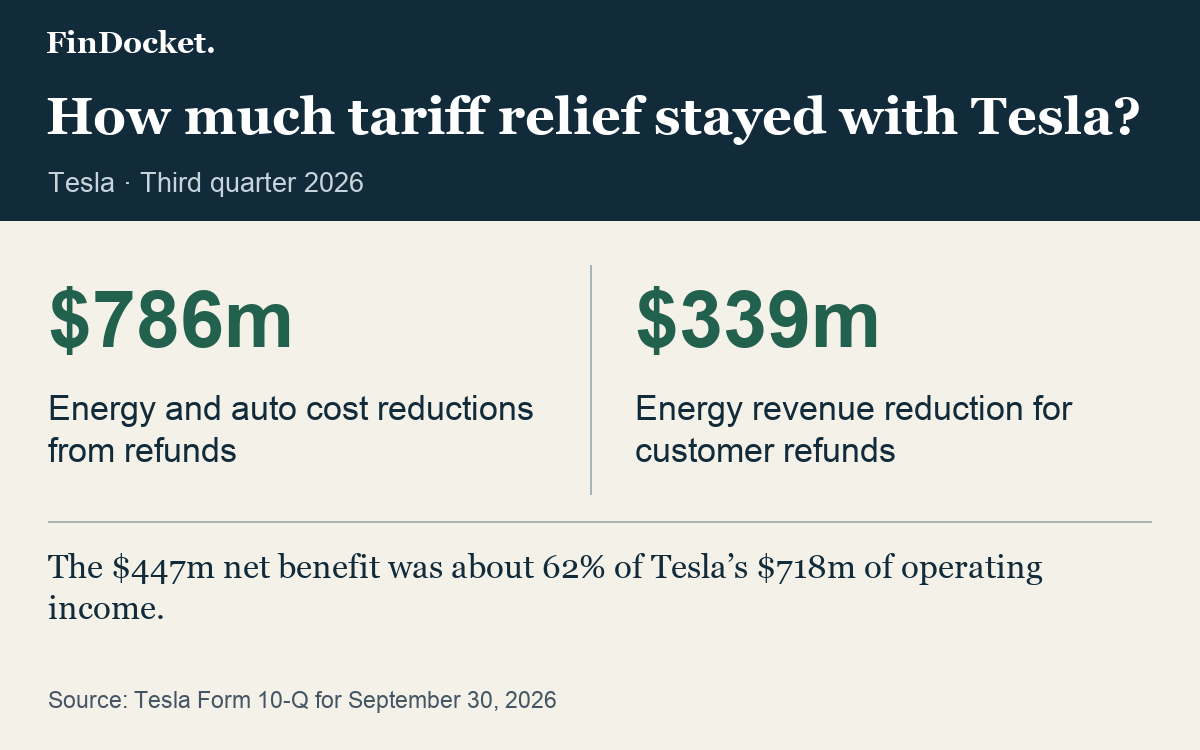
The filing reports $526 million of energy-related tariff refunds and $260 million of automotive-related refunds as cost reductions. Tesla also reduced energy revenue by $339 million for amounts contractually owed to customers.
Together, these items increased consolidated gross profit by approximately $447 million: $786 million of lower costs, less $339 million of lower revenue. Subtracting that benefit from reported operating income leaves approximately $271 million, before considering any other adjustments.
This is an analytical bridge, not a company-reported adjusted result. It shows why the full economic effect cannot be measured by looking only at the cost refund. A portion belongs to customers and reduces the revenue Tesla ultimately retains.
For energy storage, reversing both the revenue reduction and the cost refund produces an illustrative gross margin of approximately 23.8%, compared with the reported 33.1%. The difference is substantial enough to change the interpretation of the quarter’s profitability.
The broader lesson is about repeatability. Recovering a previously paid tariff restores value, but it is not evidence of an equivalent improvement in ongoing manufacturing efficiency. Future periods need to demonstrate their own pricing and cost economics.
Can services offset the vehicle slowdown?
Services and other revenue grew to $4.605 billion. Its calculated gross profit was $734 million, compared with $366 million a year earlier. That improvement offers a meaningful source of additional contribution beyond new-vehicle sales.
Still, a growing category must be assessed on retained profit, rather than revenue alone. Repairs, charging, insurance and other activities can require very different amounts of labor, equipment and working capital. The combined disclosure does not establish identical economics across all services.
Automotive regulatory-credit revenue fell to $113 million from $417 million. Credits provide revenue without the corresponding manufacturing cost of an additional vehicle, so their decline can pressure earnings disproportionately. A stronger underlying automotive business needs to replace that contribution through products and services customers buy directly.
The investment question is therefore whether service contribution and vehicle efficiency can grow quickly enough to fund a larger technology organization. Counting every dollar of services growth as equivalent to high-margin software would overstate the available evidence.
Why did cash remaining after investment decline?
Nine-month operating cash flow of $14.897 billion less $13.014 billion of property-and-equipment expenditure leaves approximately $1.883 billion. The comparable prior-year calculation leaves $4.800 billion. This cash measure declined approximately 61% even as operating cash flow increased.
Capital expenditure is not a permanent loss of value: productive assets can generate returns over many years. The immediate consequence, however, is that less internally generated cash remains available for acquisitions, financial investments or additional expansion.
Tesla also spent approximately $2.002 billion on its SpaceX equity investment. Subtracting that investment from the $1.883 billion remainder produces a small deficit before other investing and financing flows. That calculation separates the industrial investment budget from a separate allocation of capital to an affiliated company.
Working capital also matters. Accounts payable, accruals and other liabilities supplied substantial operating cash. Supplier and expense timing can support cash generation during expansion, but does not replace durable operating profitability. Investors should compare future cash flows with movements in these liabilities rather than assuming every improvement represents stronger customer economics.
Stock-based compensation creates another distinction. It preserves cash at the payment date while transferring economic value through equity. Its cash-flow addback should not be interpreted as a free source of funding.
What must improve next?
Tesla held approximately $45.4 billion of cash and short-term investments at quarter end. Its stated capital-expenditure expectation exceeds $20 billion for 2026, implying a demanding final-quarter investment pace after the first nine months.
New credit commitments increase financing flexibility. An undrawn facility is access to funding, however, rather than revenue or profit. Drawing it exchanges additional cash for repayment obligations and interest costs.
The clearest operating evidence would be stronger vehicle and service gross profit without unusual tariff benefits, followed by operating expenses growing more slowly than that gross profit. The clearest cash evidence would be operating generation covering the enlarged infrastructure and manufacturing budget.
Tesla’s balance sheet gives management room to execute. The next financial milestone is demonstrating that its expanded investment program can improve cash returns per dollar committed, while the existing business generates enough profit to support the transition.