Business · Analysis
Travelers Q3 2026: Buybacks and the Price of Capital
Travelers' Q3 2026 filings reveal strong insurance profits, substantial buybacks and investment losses in equity. We examine the price paid for per-share growth.

Travelers' third-quarter 2026 results show how a profitable insurer can deliver rising earnings per share while its reported capital absorbs a large investment loss. Its underwriting franchise remains strong. The more demanding question is whether repurchasing shares at a substantial premium to book value produces enough future earnings growth to justify the capital consumed.
This is a capital-allocation story with two distinct clocks. Insurance profits and investment income replenish capital over time. Repurchases spend that capital immediately, increasing each remaining share's ownership of future earnings. The price paid determines how much of that future ownership shareholders receive for every dollar that leaves the company.
How much earnings growth came from fewer shares?
Travelers' earnings release reports quarterly net income of $1.917 billion, versus $1.888 billion, while diluted EPS increased to $9.04 from $8.24. Diluted weighted average shares declined to 210.6 million from 227.5 million. Core income, a non-GAAP measure, increased to $1.947 billion from $1.867 billion. The combined ratio was 86.8%, and its underlying counterpart was 84.1%.
Total GAAP earnings increased approximately 1.5%, while EPS increased 9.7%. That difference is primarily the effect of the smaller share base. A simple illustration holds the earlier share count constant: current earnings divided by the prior denominator would produce roughly $8.43 per share before adjusting for income allocated to participating awards. The precise EPS reconciliation differs, but the economic conclusion is clear: repurchases provided most of the acceleration in the per-share headline.
There is nothing artificial about owning a larger portion of a business after other shareholders sell. It becomes attractive when that ownership is acquired at a price below its economic value. EPS growth alone cannot establish that condition. A company can improve EPS while reducing the value created per dollar of capital deployed.
What Travelers paid for the reduction
The Form 10-Q records approximately $1.50 billion of authorized-program repurchases at an average $376.01 per share during the quarter. It also reports $295 million of additions to net asbestos reserves, compared with $277 million a year earlier. Nine-month asbestos payments increased to $215 million from $171 million; ending net asbestos reserves were $1.435 billion.
The earnings release puts quarter-end book value at $141.48 per share and adjusted book value, excluding net unrealized investment gains and losses, at $172.47. Those are accounting reference points, not estimates of fair value. Nevertheless, the average repurchase price was approximately 2.66 times reported book and 2.18 times adjusted book.
Repurchasing above book value mechanically reduces book value per remaining share, all else equal. The company gives up more net assets than the proportionate net assets represented by the shares retired. The transaction can still create value if future returns on the remaining franchise exceed what the repurchase price requires. That is the appropriate hurdle.
Using the quarter's $9.04 EPS as a four-quarter illustration gives $36.16 of annualized earnings. Relative to the average repurchase price, that corresponds to a roughly 9.6% earnings yield. This is a sensitivity exercise, not an earnings forecast: catastrophe losses, reserve development and portfolio results vary substantially. Its purpose is to translate a large dollar buyback into a price for an earnings stream.
Reserve releases coexist with an expensive legacy
The earnings release reports $234 million of net favorable prior-year reserve development, including the asbestos addition. Adding the asbestos charge back implies approximately $529 million of favorable development elsewhere, assuming the disclosed net categories are combined on that basis. That distinction exposes the strength of favorable revisions in other books and the continuing cost of older asbestos exposures.
The asbestos addition exceeded the net reserve benefit for the whole company. Offsetting good and bad development is necessary for consolidated reporting, but it obscures how differently insurance vintages can behave. A mature liability can require more capital decades after the premium was collected, even when current products are performing well.
Nine-month asbestos payments increased approximately 26%, based on the filing figures. Dividing the ending reserve by that nine-month payment pace, annualized, produces roughly five years of coverage. This is merely a scale comparison; it is not an actuarial estimate of reserve adequacy. Settlement timing and future claim development prevent a simple payment multiple from measuring the final obligation.
That legacy matters to buyback analysis because capital supports the entire liability portfolio. New underwriting cannot be evaluated independently of obligations inherited from past underwriting. Strong performance in recent products provides capacity to absorb those revisions, but the absorption still consumes real earning power.
Investment marks change the capital picture
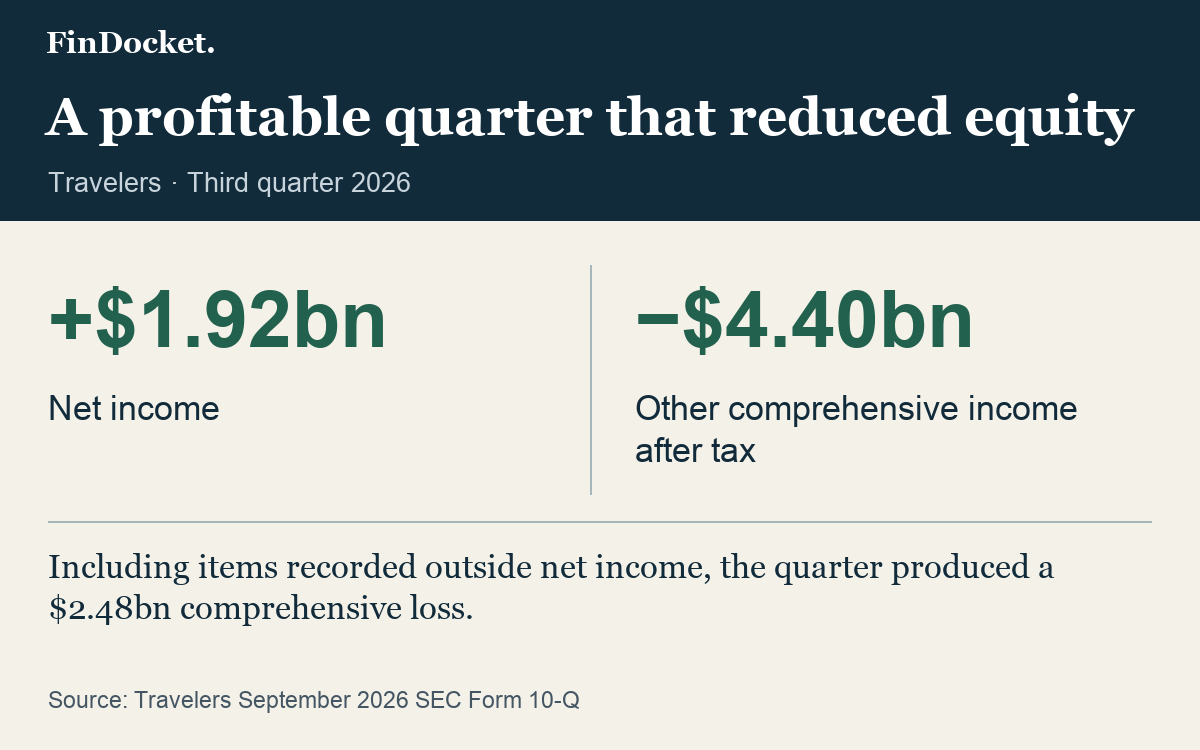
The 10-Q records quarterly other comprehensive losses of $4.395 billion and comprehensive losses of $2.478 billion despite positive net income. Quarter-end shareholders' equity was approximately $29.00 billion. The filing also reports $3.88 billion of third-quarter operating cash flow.
Positive cash generation and negative comprehensive income can coexist because they measure different things. Collecting premiums ahead of claim payments contributes cash available for investment. Falling security values reduce reported equity without requiring an immediate cash outflow. Neither number by itself describes the full economic result.
The mark-to-market decline therefore does not establish that Travelers must sell assets at depressed values. It does establish that capital distributions occurred alongside a substantial reduction in reported investment value. Liquidity, liability duration and expected claim payments determine how much room management actually has to wait for contractual bond cash flows.
The next test is value per dollar repurchased
Travelers' insurance margins provide a strong earnings base. Its share-count reduction is also producing a measurable per-share benefit. The next judgment requires more than extrapolating that benefit: current underwriting must remain profitable, reserve estimates must hold, and repurchased ownership must generate an attractive return at the price paid.
A smaller denominator can accelerate EPS immediately. The harder achievement is increasing long-term economic value after paying more than twice adjusted book for the shares retired. Travelers' Q3 filing makes that capital-allocation hurdle concrete.