Business · Analysis
Upstart Q3 2026: Marketplace Growth Has a Capital Cost
Upstart's SEC filings reveal growing fee earnings alongside retained loans, co-investment commitments and new secured borrowing. Analyze the capital bridge.

Upstart's third-quarter 2026 earnings show improving fee economics, including a positive contribution margin in secured products. The balance sheet explains the other side of that growth: the marketplace still commits capital through retained loans, co-investments and financing arrangements.
The distinction matters for valuation. A platform can earn attractive fees while supplying part of the capital or risk support needed to sustain activity. The return to shareholders depends on both the fee engine and the amount of their capital committed behind it.
How much did Upstart's fee engine improve?
The earnings release reports originations of $4.1 billion, up 44%, and fee revenue of $364 million, up 41%. Contribution profit reached $218 million, up 48%, at a 60% margin. GAAP operating income increased to $36.0 million from $23.7 million, while net income reached $36.6 million.
Contribution profit deducts borrower acquisition, verification and servicing costs from fee revenue. Its faster growth than fees indicates improved conversion after those specified direct costs.
The measure does not, however, deduct the entire cost of running the organization. The substantial difference between contribution profit and operating income shows the resources required for product development, corporate operations and other expenses outside that calculation.
For forecasting, the useful bridge begins with qualified borrower demand and funded originations, moves through fees and direct acquisition economics, then accounts for the wider operating system. An improving contribution margin is evidence of progress within that bridge, rather than the final shareholder margin.
Are secured products already a scaled profit engine?
Upstart's release reports a positive 17% contribution margin for auto and home products, versus negative 35% in the preceding quarter. Unsecured lending generated $212 million of contribution profit at a 64% margin.
The secured-product improvement is a meaningful milestone because it indicates that revenue exceeded the included direct costs. It is a different claim from achieving consolidated profitability or an adequate return on all development capital.
Unsecured lending still supplied almost all of consolidated contribution profit. Comparing its $212 million with the $218 million total leaves roughly $6 million outside that category, subject to rounding and the definitions used. The newer products' strategic significance therefore exceeds their current dollar contribution.
That is common during expansion, but it creates an execution test. New products must scale without losing the direct economics just achieved, while eventually covering the investment required to develop them. A positive percentage on a small base cannot yet carry the broader earnings model.
Why does a marketplace still hold loans?
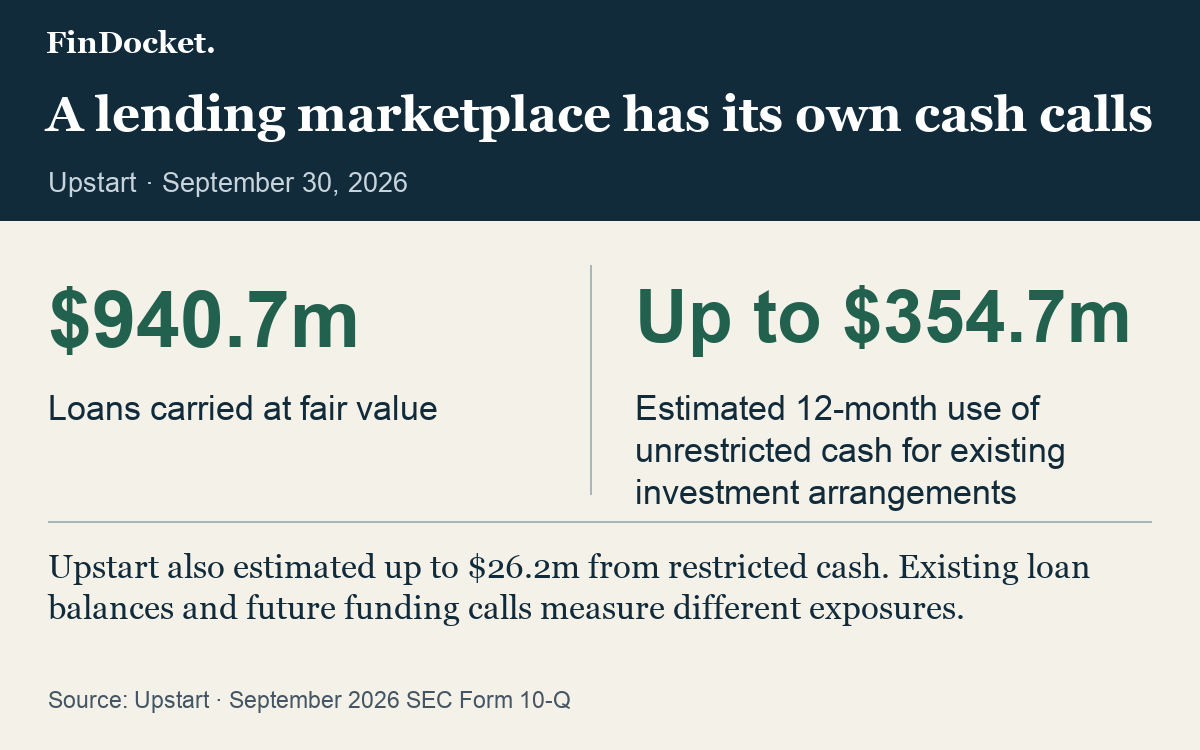
The quarterly filing reports $940.7 million of loans: $482.6 million for research and development, $429.2 million of other loans and $28.9 million inside a consolidated securitization. Management says capital supports product testing and can bridge gaps between origination and outside funding.
These categories serve different purposes. Research loans help evaluate models and products. Other retained loans can connect borrower demand with the timing or availability of external buyers. Securitization holdings arise through another funding structure.
Their presence means the balance sheet participates in the lending process even when most business is fee based. Calling the model a marketplace does not eliminate asset exposure or the need to finance assets while they remain held.
Loan balances alone also understate the full analysis. Commitments, beneficial interests and collateral arrangements can create exposure without appearing in the same line. The relevant capital map follows the contractual economics across all those forms.
How large are the co-investment cash requirements?
Upstart's filing estimates up to $354.7 million of cash requirements over the following year from cash and equivalents for existing committed-capital and co-investment arrangements, plus $26.2 million from restricted cash. It reports aggregate maximum loss exposure of $1.499 billion under severe hypothetical circumstances.
The estimated cash deployment and maximum exposure are different measures. One addresses potential funding over a defined period. The other describes a contractual extreme, rather than a forecast of expected losses. Adding them as though both were immediate payments would misrepresent the disclosure.
The funding estimate is nevertheless material relative to available corporate resources. It explains why a fee-growth forecast must include a balance-sheet schedule. Committing capital to support investor arrangements can help sustain originations, but it changes how much of the fee stream is available for other uses.
The economic question is the incremental return generated by that support. If capital commitments enable profitable volume that would otherwise be unavailable, they can create value. Their return must be measured after expected losses, funding costs and the duration of the commitment.
What changed with the October financing?
The earnings release reports September cash and equivalents of $461.5 million and restricted cash of $667.0 million. The quarterly filing subsequently discloses a new $200 million secured revolver, with $175 million drawn in October. Its purposes include flexibility during Upstart Bank's initial capitalization, which remains subject to regulatory approvals.
The September cash balance and later borrowing are different dated observations. The draw adds funding capacity and an obligation; it should not be retroactively included in quarter-end cash or treated as operating cash generation.
Restricted cash likewise has to remain tied to its permitted uses. Combining it with unrestricted corporate liquidity would overstate flexibility. A sound forecast distinguishes each cash pool, expected collections, scheduled investments and financing requirements.
Bank formation could change the future funding structure, but the disclosed approval and capitalization process must be modeled as such. The current earnings base and current financing obligations exist before that potential change is complete.
Upstart's quarter showed better direct fee economics and progress in newer products. Its capital disclosures show what supports the expansion. The lasting return will depend on converting that operating progress into earnings after the funding, retained exposure and shareholder capital required to maintain the marketplace.