Business · Analysis
Williams Q3 2026: Power Capital Has an Ownership Cost
Williams' Q3 SEC filing explains Pantheon's outside financing, power-project lease income and why dividend coverage differs from funding the full growth program.

Williams' third-quarter 2026 results show its natural-gas infrastructure business expanding into customer power supply while funding a much larger investment program. The central financial issue is ownership: outside capital can accelerate construction and reduce the amount Williams must supply, but it also gives another investor a claim on future project economics.
That makes consolidated growth an incomplete measure of shareholder progress. The more revealing questions are how much cash belongs to Williams after partner claims, what the new assets must earn and whether the dividend remains comfortably funded while construction spending rises.
Pantheon financing exchanges future economics for current capital
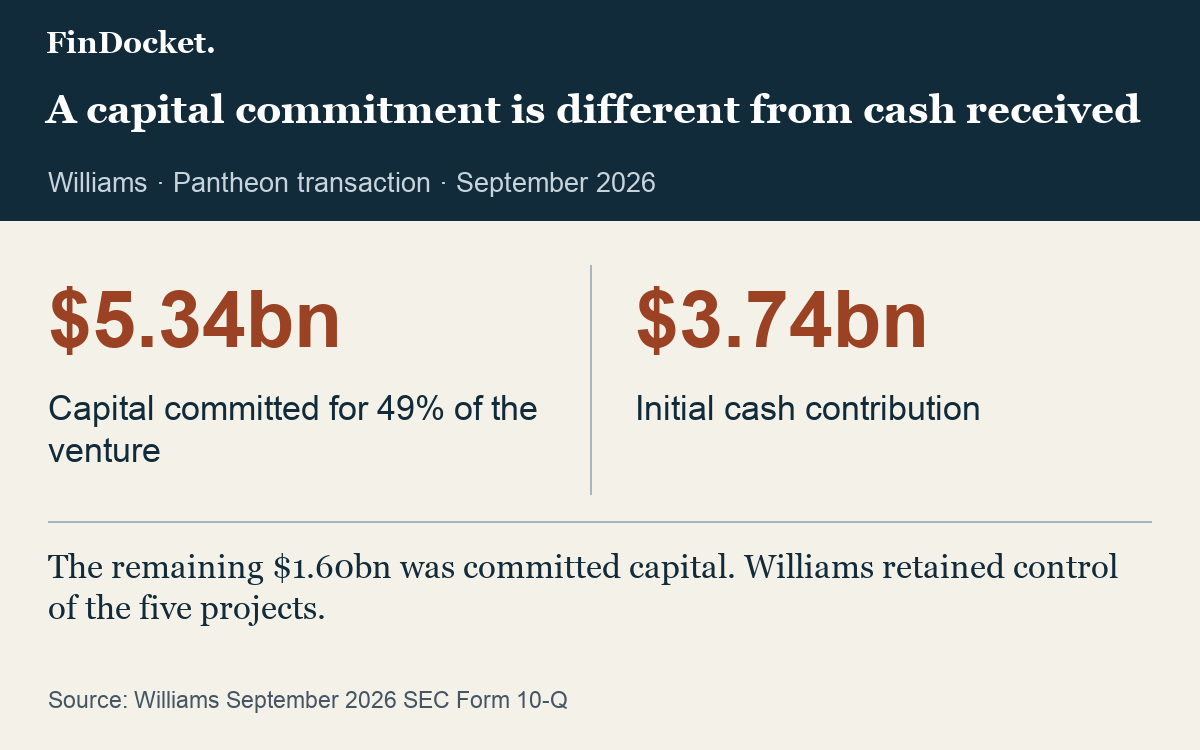
Williams arranged $5.34 billion of committed capital from a group led by Blackstone, with Apollo and KKR participation, in exchange for a 49% noncontrolling interest in five power projects. Williams retained control of the venture, Pantheon.
The financing provides capital without issuing the same amount of parent common equity or conventional debt. That can preserve flexibility for the broader investment program. It is nevertheless an exchange of economic rights rather than a free source of funding.
A simple division of the commitment by 49% would not establish the market value of a fully built, unencumbered power business. The commitment finances projects under development and is part of a contractual arrangement with future rights and obligations. Construction funding and consideration for an ownership interest cannot automatically be treated like a purchase of an already operating company with unrestricted cash proceeds.
For shareholders, the relevant comparison is the return Williams retains after sharing the capital requirement and the resulting economics. A smaller ownership share of a project completed sooner or with less balance-sheet pressure can be attractive. That conclusion depends on project returns and financing terms, not merely the amount of outside capital announced.
Committed capital and received cash are different
The SEC filing reports an initial July contribution of $3.74 billion, with another $1 billion received in October and the remaining commitment expected through the first quarter of 2027. The contributions are dedicated to construction of the power projects.
The initial payment represented approximately 70% of the total commitment. Including the October receipt takes the received amount to approximately 89%, using the rounded figures.
Those percentages track funding progress, not construction completion. Cash can arrive before equipment is installed or an asset is ready to earn revenue. Conversely, construction can create payable or accrued obligations before final cash settlement. Following receipts and project execution separately avoids confusing a financed project with a completed one.
The dedicated construction purpose also matters. The cash receipt strengthens the project's funding position, but it should not be described as unrestricted proceeds available for any parent-level use. Its value to the parent comes partly from reducing the construction cash Williams otherwise would need to supply.
Control preserves consolidation, not complete ownership
Williams retains 51% of Pantheon and consolidates it. The filing describes a buyout right in years seven through fourteen for an amount providing the investor a specified return. The ownership change was accounted for as an equity transaction.
Consolidation means the company's financial statements include the controlled business. It does not mean common shareholders own all of its earnings or cash. The outside investor's share remains economically relevant even when revenue is fully included in consolidated growth.
The buyout right creates another capital-allocation decision later. Exercising it could increase Williams' ownership of the future economics, but would require meeting the contractual price. The right is therefore an option to deploy additional capital, not evidence that the partner interest will disappear without cost.
A useful future evaluation will compare the cash required for any buyout with the additional distributions and value Williams would obtain. The original construction financing and a later repurchase should be assessed as connected investment decisions over the project's life.
Power revenue introduces a different accounting pattern
The filing reports $40 million of operating-lease income from power projects during the quarter, comprising $35 million fixed and $5 million variable. The Socrates South agreement has an initial ten-year noncancellable term and a customer extension option.
Fixed lease income and usage-linked income behave differently. Fixed payments can support visibility across changing utilization, while variable amounts depend on the activity described in the contract. Their combined reported revenue is not automatically a measure of cash profit available for distribution.
Operating expenses, maintenance and the capital invested to create the service remain part of the economic equation. A long contract can improve visibility without proving the asset earns an adequate return on its construction cost.
The lease classification also makes recognition timing important. Comparing reported revenue with cash collections and the operating costs required to provide the contracted service will show how effectively the power platform converts its contractual position into cash for owners.
Dividend coverage does not fund the entire construction program
Williams reported quarterly operating cash flow of $1.505 billion, available funds from operations of $1.589 billion and an AFFO dividend-coverage ratio of 2.42 times. Capital investments excluding acquisitions were $2.727 billion.
The coverage ratio indicates substantial capacity relative to the dividend under the company's AFFO definition. It does not indicate that the dividend and all growth investments are funded by that same quarter's internally generated cash.
Capital investment exceeded operating cash by $1.222 billion before dividends, using those disclosed measures. Investment timing, partner contributions and other financing sources are therefore central to understanding the expansion program. This comparison is not a claim that growth spending should equal cash generation each quarter. Large projects deliberately concentrate investment ahead of revenue.
The analytical requirement is to identify the funding bridge and the returns that justify using it. Dividend coverage answers a distribution question. Construction financing answers an investment question. Both can be sound while showing very different cash requirements.
Williams' power expansion broadens its opportunity to serve energy demand. The strongest evidence of shareholder value will come when completed projects produce attractive attributable cash returns after partner claims and ongoing costs. Outside financing makes the buildout more achievable; disciplined execution will determine what Williams earns from the ownership it retains.