Business · Analysis
Xcel Q3 2026: Construction Earnings Have a Cash Lag
Xcel's Q3 SEC filing shows how construction allowances, financing costs and wildfire comparisons shape earnings as its $70 billion capital program expands.

Xcel Energy's third-quarter 2026 earnings show the accounting consequences of a major utility construction cycle. Investment supports future earning capacity, but part of today's profit comes from financing allowances recorded while assets are still being built. That income does not arrive as current customer cash.
The distinction matters as Xcel expands its capital program. Investors need to track the transition from construction-period accounting income to operating assets that collect regulated revenue, while recognizing the borrowing and equity costs incurred along the way.
What did Xcel report in Q3 2026?
GAAP earnings were $960 million, or $1.52 per share, compared with $524 million, or $0.88. Ongoing earnings were $961 million, also $1.52 per share, versus $737 million, or $1.24. Diluted average shares rose to 632 million from 595 million.
Reported EPS increased approximately 73%, while ongoing EPS increased approximately 23%. The difference reflects a much less demanding comparison under GAAP, including the prior year's wildfire-related charge.
The recurring earnings measure still improved substantially. Ongoing net income grew approximately 30%, ahead of per-share growth because average shares increased approximately 6.2%. The quarter therefore contains both business growth and a larger ownership denominator.
Management's EPS bridge identifies an $0.11 benefit from higher construction allowances, offset by $0.13 of higher interest charges and $0.10 from common-equity financing. These are separate effects within the earnings bridge; they should not be mistaken for a standalone return calculation on a single project.
Together, they illustrate the central tension of the buildout. Construction-related income rises, but the capital used to fund construction also carries a cost.
Why construction allowances differ from customer cash
Allowance for funds used during construction, commonly called AFUDC, recognizes financing costs associated with qualifying construction. The equity component increases accounting income and the recorded cost of the asset. It does not represent a customer paying a current electric bill.
Xcel's nine-month cash-flow statement removes $328 million of equity AFUDC from net income when reconciling to operating cash flow, compared with $196 million a year earlier.
The increase was $132 million, or approximately 67%. That is an increase in a noncash component of earnings during a period of substantial construction. It does not mean the corresponding projects have failed to create value. It means their financing allowance and their eventual customer cash recovery occur at different times.
The later economic test is whether the completed asset enters the applicable recovery framework and earns the expected return. A construction allowance can support reported earnings before that operating phase begins, making service dates and regulatory treatment essential to the analysis.
Investors should also avoid treating equity and debt AFUDC as identical. Their accounting presentation differs. The cash-flow reconciliation's equity adjustment isolates a particular noncash earnings component; it is not a measure of every financing cost capitalized during construction.
Operating cash improved, but spending grew faster
For the first nine months, operating cash flow increased to $4.868 billion from $3.874 billion. Capital and construction expenditures rose to $9.255 billion from $7.470 billion. The filing attributes part of the cash improvement to insurance reimbursements associated with wildfire settlements.
Operating cash increased approximately 26%, while construction spending increased approximately 24%. Despite the similar percentage changes, the dollar gap widened because spending started from a much larger base.
The construction shortfall relative to operating cash was approximately $4.387 billion, compared with $3.596 billion a year earlier. That is a widening of approximately $791 million before dividends and other cash movements.
This is a funding requirement, not an earnings loss. Utilities routinely finance long-lived infrastructure over time. The analytical issue is whether the funding structure and eventual regulated returns justify the amount of external capital required.
Insurance reimbursements also need to be distinguished from a permanent increase in customer cash generation. They can improve liquidity when received, but their relationship to prior settlement costs makes them different from a growing recurring operating margin.
Rate decisions determine what construction ultimately earns
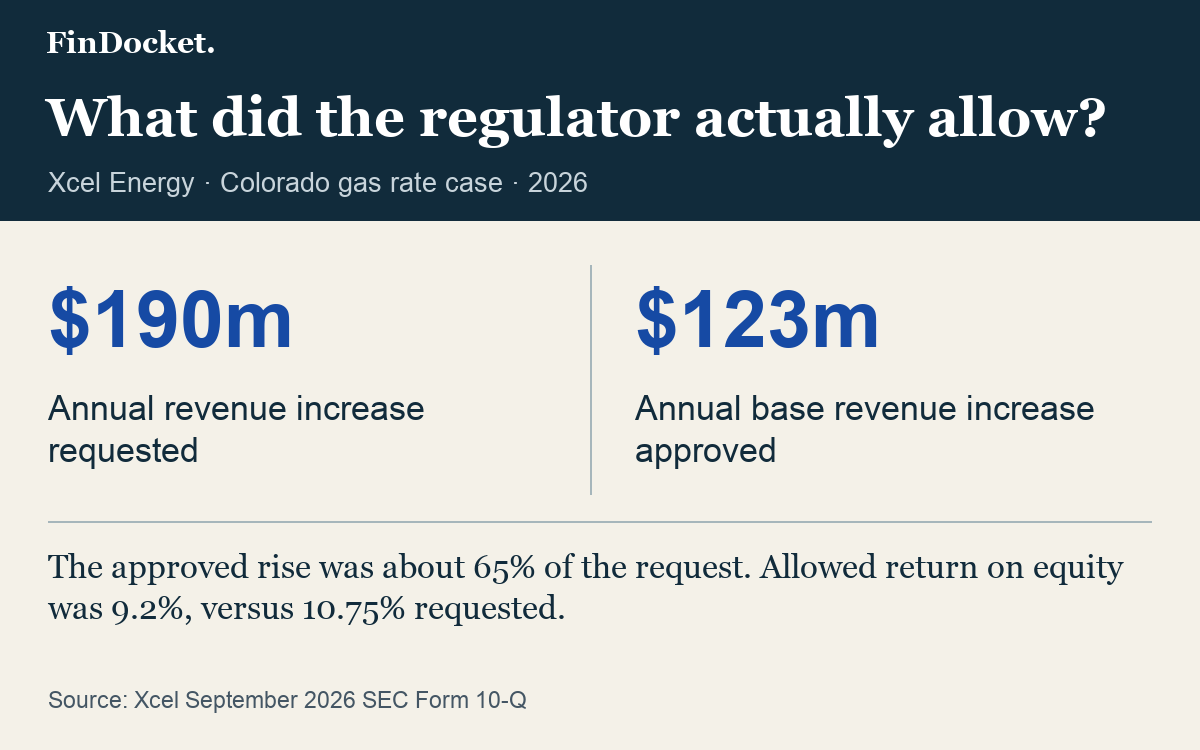
The earnings presentation shows a Colorado natural-gas settlement approving approximately $123 million of additional base revenue, compared with an approximately $190 million request. The approved return on equity was 9.20%, versus 10.75% requested, with final rates implemented in October.
The approved revenue increase was approximately 65% of the request. That comparison is not a claim that 35% of investment was disallowed: rate cases involve multiple revenue, expense and capital assumptions. It does demonstrate why a company's requested outcome cannot be substituted for the regulatory result.
Likewise, the 155-basis-point difference in requested and approved return on equity does not translate directly into a company-wide EPS adjustment. It applies within a particular proceeding and capital structure. The correct model uses the approved rate base, equity ratio, return and recovery terms together.
The capital plan makes conversion more important
Xcel presents a $70 billion base capital program for 2027–2031, with additional potential investment above that amount. It identifies approximately $7 billion for contracted data centers and an $8 billion equity and equity-content financing plan that is approximately 40% contracted or priced.
At that stated completion percentage, approximately $3.2 billion of the equity-related plan is addressed arithmetically. The remaining amount and any upside from existing arrangements depend on the financing structure and subsequent execution; the percentage does not establish that every funding dollar is already cash on the balance sheet.
The next filings should be judged on conversion: projects completed, approved recovery implemented, construction allowances replaced by operating returns and cash collected. Xcel's current earnings demonstrate growth during construction. The durable shareholder payoff depends on what the finished system earns after financing costs and additional ownership claims.