Business · Analysis
Zimmer Biomet Q3 2026: Distributor Credit and Knee Sales
Zimmer Biomet's SEC filing reveals extended distributor credit alongside weaker knee sales and stronger cash flow. Our analysis examines the recovery's funding.

Zimmer Biomet's third-quarter 2026 earnings present a recovery with an important financing detail. While other orthopedic franchises expanded and cash generation improved, knee sales declined and a distributor transition left the company extending credit to its new commercial partner.
The SEC filing connects those issues to execution rather than simply describing a uniform slowdown in orthopedic demand. The central question is whether sales-channel changes produce stronger recurring customer demand while converting the associated receivables back into cash.
What changed in the distributor network?
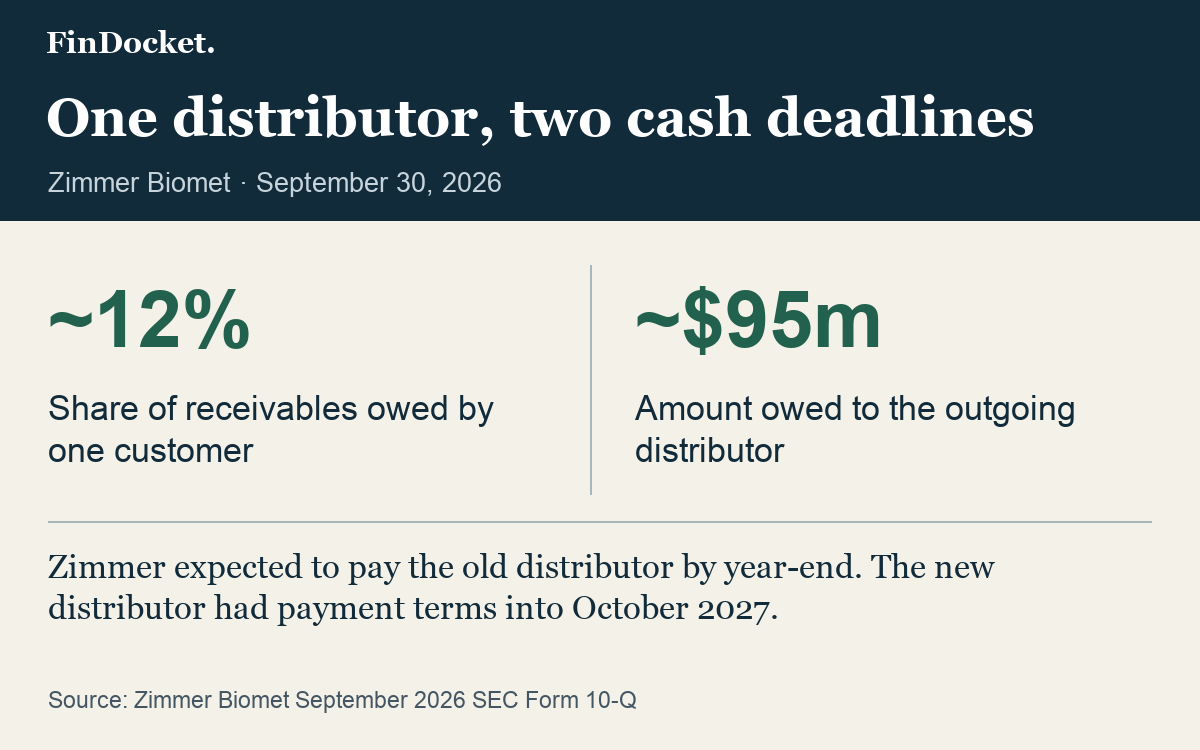
The Form 10-Q says one customer represented approximately 12% of consolidated accounts receivable at September 30. Zimmer repurchased inventory from an incumbent distributor and immediately resold most of it to a new platform distributor. The company describes the consolidated sales effect as immaterial.
The new distributor received payment terms extending through October 2027. Zimmer also owed approximately $95 million to the previous distributor, expected to be paid by the end of 2026.
That is a working-capital commitment even without a meaningful sales benefit. The company owes cash on a shorter timetable while collecting the new distributor's initial purchase over a longer period. Moving inventory between channel partners can therefore simplify commercial execution while temporarily increasing the manufacturer's financing burden.
The roughly 12% concentration is a measure of customer credit exposure, not evidence that the receivable is uncollectible. The useful monitoring questions are whether installments arrive on schedule, whether new purchases require similar terms and whether the transition improves sales to the ultimate hospital customers.
An orderly distributor replacement could strengthen the business. Its success should be demonstrated by collections and repeat demand rather than inferred from the movement of inventory alone.
Knee weakness remains the largest commercial problem
The SEC earnings release shows knee sales of $767.5 million, down 3.1% as reported and 2.6% at constant currency. Hips increased 6.0% as reported, S.E.T. increased 6.8%, and Technology & Data, Bone Cement and Surgical increased 11.9%.
Knees still accounted for approximately 37% of quarterly company sales. A decline in that franchise consequently weighs more heavily than the same percentage change in a smaller category.
Using the reported product totals, the three growing categories together added approximately $86.4 million of sales. The $24.9 million knee decline absorbed about 29% of that increase, leaving consolidated growth of approximately $61.5 million.
This calculation explains why management can point to diversification progress while overall growth remains modest. More businesses are contributing, but a large established franchise is reducing the consolidated benefit. Diversification improves resilience; it does not eliminate the need to repair the core.
A knee recovery would also improve the quality of the growth mix. Instead of asking faster-growing activities to offset weakness elsewhere, the company would have more of its existing commercial infrastructure supporting expansion at the same time.
Growth needs to survive beyond quarter-end purchasing
The filing attributes knee weakness primarily to the U.S. sales-force transition and competition, together with a distributor transition in China. It also identifies opportunistic end-of-quarter purchases as a partial offset and as a contributor to broader volume and mix growth.
Those purchases are real revenue, but their timing matters. A customer buying earlier than usual can raise one period's sales while reducing the next period's replenishment requirement. The disclosure does not quantify that effect, so subtracting an invented amount would create false precision.
The practical test is subsequent demand. Continued procedure-related consumption, consistent ordering and improved collections would support the case that the quarter reflects durable commercial progress. A sharp reversal after quarter-end purchases would suggest that timing contributed more to the reported momentum.
Pricing adds another constraint. The filing reports a 0.7% negative selling-price effect, including volume discounts. Shipment growth accompanied by discounts has a different profit contribution from the same volume sold at stable prices. Revenue alone therefore cannot establish how much value the commercial recovery creates.
Cash improved, but its sources matter
Zimmer reported quarterly operating cash flow of $560 million and free cash flow of $372.4 million. That implies approximately $187.6 million of capital spending under the company's reconciliation, or roughly one-third of operating cash generation.
The expenditure is part of supporting an orthopedic business with instruments, manufacturing and product introductions. Treating all operating cash as freely distributable would overlook the investment required to maintain that commercial system.
For the nine-month period, the filing attributes stronger operating cash to lower restructuring payments, lower net tariff payments, lower tax payments and nonrecurring prior-year acquisition payments, partly offset by other payment timing. These are specific improvements in cash conversion, but they do not all represent additional recurring product profit.
The distributor payable is another prospective claim on cash. Management must fund it alongside investment, financing obligations and shareholder distributions. Cash generation can be strong in aggregate while a particular channel transition still consumes liquidity.
What does the updated outlook establish?
Zimmer raised full-year organic constant-currency sales-growth guidance to 3.0%–3.5% from 2.25%–3.25%. Adjusted EPS guidance increased to $8.50–$8.60 from $8.47–$8.59.
The sales midpoint rose half a percentage point, while the EPS midpoint rose only two cents. The revised forecast expresses better expected revenue without implying a large immediate improvement in per-share earnings power.
The next assessment should focus on knee stabilization, distributor collections and operating profit after the costs required to support growth. Zimmer's expanding franchises and cash generation provide resources for the transition. The commercial changes earn their return only when those resources produce sustained demand and collectible earnings.