Markets · Analysis
Why two AI suppliers at the same P/E can have different credit risk
Price-to-earnings comparisons can conceal different debt schedules and cash restrictions. A repayment forecast needs both.
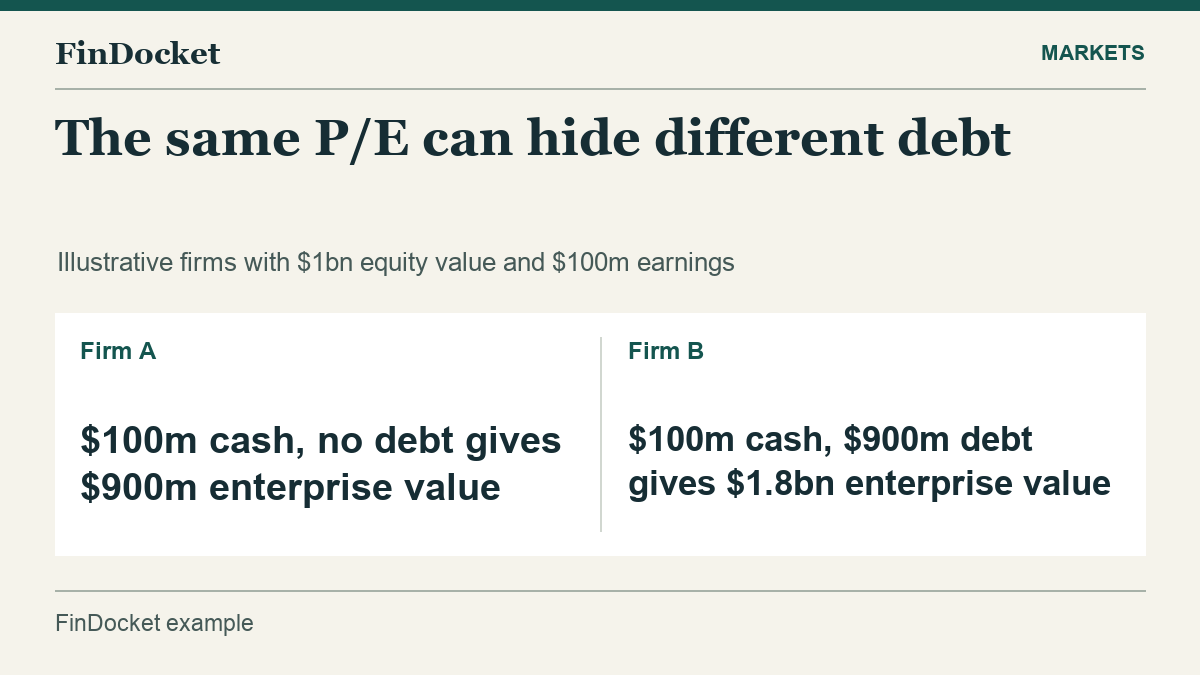
A price-to-earnings multiple expresses the market price of common equity relative to earnings attributable to it. Interest expense already affects net income. The multiple still leaves unanswered the question that matters most to a lender. Will enough cash be available when the next principal payment is due?
Imagine two businesses each valued at $1 billion in the stock market and each earning $100 million. Both trade at ten times earnings. One holds $100 million in cash and has no debt. The other holds the same cash and owes $900 million. A simple enterprise-value calculation gives $900 million for the first and $1.8 billion for the second, before other adjustments. These companies could earn identical net income while having substantially different operating income, financing costs and maturity exposure.
For a real AI infrastructure operator, IREN’s quarterly release illustrates the importance of reading the definitions. It reports restricted cash separately and describes a net debt measure that excludes operating lease liabilities. A creditor comparing several operators would need consistent treatment of restricted balances, leases, equipment commitments and financing secured on particular assets.
An allegation that firms are circulating cash and counting it as revenue needs transaction evidence of its own. Trace the contract, the service delivered, the related-party relationship if any, and cash ultimately collected. A low earnings multiple cannot clear a company of financing risk, and a high debt balance alone cannot establish improper revenue recognition.