Technology · Analysis
Why a gigawatt forecast does not tell you how much compute gets sold
Customer contracts and billable processor-hours connect installed computing capacity to realized revenue.
Forecasts for AI infrastructure often start with gigawatts because utilities need to know how much power a campus might draw. Customers buy a different product. They pay for available or delivered computing under contracts that can be billed by time, reservation or usage. Connecting those forecasts requires assumptions about installation dates, operating hours and customer demand.
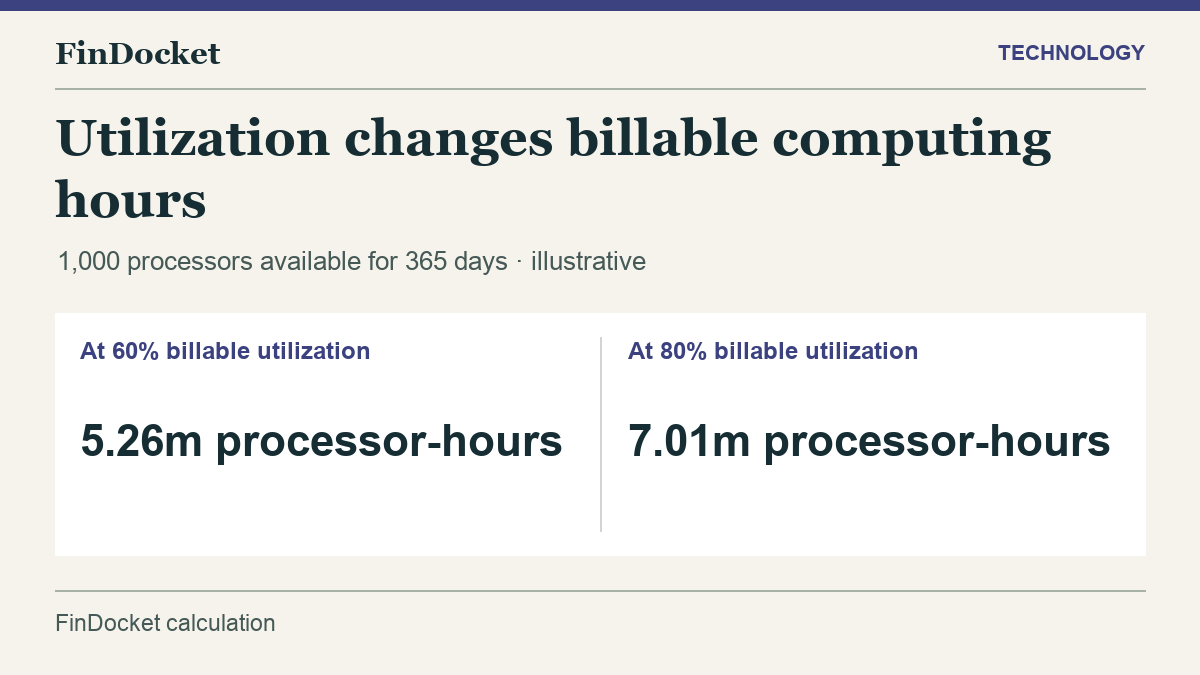
Consider a hypothetical operator with 1,000 processors available throughout a 365-day year. Each contributes 8,760 potential hours, for 8.76 million in total. At 60% billable utilization the operator sells about 5.26 million processor-hours. At 80% it sells about 7.01 million. That is one third more billed time on the same installed hardware. A fixed reservation contract could allocate utilization risk differently between operator and customer.
Power adds another layer. The International Energy Agency's data center analysis includes electricity for cooling and other infrastructure alongside the hardware doing the computing. Power brought to a campus is not a direct measure of productive work. Processor generation, workload and software efficiency can change how much work fits into each hour.
IREN's own release explains that its annualized run-rate calculation uses contracted pricing and 8,760 hours and that recognized revenue may be lower. For a credible timetable, track the sequence from grid connection through installed equipment, customer acceptance and billable service. Each milestone shifts the economic question from what could be built to what a customer can actually use.