Technology · Analysis
Transense’s Revenue Growth Meets a Coming Royalty Step-Down
Transense’s sales rose 10%, but EBITDA was flat. Its FY28 iTrack royalty reduction makes sensor growth and cash conversion central to the outlook.
Transense Technologies’ November 27 update reports 10% revenue growth for the first four months of FY27, alongside broadly unchanged adjusted EBITDA. Available cash increased to £1.58 million from £1.50 million at July 1. The business is growing, but the latest sales increase has not yet produced a corresponding increase in that earnings measure.
Where is growth coming from?
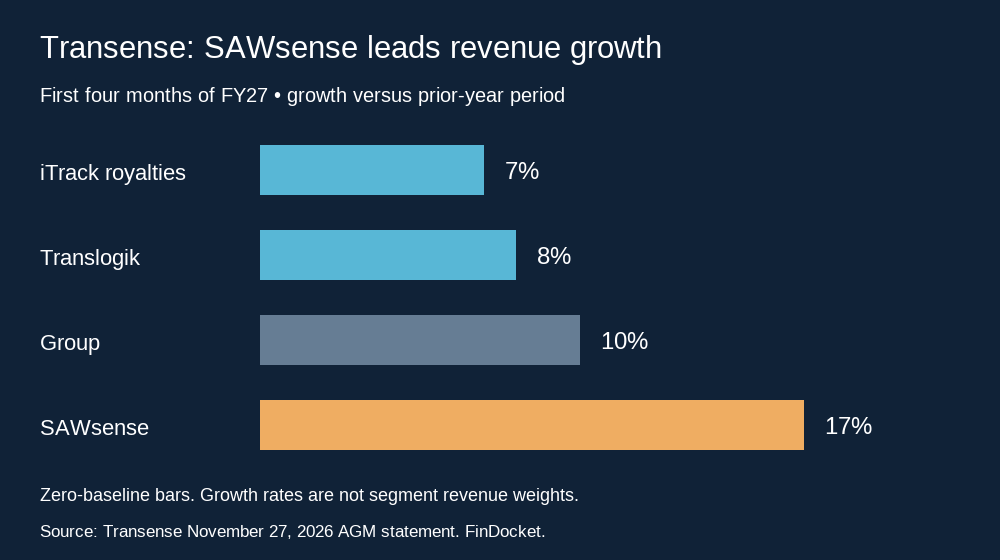
SAWsense revenue increased 17%, compared with 8% for Translogik and 7% for Bridgestone iTrack royalties. Gross margin remained above 85%. These are different revenue streams: sensor development and components, tyre-inspection tools, and licensing income. Their growth rates cannot be averaged without knowing their respective revenue weights.
The company expects its Continental development-and-supply contract to add significant second-half revenue. Other pipeline opportunities remain uncommitted. A contract progressing toward delivery and an advanced sales prospect should therefore be treated differently when assessing the earnings outlook.
What does the royalty schedule change?
September’s results say the iTrack unit royalty stays unchanged in FY27 before falling by another approximately one-third in FY28, to 40% of the original rate. The licence ends in June 2030. That schedule creates a measurable replacement-income task for the operating businesses.
A one-third reduction takes a rate from 60 to 40 on an original-rate index of 100. Holding revenue constant at that lower rate would require 50% more royalty-bearing units, assuming an unchanged mix and all other terms equal. This is a sensitivity calculation, not a forecast of installations. Current royalty growth does not establish that this volume hurdle will be met.
How much financial capacity supports the transition?
FY26 total revenue, including grant income, was £4.626 million against £5.550 million previously. Statutory pretax results moved from a £1.408 million profit to a £105,000 loss. Those annual results provide the baseline for judging the current improvement.
The £80,000 increase in available cash through October equals about 5.3% of the opening balance. A change in cash balances alone does not measure free cash flow: investment, financing and working-capital movements also affect it. The detailed cash-flow statement will establish the resources generated internally to support product development.
The next results need to show whether second-half deliveries convert the sales improvement into higher profit and cash. The central comparison is the operating businesses’ additional contribution against the scheduled royalty reduction. Maintaining a high gross-margin percentage will matter less if the absolute income available for investment fails to grow fast enough.