Technology · Analysis
Craneware’s Recovery Plan Faces a $21 Million Revenue Gap
Craneware has completed its cost review and extended bank financing. Its $185 million revenue baseline shows the scale of the recovery still required.
Craneware’s November 27 AGM statement confirms completion of its cost review and a banking extension to August 27, 2029. Those are concrete advances in its recovery programme. The earnings challenge remains substantial: September’s roughly $185 million FY27 revenue baseline is $21 million below the $206 million reported for FY26, a 10.2% decline calculated by FinDocket.
What has the latest update changed?
Management says actions from the cost review have been taken, trading is consistent with the September guidance, and the business remains positioned for a return to revenue growth and a 30% EBITDA margin in FY28. The credit extension uses the first of two available one-year options. It lengthens the funding timetable; the statement does not announce fresh capital or a larger facility.
The company also says customer and pharmacy-partner engagement following its cyber incident has been constructive. Legal and operational work continues. That is progress in the response, rather than evidence that every financial consequence has been resolved.
How large is the revenue reset?
The September results established annual recurring revenue of about $185 million and reset FY27 expectations to that level. FY26 adjusted EBITDA was $67.1 million, with a reported margin of approximately 33%. These financial figures are in US dollars, despite the company’s London listing.
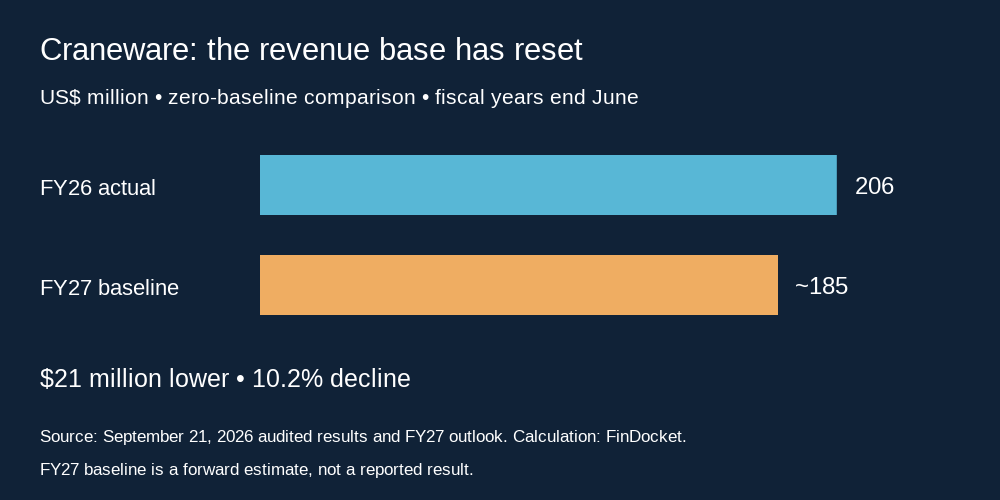
The $21 million difference is equivalent to about 31% of FY26 adjusted EBITDA. That comparison does not mean profit falls by $21 million: delivery costs, revenue mix and the cost actions all affect conversion. It does show why reaffirming guidance is insufficient on its own to demonstrate an earnings rebound.
Does a 30% margin restore the previous earnings level?
At an illustrative $185 million revenue level, a 30% margin produces $55.5 million of EBITDA. This is arithmetic, not management’s FY28 revenue or profit forecast. The result is $11.6 million below FY26 adjusted EBITDA. Matching $67.1 million at 30% would require approximately $223.7 million of revenue, about 20.9% above the FY27 baseline.
That sensitivity identifies the real test: margin recovery and revenue recovery must be assessed together. A margin percentage can improve while the absolute earnings pool remains smaller.
The November statement links future growth to greater clarity in the US 340B market and demand for its expanded software range. That remains management’s expectation. The next results should establish whether recurring revenue expands, customers adopt those offerings and the completed cost measures improve profit conversion. The facility extension provides more time for that process; reported sales and cash generation will establish whether the operating recovery follows.