Technology · Analysis
Softcat’s Strong Quarter Leaves GDT’s Price and Timing in Focus
Softcat kept FY2027 guidance unchanged after double-digit Q1 profit growth. GDT’s $1.05 billion price, forecast earnings and share issue explain the next test.
Softcat reported strong double-digit growth in gross profit and underlying operating profit for the quarter ended October 31, while leaving its full-year outlook unchanged. The November 12 update also described progress toward completing GDT. That puts the existing business’s momentum alongside a transaction whose price, financing and completion date will reshape the earnings calculation.
What does unchanged guidance cover?
October’s results set out high single-digit underlying operating profit growth for FY2027, excluding GDT, slightly ahead of gross profit growth. That comparison starts from £215.1 million of FY2026 underlying operating profit, up 19.4%, and gross profit of £616.3 million, up 24.7%.
The first-quarter release gives no exact growth percentage or quarterly profit amount. A strong opening quarter therefore cannot be mechanically annualised into a new full-year estimate. It establishes momentum against an outlook management has retained.
The prior year also contained specific boosts: larger solutions projects, some customer orders brought forward because of memory shortages, and a positive vendor rebate contribution. Those disclosures matter when assessing how much of the growth base repeats. Gross profit is also more useful than simply comparing headline revenue across IT resellers, where principal-versus-agent accounting changes the amount reported as revenue.
What price is Softcat paying for GDT’s earnings?
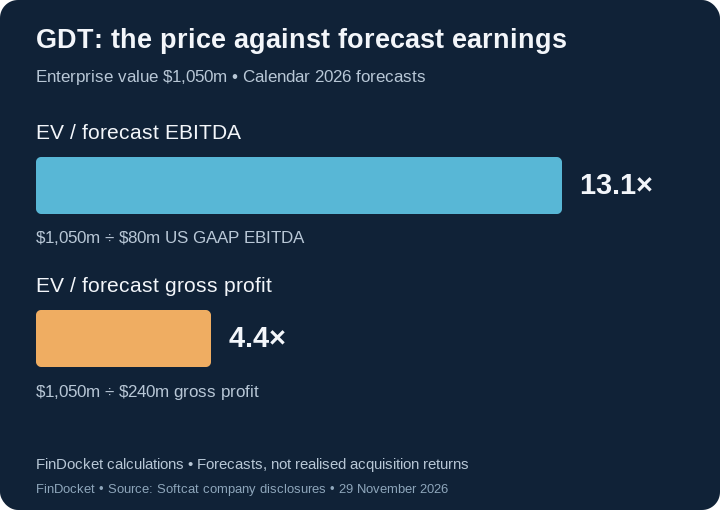
September’s announcement assigns GDT an enterprise value of $1.05 billion. It forecasts about $240 million of gross profit and $80 million of US GAAP EBITDA for the 12 months ending December 2026.
Dividing that enterprise value by forecast EBITDA produces approximately 13.1 times; dividing by forecast gross profit produces about 4.4 times. These calculations describe the acquisition price against management’s projected financial measures. EBITDA excludes financing, tax and other costs that determine earnings available to shareholders.
Softcat targets high single-digit to low double-digit underlying EPS accretion in the first full fiscal year. That is a different test from growth in consolidated operating profit: interest, tax and the larger share count all enter the per-share outcome.
Why does the calendar matter?
The annual report records 18,730,158 new shares issued after the July balance-sheet date, raising £354 million gross. It retains an expected closing deadline of the end of the first calendar quarter of 2027, subject to approvals. November’s update does not announce completion.
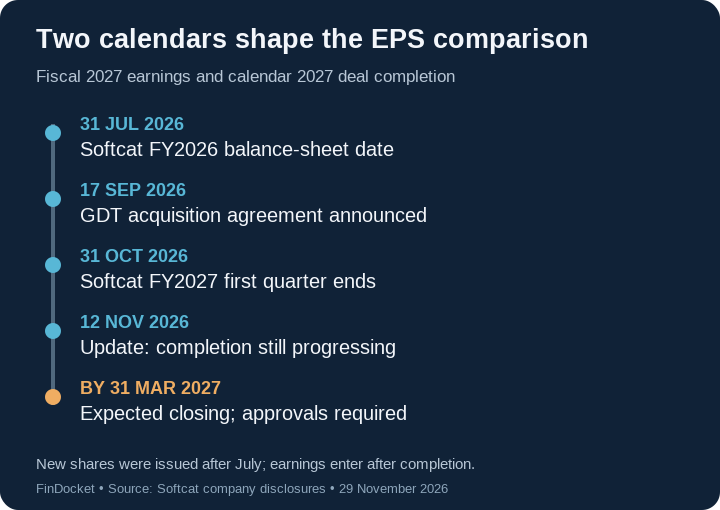
Consequently, the new shares and acquired earnings do not necessarily enter the calculation on the same date. The first full fiscal year of ownership is also different from the partial contribution after closing. The next results need to reconcile those periods, the acquired profit contribution and financing costs before the accretion target can be assessed against reported EPS.