Technology · Analysis
Halma’s Photonics Growth Adds Five Points—and a Scaling Test
Halma’s HY27 results show a five-point photonics growth premium. Its analyst presentation explains customer concentration, order visibility and the production challenge.
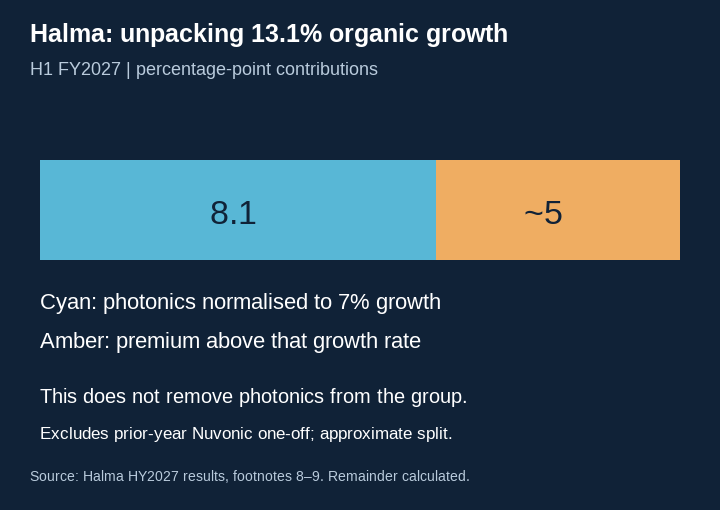
Halma’s November 19 results show 13.1% organic revenue growth excluding the prior-year Nuvonic one-off, including roughly five percentage points of exceptional photonics contribution. The analyst presentation supplies the more consequential detail: this business serves a longstanding hyperscaler customer, with demand visibility measured through rolling orders and growth dependent on production capacity.
What does the five-point premium measure?
Halma defines the photonics premium as the incremental contribution above what that business would have added at the group’s 7% long-term organic-growth rate. It is not the photonics business’s entire contribution to group growth.
Subtracting approximately five points from 13.1% leaves roughly 8.1% on a basis that normalises photonics to that 7% growth rate. It does not calculate growth for the group with photonics removed altogether. The distinction prevents an incorrect claim about the remaining portfolio.
How visible is the customer demand?
The analyst presentation says photonics revenue grew around 30% organically, after more than doubling over the preceding two years. Management describes a longstanding relationship supplying optical switches for a customer in the global data-centre market.
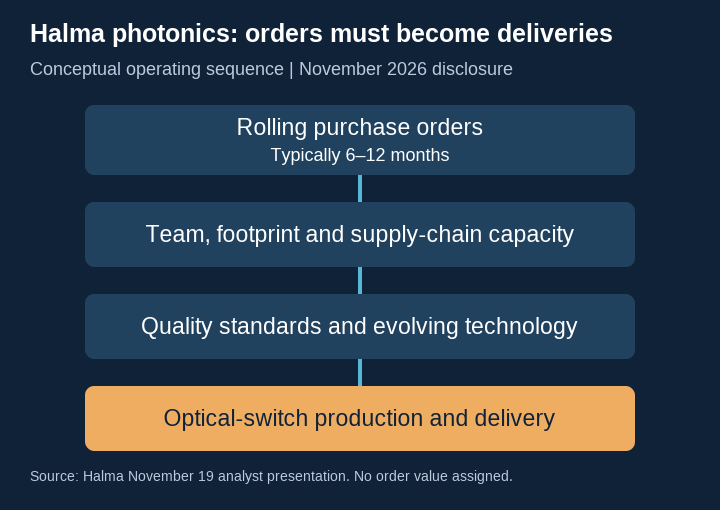
Its disclosed rolling purchase orders typically extend six to twelve months. That is useful scheduling evidence, but it should not be modelled as a guaranteed multiyear order book. The document does not identify the customer, and the article assigns no name to it.
Management says expansion of the footprint and fit-out is underway, alongside work with the customer on engineering and product development. It also identifies quality standards, supply-chain adaptation and building the team as practical constraints on scaling.
What do the wider results establish?
The investor slides show growth across all three sectors, rather than photonics being the sole source of progress. The group achieved a 24.1% adjusted EBIT margin, while the full-year outlook remains 23.5%–24%, with low-double-digit organic constant-currency sales growth.
In the Q&A, the finance director emphasised sustaining growth and returns over the long term rather than continually pushing margins higher. She said mix, operating execution and portfolio activity helped the latest result and that changing the long-term margin range would require several years of outperformance.
That framing matters when valuing a rapid growth period. Capitalising the latest margin indefinitely assumes that favourable mix persists while capacity expands. The evidence currently supports strong demand and active investment; subsequent results must show the conversion of both into delivered sales, cash and returns.
The next updates should establish whether orders continue to support the planned production ramp and whether quality and delivery hold as volumes increase. Those operating measures will make the photonics growth rate more informative than a broad label such as data-centre exposure.