Technology · Analysis
Putting an electricity price on a budget graphics card
The B580’s board-power specification is a starting point. Actual gaming hours and measured power differences determine the cost of ownership.
A discounted graphics card can save money at the checkout and consume some of the difference over time. Intel lists total board power of 190 watts for its Arc B580. That specification is useful for identifying the product and considering a compatible system. The electricity bill depends on average power during the games a particular owner actually plays.
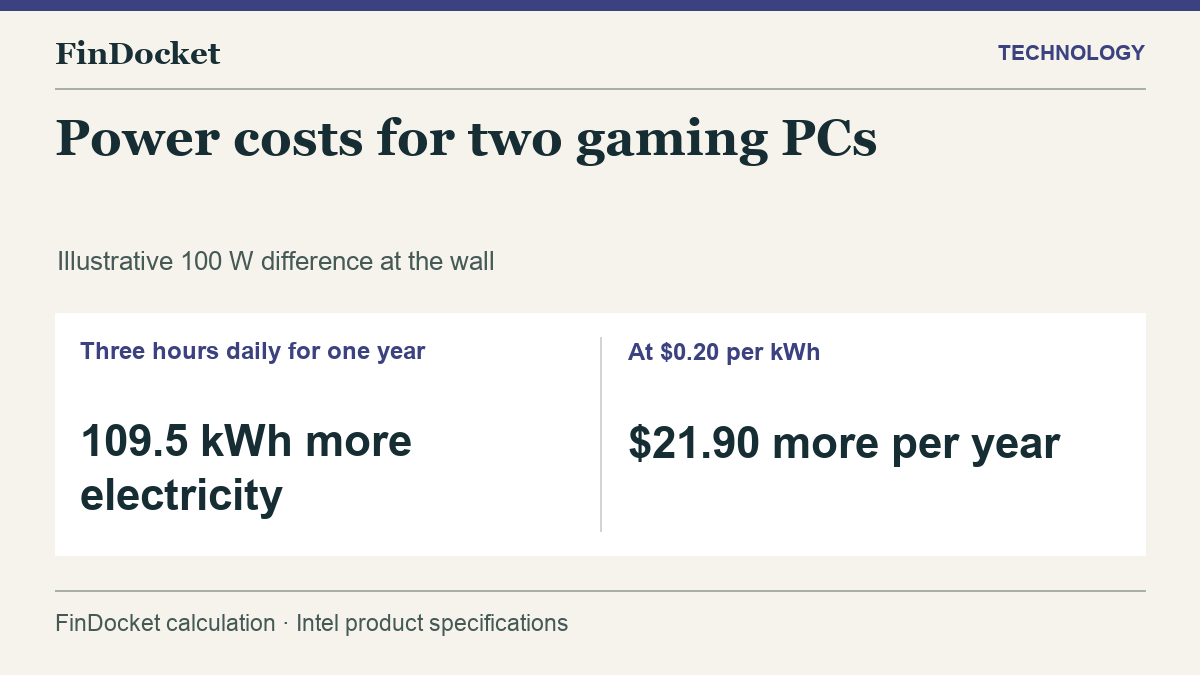
Suppose two otherwise comparable setups differ by 100 watts at the wall while running the same game at the same frame rate. Three hours a day over 365 days yields 109.5 extra kilowatt-hours. At an illustrative tariff of $0.20 per kilowatt-hour, the annual cost difference is $21.90. A $60 purchase-price advantage would take about 2.7 years to use up at that rate. Changing the gaming schedule or tariff changes the result proportionally.
The 100-watt gap is a scenario, not a measurement of the B580 against another card. A published board specification excludes the rest of the computer. An at-the-wall measurement includes the processor, cooling and power supply losses. Comparing one measurement method with the other would give a misleading estimate.
A fair budget comparison starts with independent measurements at the desired resolution and quality settings. Then apply local electricity prices, expected hours, warranty coverage and the cost of any power-supply replacement. That gives the buyer a usable total for getting the frame rate they actually want.