Technology · Analysis
When a customer prepays 90% of GPU spending, who finances the rest?
A proposed prepayment percentage applies to GPU spending on one deal. Facility costs and the delivery obligation still matter.
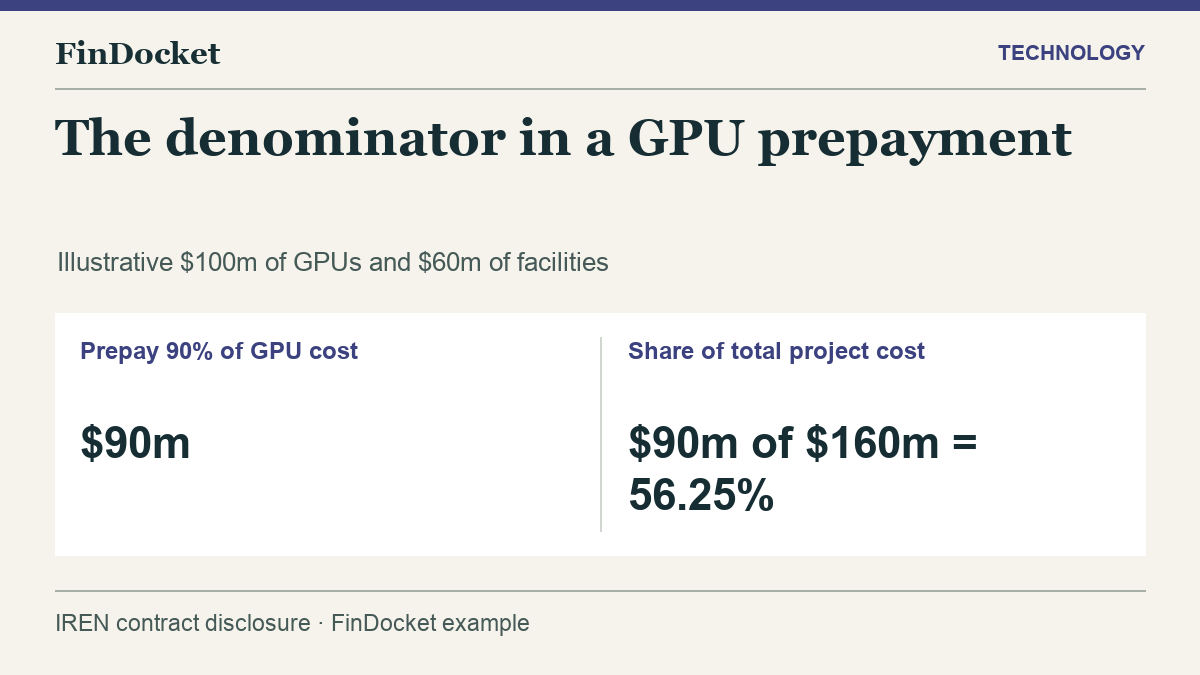
An IREN disclosure provides a useful test of claims about who is financing AI construction. In its fiscal first-quarter results, the company said it had signed a five-year contract after quarter-end under which a customer prepaid 90% of GPU capital expenditure. The denominator is the spending on GPUs for that deal. It says nothing by itself about the fraction of an entire campus financed by the customer.
Suppose the GPUs cost $100 million and the facility, power equipment and other infrastructure cost another $60 million. A 90% GPU prepayment supplies $90 million, or 56.25% of the combined illustrative total. That leaves $70 million to be financed elsewhere. Change the ratio of equipment to building costs and the financing share changes even if the contractual prepayment percentage stays fixed.
A prepayment also carries a delivery obligation. It shifts some upfront funding to the customer, while subsequent cash receipts depend on what the customer already funded and what IREN must deliver. It cannot be counted once as financing today and again as entirely new future cash from the same invoice.
IREN’s release distinguishes actual cash, restricted cash, committed facilities and contracted prepayments still to be received in one of its funding measures. To map the exposure, record the payer, the payment date, the assets covered and the consequences of a delay. That gives investors a way to examine the specific agreement without attributing an unverified systemwide debt figure to a single project.