Markets · Analysis
How much of a 116% stock-market gain can a drawdown erase?
After a 116% rally, a loss of about 54% would erase the entire advance. A buyer nearer the peak faces a very different result.
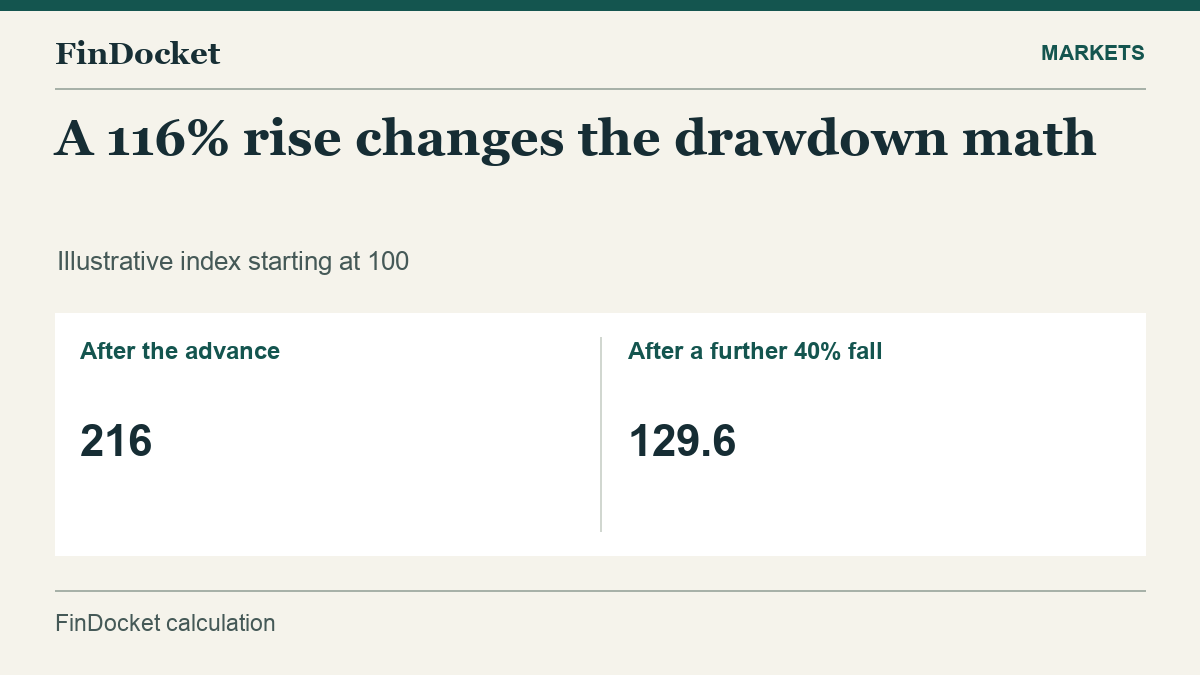
A 116% surge followed by a large decline can produce sharply different headlines for investors who entered the Korean market on different dates. Using the run-up reported by Bloomberg, an index starting at 100 would reach 216 at its peak. To return to 100 it would have to lose 116 points out of 216, a fall of about 53.7%.
The arithmetic becomes more informative when two investors are placed on the same chart. Suppose the index subsequently falls 40% from its high. It ends at 129.6. The investor who started at 100 is still up 29.6%, while the one who bought at 216 is down 40%. These are examples using the reported starting gain. The 40% is an illustration and makes no assertion about the actual size of the Korean drawdown.
Why the recovery number looks larger
At 129.6, recovering the high of 216 requires a gain of 66.7%. What changed was the base on which the percentage is calculated. A daily rebound therefore needs context: the level reached after the move and the level the investor is trying to recover.
An overseas investor has a further calculation. A KOSPI price-index move in won excludes currency translation into the investor’s home currency and excludes dividends. For a realistic account of an investor’s experience, report entry and exit dates, the index version, and whether currency exposure was hedged. Those details can matter more than the choice between the words boom and bust.