Markets · Analysis
The two closing prices behind Nasdaq’s overnight trading band
Two reference prices determine the proposed overnight bands. A worked example explains why the limits can be asymmetric around the closing price.
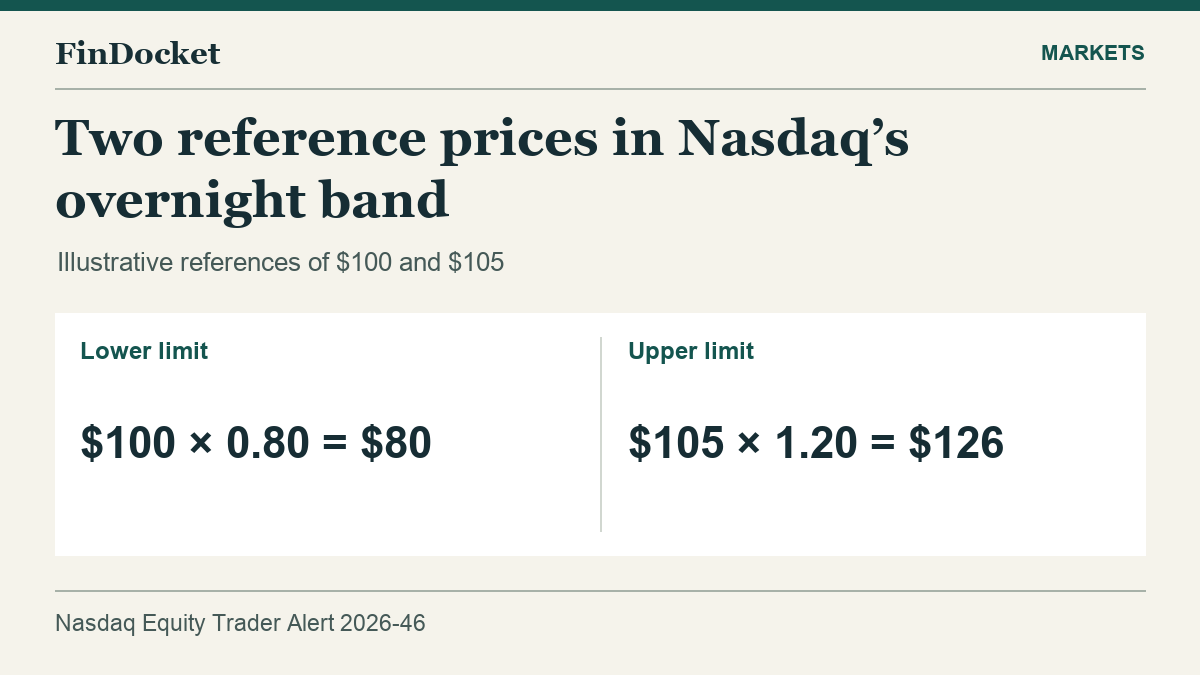
The extra hours planned for the Nasdaq Stock Market come with rules for the prices orders can carry. For someone accustomed to the daytime close, the surprise is that the overnight protection uses two reference prices. The band can therefore be asymmetric around the official closing price.
Nasdaq's notice describes the listing market’s adjusted official closing price and the adjusted last round-lot sale before 7:45 p.m. Eastern time. The upper band is set 20% above the greater reference and the lower band 20% below the lesser reference, subject to stated minimum widths. Take references of $100 and $105 in a case where the minimums do not bind. The upper limit is $126 and the lower limit $80. Applying 20% only to the official close would produce the wrong upper figure.
The exchange describes rejecting orders priced outside the applicable static bands. An eligible price still needs someone willing to take the other side. The band neither creates liquidity nor promises a fill. A wide spread can exist well inside the permitted range, particularly when fewer market participants are present.
For a reader assessing a headline about 23-hour stock trading, first identify the venue, security, broker access and session. Then check the applicable reference prices and overnight order handling. The December 6 schedule describes a market facility. It does not give every shareholder the same price or the same hours through every broker.