Markets · Analysis
What a 35,000% Nvidia gain would mean in annual terms
A 35,000% gain implies an ending value of 351 times the original stake. Verifying the historical return requires comparable endpoints.
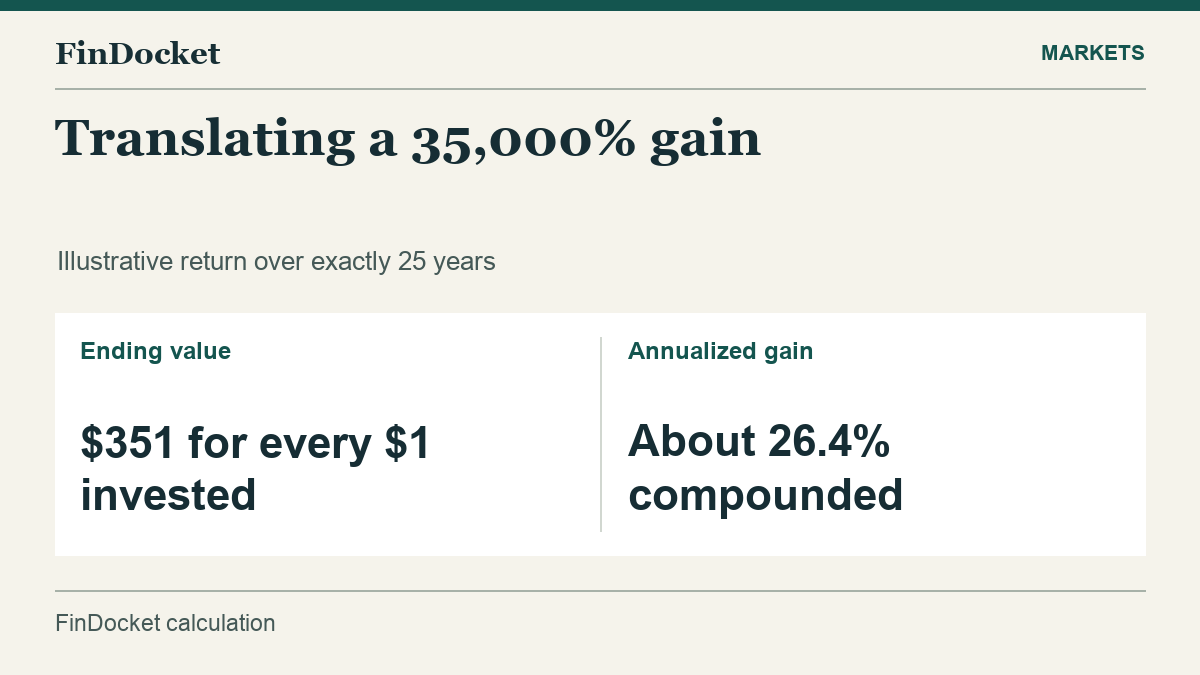
A gain of 35,000% is easily mistaken for a 350-fold ending value. The gain itself is 350 times the starting amount. Add back the original dollar and the ending value is $351. A hypothetical $1,000 investment at precisely that return would finish at $351,000 before taxes, fees and any return convention adjustments.
Over exactly 25 years, the compound annual growth rate is the twenty-fifth root of 351, minus one, or about 26.4%. That translation is useful because it makes the scale comparable with other long-term investments. It says nothing about the path between the endpoints. A holder could experience very large interim losses and still finish with the same compound rate.
The post uses Nvidia's admission to the S&P 500 as its starting point. Verifying its precise return requires choosing the effective index date, specifying entry and exit prices, and adjusting for changes in the number of shares. Nvidia announced a four-for-one split in 2021 and a ten-for-one split in 2024. Each split changes a raw quote per share without creating wealth on that date. A total-return comparison must also treat dividends consistently on both the stock and the benchmark.
The arithmetic above translates the posted claim and does not independently certify its endpoints. The reproducible test is a pair of dated, consistently adjusted series. Stating the return convention is particularly important for comparing a stock with an index commonly quoted on a price-only basis.