Technology · Analysis
What would a 30,000-rack customer mean for Nvidia?
At the top of the reported SpaceX scenario, delaying a quarter of one buyer’s racks would reduce projected annual deliveries by a tenth.
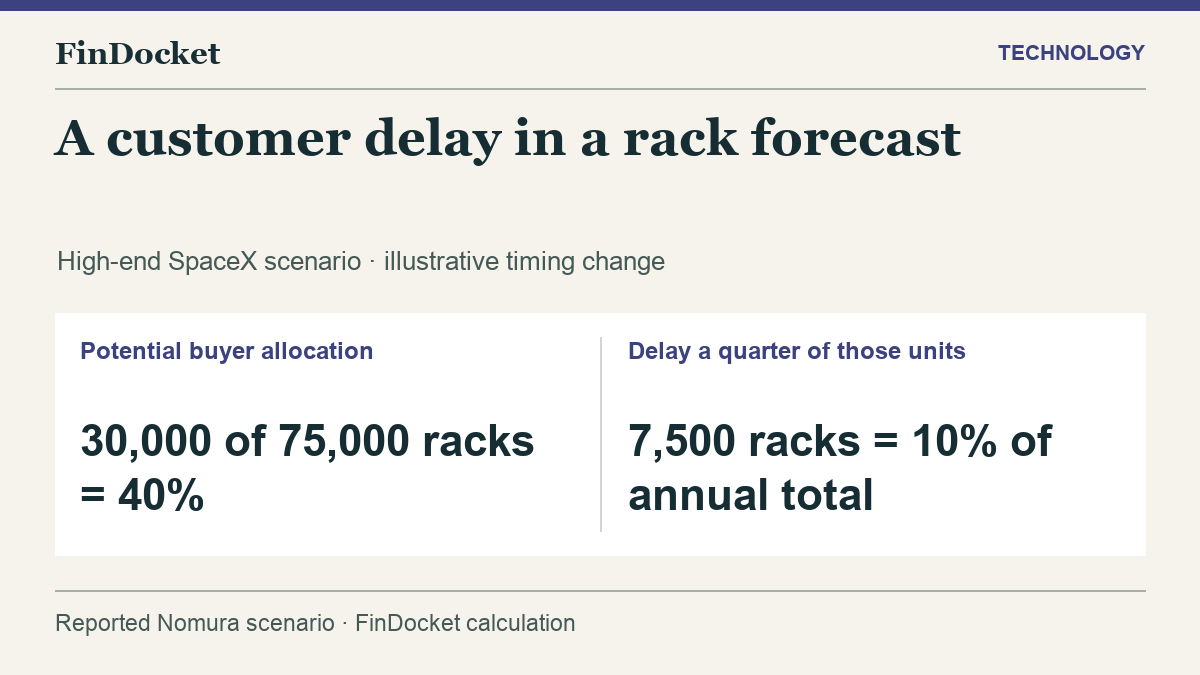
One revealing way to read a chip forecast is to remove some of its largest customer's expected deliveries and see what remains. A post discussing Nomura’s research says SpaceX’s targeted expansion would require roughly 30,000 racks against a projected 75,000-rack market for 2027. That is the high end of the post’s reported 20%–40% base-case allocation, not a confirmed purchase.
Suppose a quarter of that customer's expected racks move into the following year. That displaces 7,500 units, or 10% of the entire year's estimate. Other buyers could absorb some of the equipment, and some components could be redeployed. If neither happens, the revised total would be 67,500. This is sensitivity arithmetic on a third-party forecast. A public confirmation of a binding order would be stronger evidence.
There is also a difference between who uses a rack and who pays an Nvidia invoice. A hardware integrator or computing service provider may sit between the manufacturer and the eventual user. A 40% unit share in one generation of racks cannot simply be multiplied by Nvidia's reported company-wide revenue to estimate sales to one customer.
The most revealing follow-up would be evidence that the orders are committed, the installation sites are ready and the units shipped in the forecast period. Until then, the calculation measures how much the projection depends on a particular buyer's timetable. It does not establish that buyer's rank in the accounts.