Markets · Analysis
United Fidelity had $5.9 billion of assets. What did the failure actually cost?
The failed bank’s assets, the buyer's bid discount and the estimated loss to the insurance fund measure three separate parts of the resolution.
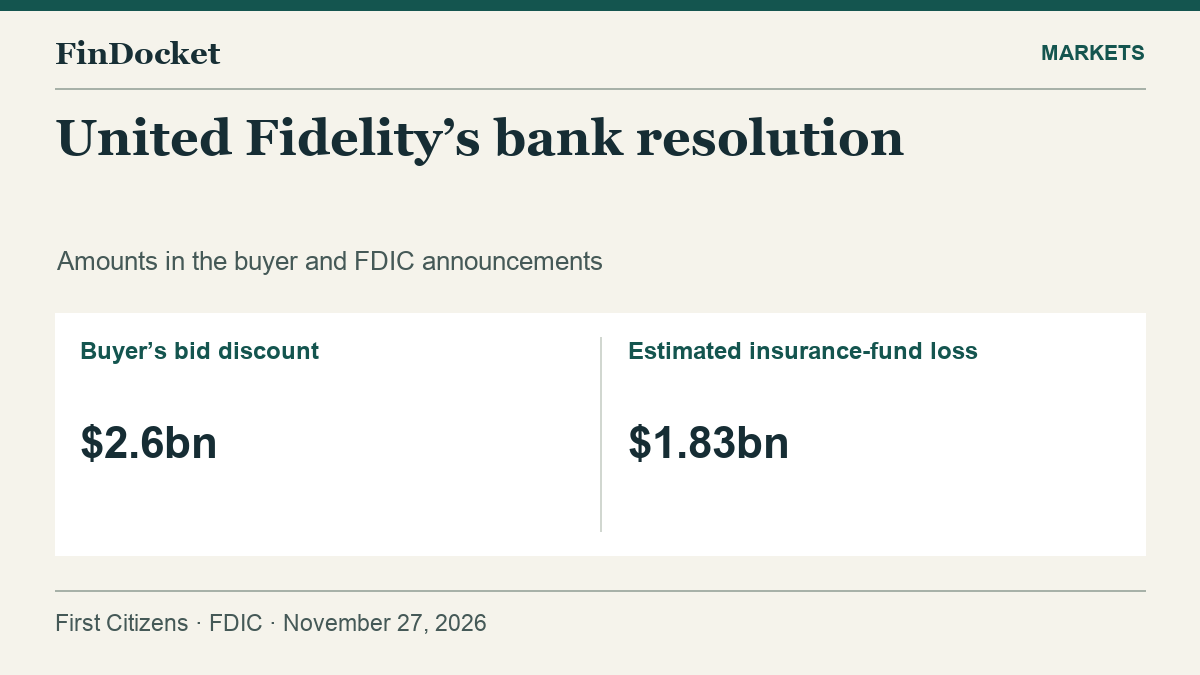
United Fidelity’s failure left behind loans, buildings and other assets that a buyer was willing to acquire. First Citizens put their September 30 carrying amount at $5.9 billion. The FDIC estimated the cost to its insurance fund at $1.83 billion. Treating the larger figure as money destroyed overstates what the regulator reported.
What did First Citizens bid?
The winning bid included a roughly $2.6 billion asset discount and no deposit premium. On the announced figures, that discount is about 44 cents per dollar of recorded assets. It describes the bargain struck with a buyer taking over a bank under duress. A loan acquired at a discount can still produce payments for years afterward. Its ultimate recovery depends on the borrower and collateral.
The FDIC’s estimate answers a different question. Resolving the institution means transferring some obligations, collecting on assets, and meeting the costs of the receivership. Dividing $1.83 billion by $5.9 billion produces about 31%. That ratio measures estimated fund cost against a familiar balance-sheet figure. Applying it to each customer's account would give a fictional depositor loss.
Which figures could still change?
First Citizens explicitly based its announcement on September balances. Closing balances and the subsequent settlement with the receiver can change the acquisition figures. The FDIC also labeled its fund cost an estimate. The two disclosures worth comparing next are the buyer’s opening valuation of the acquired assets and the receiver’s updated recovery estimate. Each revises a different part of the transaction.